

What Is Full-Time Equivalent (FTE)?
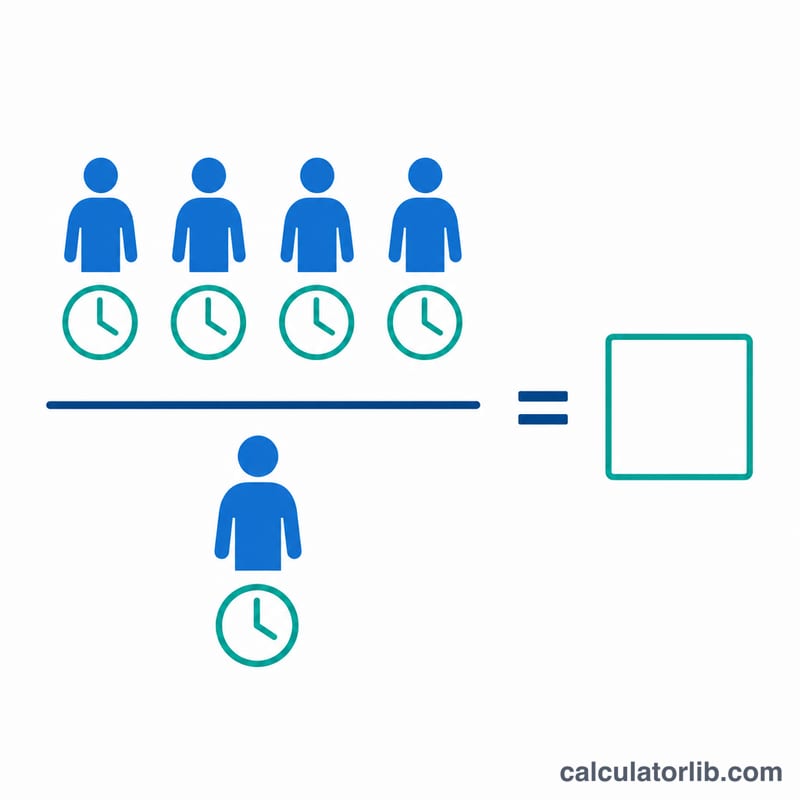
Full-Time Equivalent (FTE) is a standardized way to express the combined workload of all your employees — full-time and part-time — as a number of full-time workers. Instead of counting heads, FTE counts capacity. Two part-timers each working half a normal schedule equal one FTE. This metric is widely used for budgeting, workforce planning, grant reporting, and benefit-eligibility thresholds.
How to Use This Calculator
Enter the total hours worked by all employees over a chosen period (for example, a year), and the full-time hours per period that define a single full-time role over the same period. A common annual standard is 2,080 hours (40 hours × 52 weeks). The calculator divides the two values to give your FTE, and rounds up to show the equivalent full-time headcount.
The Formula Explained
$$\text{FTE} = \frac{\text{Total Hours Worked}}{\text{Full-Time Hours per Period}}$$
The two inputs must cover the same period. If you use weekly full-time hours (e.g. 40), supply total weekly hours; if you use annual hours (e.g. 2,080), supply total annual hours.
Worked Example
Suppose your team logged 8,000 total hours in a year and a full-time role is 2,080 hours per year.
$$\text{FTE} = \frac{8{,}000}{2{,}080} \approx 3.85$$
That means your staff collectively perform the work of about 3.85 full-time employees, requiring roughly 4 full-time positions to cover.
FAQ
What counts as full-time hours? It depends on your policy or jurisdiction. Common standards are 40 hours/week or 2,080 hours/year, but some organizations use 35 or 37.5.
Can FTE be a decimal? Yes. A 0.5 FTE means half a full-time schedule. Decimals are normal and useful for precise budgeting.
Is FTE the same as headcount? No. Headcount is the number of people; FTE measures total working capacity. Ten half-time employees equal 10 in headcount but only 5 FTE.