What is the GPA Score Calculator?
Your Grade Point Average (GPA) is a single number that summarizes your academic performance across multiple courses. Because courses can carry different credit hours, GPA is a credit-weighted average — a 4-credit course counts more than a 1-credit course. This calculator uses the common 4.0 scale where A = 4.0, B = 3.0, C = 2.0, D = 1.0 and F = 0.0.
How to use it
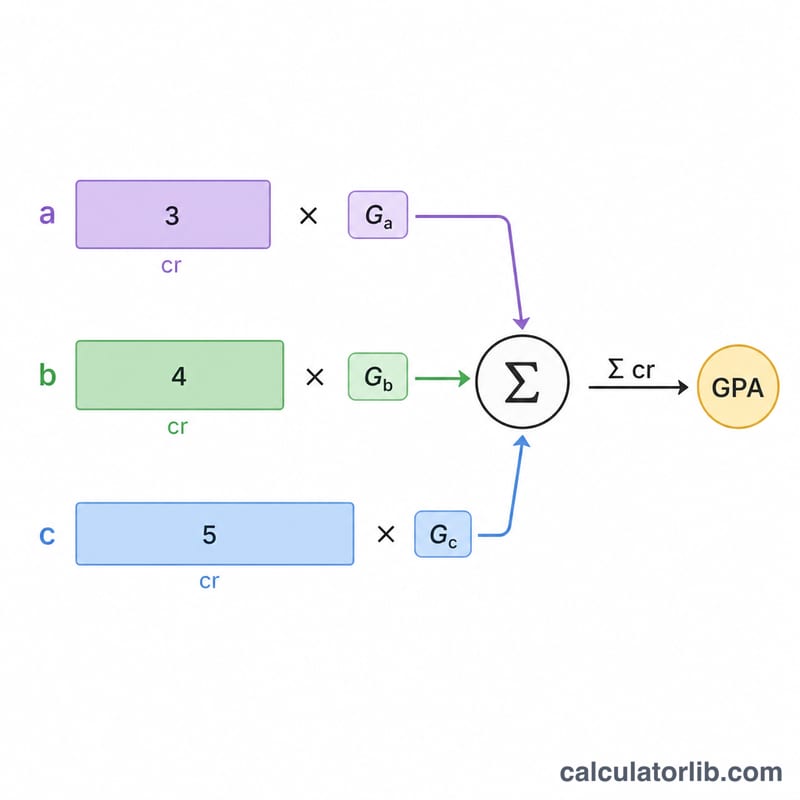
For each course, enter the grade points (the 4.0-scale value for the letter grade earned) and the number of credit hours. Leave any unused rows blank. The calculator multiplies grade points by credits for each course, adds them up, and divides by the total credits to produce your GPA, along with the total credits and total grade points.
The formula explained
$$\text{GPA} = \frac{\sum (\text{Grade Points} \times \text{Credits})}{\sum \text{Credits}} = \frac{g_1\,c_1 + g_2\,c_2 + \cdots + g_5\,c_5}{c_1 + c_2 + \cdots + c_5}$$ The numerator is your total "quality points." The denominator is the total credits attempted. Dividing the two yields a weighted average that respects how heavy each course is.
Worked example
Suppose you took three courses: an A (4.0) worth 3 credits, a B (3.0) worth 4 credits, and an A- (3.7) worth 3 credits. Quality points $$= (4.0\times3) + (3.0\times4) + (3.7\times3) = 12 + 12 + 11.1 = 35.1.$$ Total credits \(= 3 + 4 + 3 = 10\). GPA \(= 35.1 \div 10 = 3.51\).
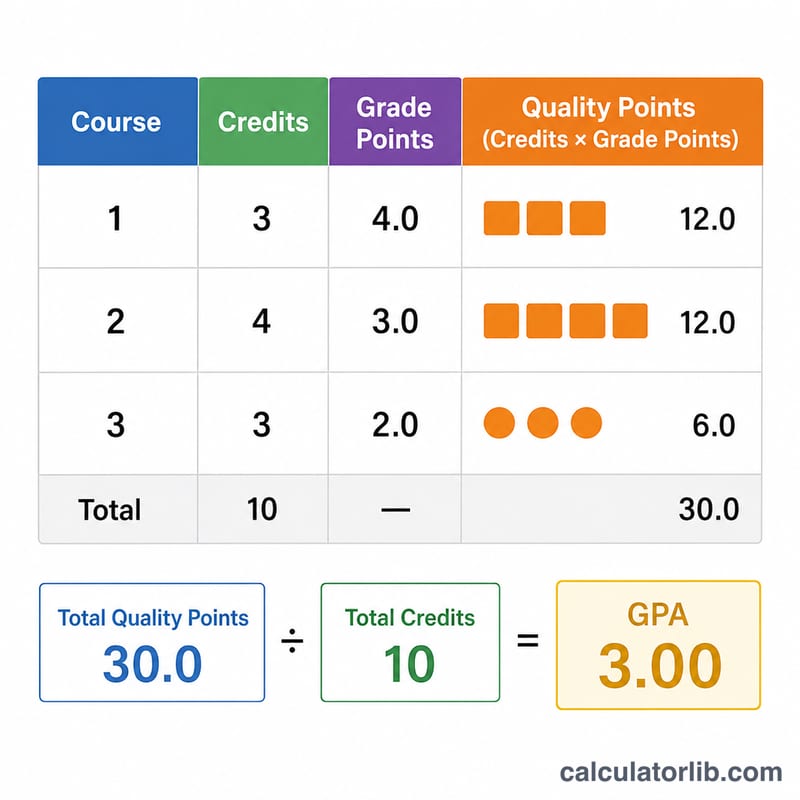
Letter Grade to 4.0 Scale Conversion Chart
The table below shows the standard US-style 4.0 scale used by many colleges and high schools, with commonly used percentage ranges. Enter the grade points from the middle column into the calculator along with each course's credit hours.
| Letter Grade | Grade Points (4.0 scale) | Typical Percentage Range |
|---|---|---|
| A+ / A | 4.0 | 93–100% |
| A- | 3.7 | 90–92% |
| B+ | 3.3 | 87–89% |
| B | 3.0 | 83–86% |
| B- | 2.7 | 80–82% |
| C+ | 2.3 | 77–79% |
| C | 2.0 | 73–76% |
| C- | 1.7 | 70–72% |
| D+ | 1.3 | 67–69% |
| D | 1.0 | 63–66% |
| D- | 0.7 | 60–62% |
| F | 0.0 | Below 60% |
Important: The percentage ranges are typical examples, not a universal standard. Each school or instructor sets its own cutoffs. The handling of A+ also varies: many schools cap it at 4.0, while some award more (for example 4.3). Some institutions use a 4.3 or 4.5 scale, and some countries use entirely different grading systems. Check your institution's published grading policy.
Interpreting Your GPA
The bands below describe how GPAs on a 4.0 scale are commonly characterized in the United States. They are general reference points, not official rules.
| GPA Range | Typical Meaning |
|---|---|
| 3.5–4.0 | High honors range; mostly A and A- work |
| 3.0–3.49 | Good standing; roughly a B average |
| 2.0–2.99 | Satisfactory; roughly C to B- range |
| Below 2.0 | Often the threshold for academic probation at many institutions |
Honors cutoffs (such as cum laude levels), dean's list requirements, and academic standing policies are set by each institution and can differ substantially, including by program or college within the same school. Consult your school's catalog or registrar for its exact definitions.
How Credit Weighting Changes Your GPA
GPA is weighted by credits: each grade's points are multiplied by the course's credit hours (giving quality points), then the total is divided by total credits. The same two grades can therefore produce different GPAs depending on where the credits fall.
$$\text{GPA} = \frac{ \sum (\text{Grade Points} \times \text{Credits}) }{ \sum \text{Credits} }$$
| Scenario | Quality Points | Total Credits | Weighted GPA | Simple (Unweighted) Average |
|---|---|---|---|---|
| A (4.0) in 4 credits + C (2.0) in 2 credits | 4.0×4 + 2.0×2 = 20 | 6 | 3.33 | (4.0 + 2.0) ÷ 2 = 3.00 |
| A (4.0) in 2 credits + C (2.0) in 4 credits | 4.0×2 + 2.0×4 = 16 | 6 | 2.67 | (4.0 + 2.0) ÷ 2 = 3.00 |
| A (4.0) in 3 credits + C (2.0) in 3 credits | 4.0×3 + 2.0×3 = 18 | 6 | 3.00 | (4.0 + 2.0) ÷ 2 = 3.00 |
Weighted GPA equals the simple average only when the credits are equal. When the higher grade carries more credits, the GPA rises above the simple average (3.33 vs. 3.00); when the lower grade carries more credits, it falls below it (2.67 vs. 3.00). Results are rounded to two decimals, and some schools round differently.
FAQ
What if my school uses a different scale? Convert each letter grade to its 4.0-scale equivalent before entering it. Schools using a 4.3 or 4.5 scale should enter those raw values; the math still works.
Do I include credits for failed courses? Yes — a failing grade (F = 0.0) still counts in total credits, which lowers your GPA.
What's the difference between weighted and unweighted GPA? This tool computes a credit-weighted GPA. A simple unweighted average ignores credit hours; here courses with more credits influence the result more.