

What Is a Gratuity Calculator?
This calculator applies to India under the Payment of Gratuity Act, 1972. Gratuity is a lump-sum reward paid by an employer to an employee for long, continuous service — typically on retirement, resignation, or superannuation after at least 5 years of service. This tool estimates the amount based on your last drawn salary and total years of service. The assumptions follow the standard statutory formula using a 26-day working month.
How to Use It
Enter your last drawn salary (basic pay plus dearness allowance), then your total years of service. The calculator instantly shows the gratuity payable. Under the Act, a period of more than six months in the final year is rounded up to a full year (this tool uses the exact value you enter, so round beforehand if needed).
The Formula Explained
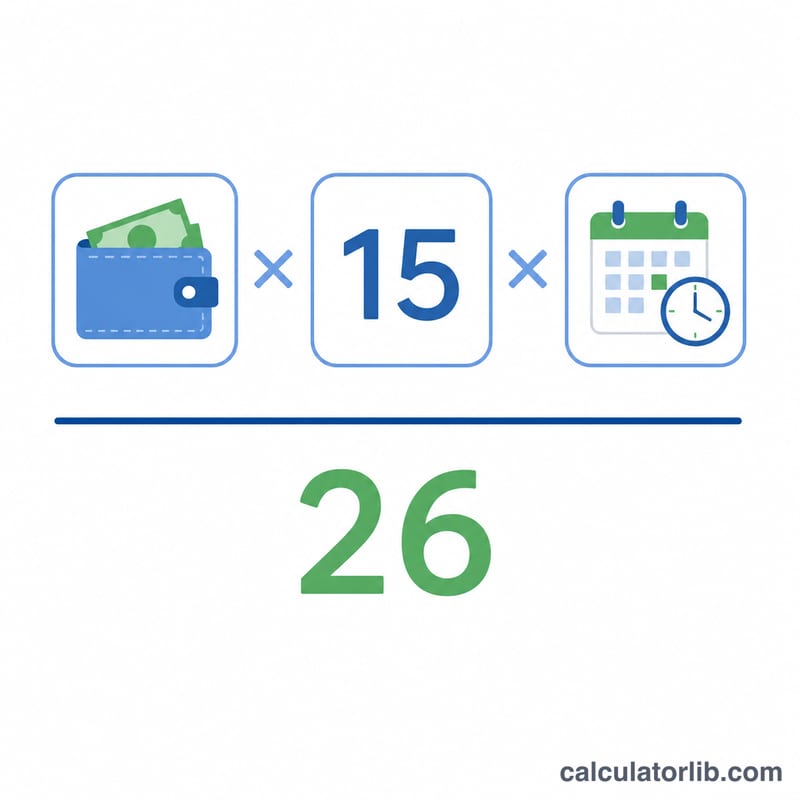
The gratuity formula is:
$$\text{Gratuity} = \frac{\text{Last Drawn Salary} \times 15 \times \text{Years of Service}}{26}$$
The number 15 represents 15 days' wages for every completed year of service, and 26 is the number of working days assumed in a month (excluding Sundays).
Worked Example
Suppose your last drawn salary (basic + DA) is ₹50,000 and you have completed 10 years of service:
$$\text{Gratuity} = \frac{50{,}000 \times 15 \times 10}{26} = \frac{7{,}500{,}000}{26} = \textbf{₹2{,}88{,}461.54}$$

FAQ
Is gratuity tax-free? For employees covered under the Act, gratuity up to ₹20 lakh is exempt from income tax; amounts above the limit may be taxable.
What is the minimum service period? Generally 5 years of continuous service, except in cases of death or disablement.
Does this apply to all employers? The Act covers establishments with 10 or more employees. This tool gives an estimate and is not legal or financial advice.