What is the Hours to Days Calculator?
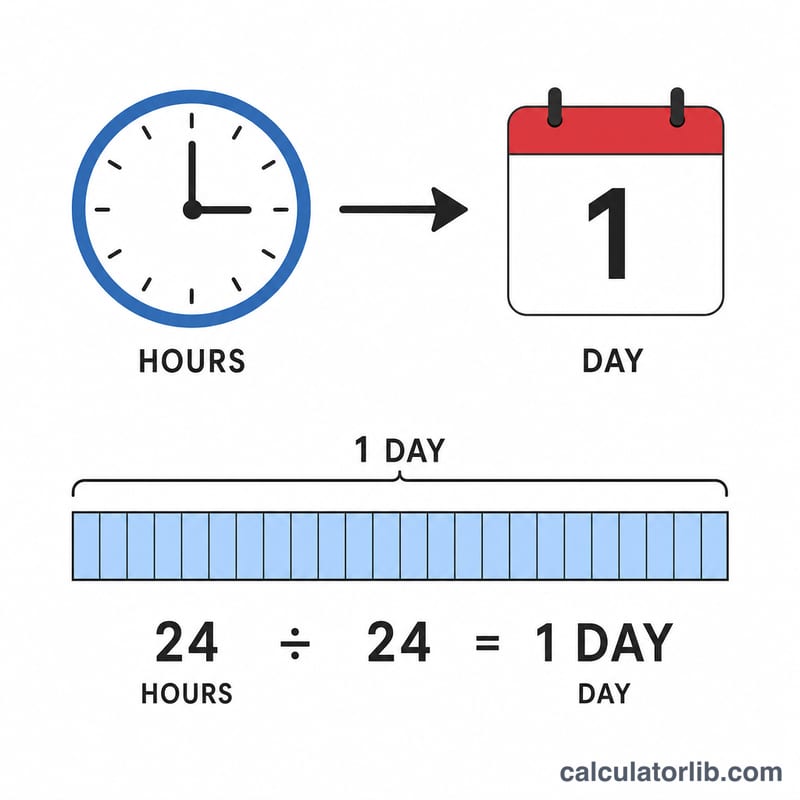
The Hours to Days Calculator converts a duration measured in hours into the equivalent number of days. Since one day contains 24 hours, the conversion is a simple division. This tool is handy for planning schedules, estimating project timelines, billing, travel times, and any situation where you need to express a span of hours in larger, easier-to-grasp units.
How to use it
Enter the number of hours you want to convert into the input field and view the result. Decimal hours are supported, so you can convert values like 30.5 hours. The calculator instantly returns the equivalent days, which may itself be a decimal value.
The formula explained
The conversion uses the relationship $$\text{days} = \frac{\text{hours}}{24}$$ Because a full day is defined as 24 hours, dividing the total hours by 24 yields the number of days. For example, \(48 \div 24 = 2\) days, and \(12 \div 24 = 0.5\) days.
Worked example
Suppose a task takes 100 hours to complete. Dividing 100 by 24 gives approximately 4.1667 days.
$$\frac{100}{24} \approx 4.1667 \text{ days}$$
So 100 hours is just over four days of continuous time.
Common Hours to Days Conversions
One day is 24 hours, so you convert hours to days by dividing by 24: \(\text{Days} = \frac{\text{Hours}}{24}\). The table below shows common values as decimal days and as whole days plus remaining hours.
| Hours | Days (decimal) | Days + hours |
|---|---|---|
| 1 | 0.0417 | 0 days 1 hour |
| 6 | 0.25 | 0 days 6 hours |
| 12 | 0.5 | 0 days 12 hours |
| 18 | 0.75 | 0 days 18 hours |
| 24 | 1 | 1 day |
| 36 | 1.5 | 1 day 12 hours |
| 48 | 2 | 2 days |
| 72 | 3 | 3 days |
| 96 | 4 | 4 days |
| 120 | 5 | 5 days |
| 168 | 7 | 7 days (1 week) |
| 240 | 10 | 10 days |
| 336 | 14 | 14 days (2 weeks) |
| 720 | 30 | 30 days |
| 8,760 | 365 | 365 days (a non-leap year) |
The 1-hour value is rounded: \(1 \div 24 = 0.041666\ldots\)
Converting Decimal Days to Days and Hours
A decimal result such as 4.1667 days is easier to read as whole days plus hours. The whole-number part is the number of full days. Multiply the fractional part by 24 to get the remaining hours. Equivalently, the remaining hours equal the total hours modulo 24 (the remainder after dividing by 24).
Example: 100 hours
- Divide by 24: \(100 \div 24 = \)4.1667 days.
- Whole days: 4 (since \(4 \times 24 = 96\)).
- Remaining hours: \(100 - 96 = 4\), which is \(100 \bmod 24 = 4\). Checking via the fraction: \(0.1667 \times 24 \approx 4\) hours (a small rounding difference).
So 100 hours = 4 days 4 hours.
Things to keep in mind
- A day here is a fixed 24-hour period. Calendar days can be 23 or 25 hours long in places that change clocks for daylight saving time, so a span measured on a wall clock may differ from the simple division by 24.
- Working days are different from 24-hour days. If you want to know how many 8-hour workdays a task takes, divide by 8 instead: 40 hours is 40 ÷ 24 ≈ 1.67 days of elapsed time, but 40 ÷ 8 = 5 workdays.
- Rounding: decimal days are often rounded (for example to 4 decimal places). Use the days-and-hours form when you need an exact figure.
FAQ
How many days is 24 hours? Exactly 1 day, since \(24 \div 24 = 1\).
How many days is 72 hours? \(72 \div 24 = 3\) days.
Can I convert fractional hours? Yes. Enter any decimal value such as 36.5 hours and the calculator returns the precise number of days (about 1.5208 days).