
What this calculator does
Concentrated reagent acids such as hydrochloric acid (HCl) and sulfuric acid (H₂SO₄) are sold by mass percent (% w/w) on the label, not by molarity. This tool converts that percent—together with the solution density and the molar mass of the acid—into molar concentration (mol/L), the unit you actually need for dilution and stoichiometry. It is a universal chemistry conversion that works for any liquid reagent, not just acids.
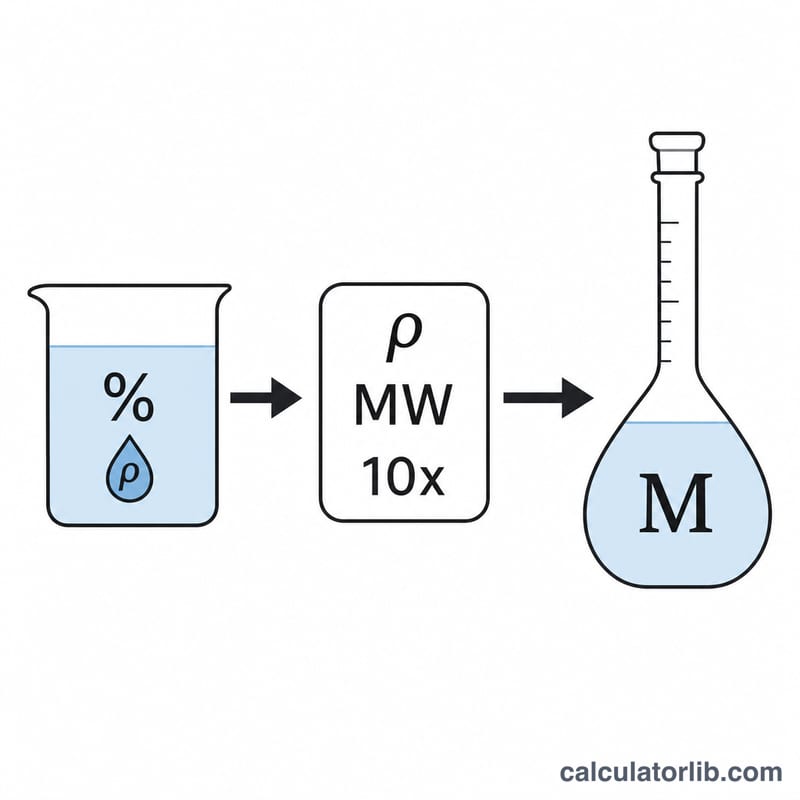
How to use it
Enter three values: the concentration as a weight percent (e.g. 37 for fuming HCl), the density of that stock solution in g/mL (read from the bottle label or a reference table), and the molar mass of the compound in g/mol (HCl ≈ 36.46, H₂SO₄ ≈ 98.08). Press calculate to get the molarity. To then dilute it, use \(M_1 V_1 = M_2 V_2\).
The formula explained
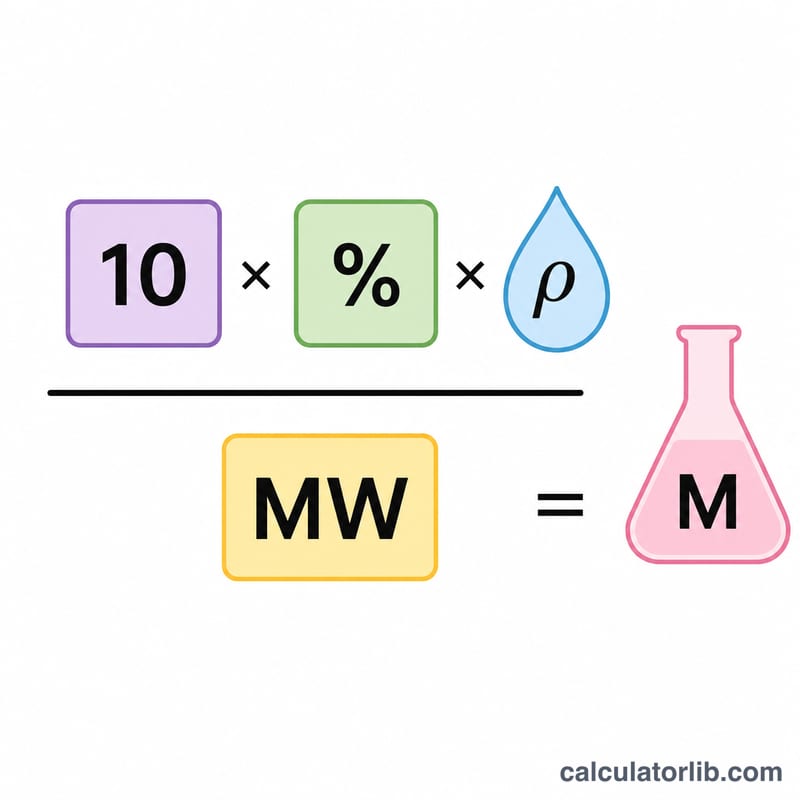
The equation is $$\text{M} = \frac{10 \cdot \%\text{w/w} \cdot \rho}{\text{MW}}$$ Density \(\rho\) (g/mL) times 1000 gives grams of solution per litre; multiplying by the percent fraction (%/100) gives grams of solute per litre; dividing by molar mass converts grams to moles. The 1000 and the 100 combine into the constant 10.
Worked example
For 37% w/w HCl with density 1.18 g/mL and MW 36.46 g/mol: $$\text{M} = \frac{10 \times 37 \times 1.18}{36.46} = \frac{436.6}{36.46} \approx 11.97 \text{ mol/L}$$—the familiar ~12 M concentrated HCl.
FAQ
Why is the factor 10 there? It is 1000 mL/L divided by 100 (to turn percent into a fraction).
What density should I use? Use the density of the stock solution at the stated percent, not the density of water.
Does it work for bases or salts? Yes—any liquid solution. Just supply the correct molar mass and density.