What it is
The Knockout Tournament Rounds Calculator tells you how many rounds a single-elimination (knockout) event needs, how many first-round byes are required, and how many matches will be played in total. In a knockout format every match eliminates one player, so the structure is fully determined by the number of participants.
The formula explained
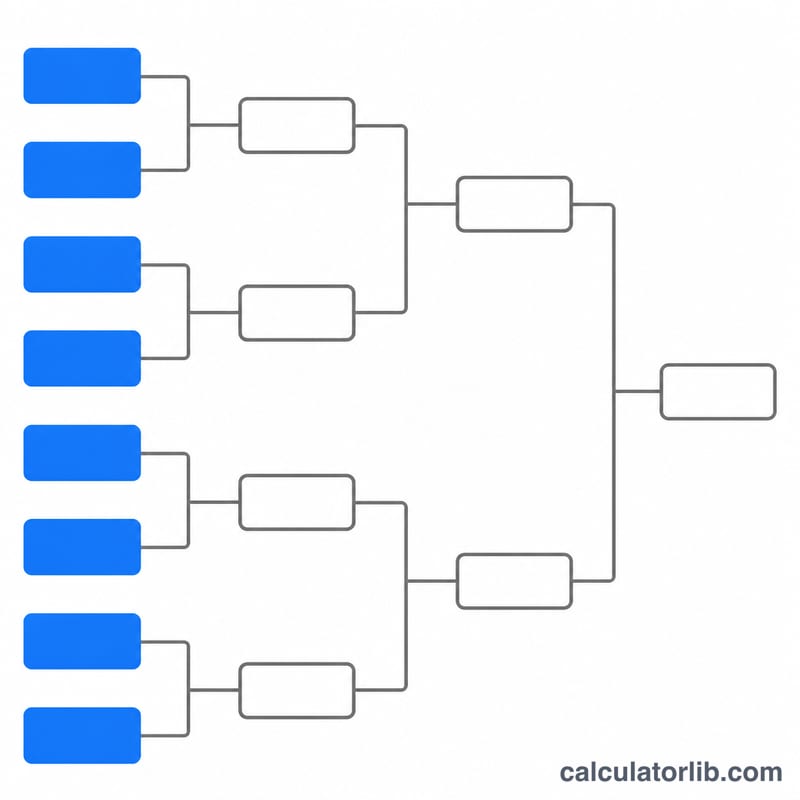
A clean bracket needs a size that is a power of two. The number of rounds \(R\) is the base-2 logarithm of the participant count \(N\), rounded up:
$$R = \lceil \log_2(N) \rceil$$The bracket size is then \(2^{R}\). Any empty slots become byes \(B\), and because each match removes exactly one competitor, the total number of matches \(M\) is always one fewer than the field:
$$B = 2^{R} - N, \qquad M = N - 1$$Here \(N\) = number of participants, \(R\) = rounds, \(B\) = byes, and \(M\) = total matches.
How to use it
Enter the number of participants and read the results. The main figure is the round count; the table adds the padded bracket size, the number of byes granted in round one, and the total matches to schedule.
Worked example
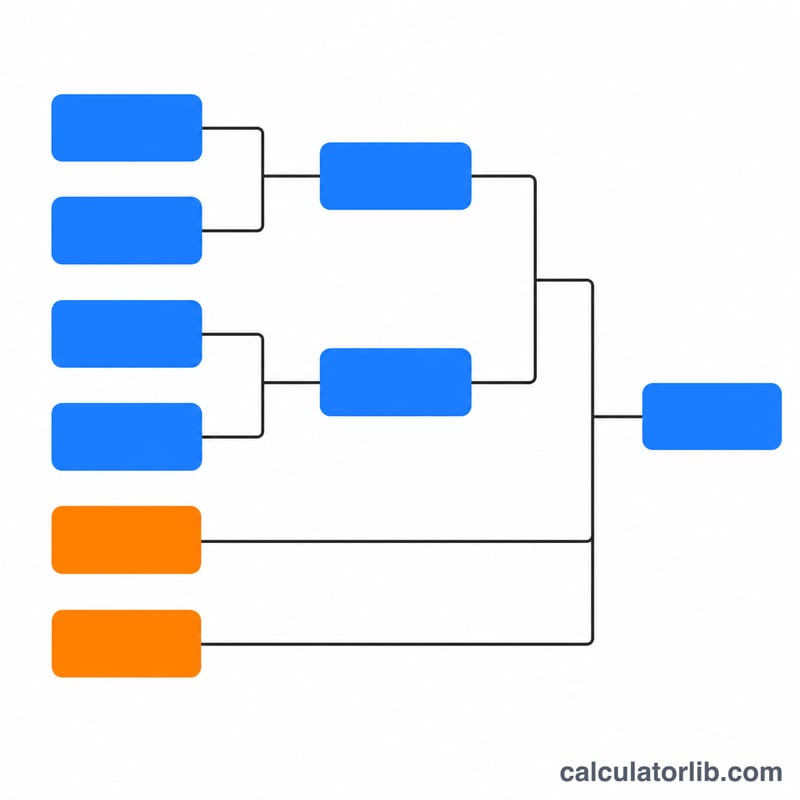
Suppose \(N = 6\) players enter. The rounds are:
$$R = \lceil \log_2(6) \rceil = \lceil 2.585 \rceil = 3$$The bracket size is \(2^{3} = 8\), so the byes and matches are:
$$B = 8 - 6 = 2, \qquad M = 6 - 1 = 5$$Two players get a first-round bye, and five matches decide the champion over three rounds.
Rounds, Byes & Matches by Field Size
In a single-elimination (knockout) tournament, the number of rounds is \( R = \lceil \log_{2} N \rceil \), where \(N\) is the number of participants. The bracket must be filled to the next power of two, \(2^{R}\); any empty slots become byes, \( B = 2^{R} - N \). Because every match eliminates exactly one participant and the tournament ends with one champion, the total number of matches is always \( M = N - 1 \), regardless of byes. Find your field size below.
| Participants (N) | Rounds R = ⌈log₂N⌉ | Bracket size 2^R | Byes B = 2^R − N | Total matches M = N − 1 |
|---|---|---|---|---|
| 4 | 2 | 4 | 0 | 3 |
| 6 | 3 | 8 | 2 | 5 |
| 8 | 3 | 8 | 0 | 7 |
| 12 | 4 | 16 | 4 | 11 |
| 16 | 4 | 16 | 0 | 15 |
| 24 | 5 | 32 | 8 | 23 |
| 32 | 5 | 32 | 0 | 31 |
| 64 | 6 | 64 | 0 | 63 |
When \(N\) is already a power of two (4, 8, 16, 32, 64), there are no byes and every round is full. Otherwise the byes are typically given to the top-seeded participants, who then enter in the second round.
FAQ
Why is the bracket rounded up to a power of two? A single-elimination bracket halves the field each round, so a clean structure requires \(2^{R}\) slots.
What are byes? Byes are automatic first-round advances given when the field is smaller than the bracket size, keeping later rounds balanced.
Why is the match count always \(N - 1\)? Every match eliminates one player and only one champion remains, so exactly \(N - 1\) players must be eliminated.