What is the kWh to Cost Calculator?
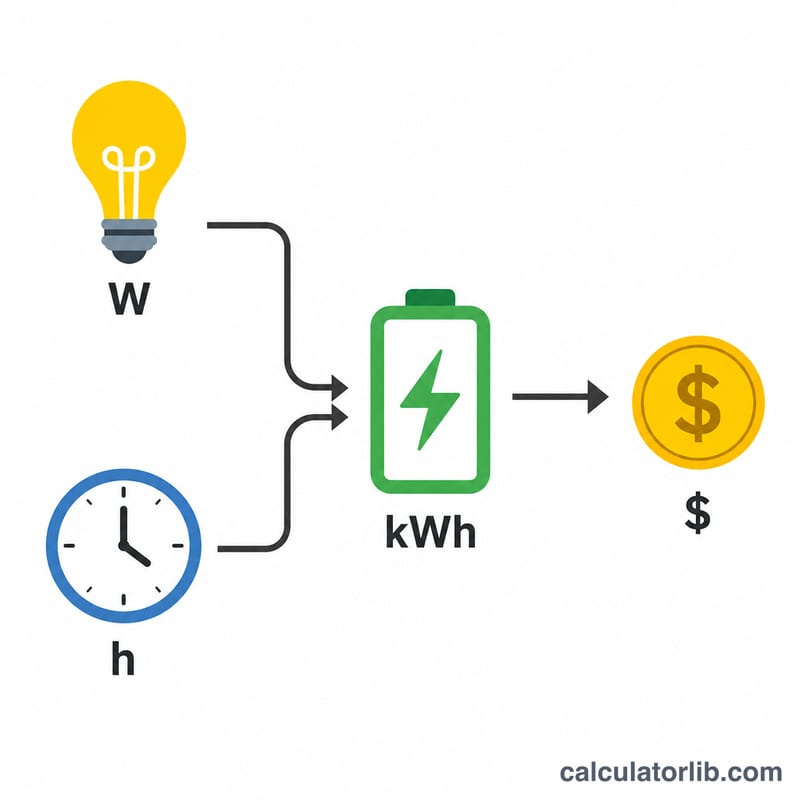
This tool turns electricity consumption into money. Electricity is billed in kilowatt-hours (kWh) — one kWh is the energy used by a 1,000-watt appliance running for one hour. By multiplying the kWh you consume by your utility's price per kWh, you get the exact cost of running an appliance, a room, or your whole home.
How to use it
Choose one of two modes. If you already know the energy used (for example from a meter reading or appliance label), select "Enter kWh directly" and type the figure. If you only know an appliance's power rating and how long it runs, select "Calculate from watts & hours" and enter both — the calculator converts them to kWh for you. Finally enter your price per kWh (check your electricity bill) and read the cost instantly.
The formula explained
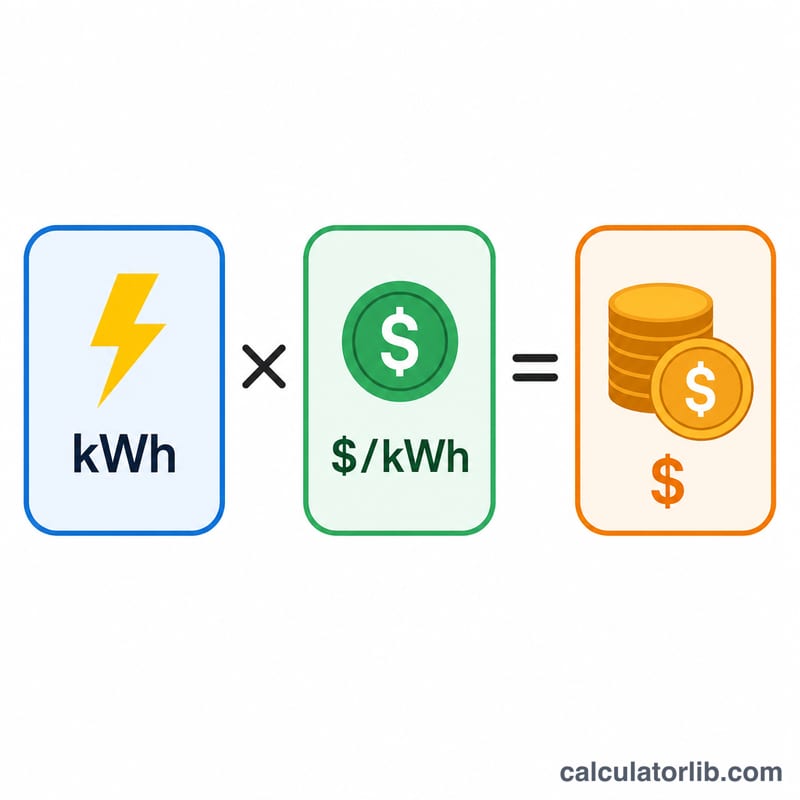
The core equation is simply $$\text{Cost} = \text{kWh} \times \text{Price per kWh}$$ When you start from a device, kWh is first derived with $$\text{kWh} = \frac{\text{Watts} \times \text{Hours}}{1000}$$ Dividing by 1000 converts watt-hours into kilowatt-hours, the unit your meter and bill use.
Worked example
Suppose a 1,500 W space heater runs for 4 hours and electricity costs $0.20 per kWh. Energy used $$= \frac{1500 \times 4}{1000} = 6 \text{ kWh}$$ Cost $$= 6 \times 0.20 = \$1.20$$ Run it daily for a month and that becomes about $36.
Typical Power Ratings of Common Appliances
The table below lists typical power draws for common household and office equipment. These are broad indicative ranges for consumer models sold in Europe and North America — an individual appliance can sit well outside them, so always prefer the rating plate on the device (or a plug-in energy monitor) over a generic figure. Note that some categories differ by market: mains voltage is nominally 120 V in North America and 230 V in most of Europe, and "EV charger (Level 2)" is the North American term for the ~7.2 kW AC charging tier.
| Device | Typical power | Example daily use | Example kWh/day |
|---|---|---|---|
| LED bulb | 8–12 W | 5 h | 0.04–0.06 |
| Laptop (incl. charger) | 30–65 W | 8 h | 0.24–0.52 |
| Desktop PC + monitor | 100–300 W | 6 h | 0.6–1.8 |
| TV, 55" LED | 60–120 W | 4 h | 0.24–0.48 |
| Fridge/freezer (cycling) | 100–200 W when running | 24 h, ~25–40% duty cycle | ~1–2 |
| Washing machine | 500–1500 W | 1 cycle (~1 h) | 0.5–1.5 |
| Tumble dryer (vented/condenser) | 2000–3000 W | 1 cycle (~1 h) | 2–3 |
| Dishwasher | 1200–1800 W | 1 cycle (~1 h of heating) | 1.2–1.8 |
| Electric kettle | 2000–3000 W | 10 min total | 0.33–0.5 |
| Microwave | 800–1200 W (input) | 15 min | 0.2–0.3 |
| Space heater | 1500–2000 W | 4 h | 6–8 |
| Air conditioner, window unit | 900–1500 W when running | 8 h, ~60% duty cycle | ~4.3–7.2 |
| EV charger, Level 2 | 7200 W | 3 h | 21.6 |
Watch out for cycling loads. Thermostatically controlled appliances — fridges, freezers, air conditioners, heat pumps, and any heater with a thermostat — only draw their rated power while the compressor or element is actually on. A fridge plated at 150 W does not use 3.6 kWh per day; it typically uses about 1–2 kWh per day because it runs perhaps a quarter to a third of the time. For these devices, use a measured kWh figure (from a plug-in meter, the appliance's energy label, or your utility bill) or apply a duty-cycle factor:
$$\text{Energy (kWh)} = \frac{\text{Watts} \times \text{Hours} \times \text{Duty cycle}}{1000}$$For example, a 1200 W window air conditioner running 8 hours at a 60% duty cycle uses \(\frac{1200 \times 8 \times 0.60}{1000} = 5.76\) kWh, not 9.6 kWh. Resistive loads such as kettles, toasters, incandescent bulbs and unregulated space heaters do draw close to their rated power whenever they are on, so watts × hours works directly for them.
Key Terms and Units Explained
- Watt (W) — the SI unit of power: how fast a device converts electrical energy at a given instant. A rating plate showing 1500 W tells you the rate of consumption, not the total consumed; on its own it says nothing about cost.
- Kilowatt (kW) — 1000 watts. A 2400 W kettle is a 2.4 kW kettle. Because tariffs are priced per kilowatt-hour, converting watts to kilowatts (divide by 1000) is almost always the first step.
- Watt-hour (Wh) and kilowatt-hour (kWh) — units of energy: power multiplied by time. One kWh is 1000 W sustained for one hour, or equivalently 100 W for 10 hours, or 2000 W for 30 minutes. This is the unit your meter records and your supplier bills.
- Price per kWh (unit rate) — the variable charge your supplier applies to each kilowatt-hour consumed, quoted in your local currency (cents/kWh, pence/kWh, and so on). Multiply energy by this rate to get the usage cost: \(\text{Cost} = \text{kWh} \times \text{Price}\). Rates may differ by time of day (time-of-use tariffs) or by consumption tier, and many bills add sales tax or VAT on top.
- Standing charge / fixed daily charge — a fixed amount billed per day or per month simply for being connected, regardless of how much you use. This calculator returns only the usage cost; a bill of, say, 180 kWh at $0.20 plus a $0.40 daily standing charge over 30 days would be $36.00 of usage plus $12.00 of standing charge. Add any fixed charges separately.
- Volt-amps (VA) vs watts — power factor — equipment such as UPS units, transformers and some motors is rated in volt-amps, the apparent power. Real power in watts is apparent power multiplied by the power factor: \(\text{W} = \text{VA} \times \text{PF}\). A 1000 VA UPS with a power factor of 0.8 supports 800 W of real load. Residential meters bill real energy (kWh), so use watts, not VA, in the calculation; modern electronics with power-factor correction are typically 0.9–1.0, while small motors can be nearer 0.6–0.8.
- Amps × volts = watts — for devices labelled only with current and voltage, \(\text{W} = \text{A} \times \text{V}\) (for AC loads, multiplied by the power factor). A device drawing 5 A at 120 V is 600 W; the same 600 W device on a 230 V supply would draw about 2.6 A. Running that 600 W load for 2 hours uses 1.2 kWh, which at an illustrative $0.20 per kWh costs $0.24.
Two units that cause confusion: a kWh is energy (what you pay for), while a kW is power (how fast you use it). Some commercial and industrial tariffs — and a few residential ones in certain countries — also bill a separate demand charge based on peak kW, which this calculator does not cover.
FAQ
Where do I find my price per kWh? It is listed on your electricity bill, often as "rate" or "unit price". Divide total energy charges by total kWh if it is not stated directly.
Does this include standing charges or taxes? No — it estimates only the variable energy cost. Add any fixed daily charges separately.
What currency does it use? The result is in whatever currency your price per kWh is entered in, so it works anywhere.