
What this calculator does
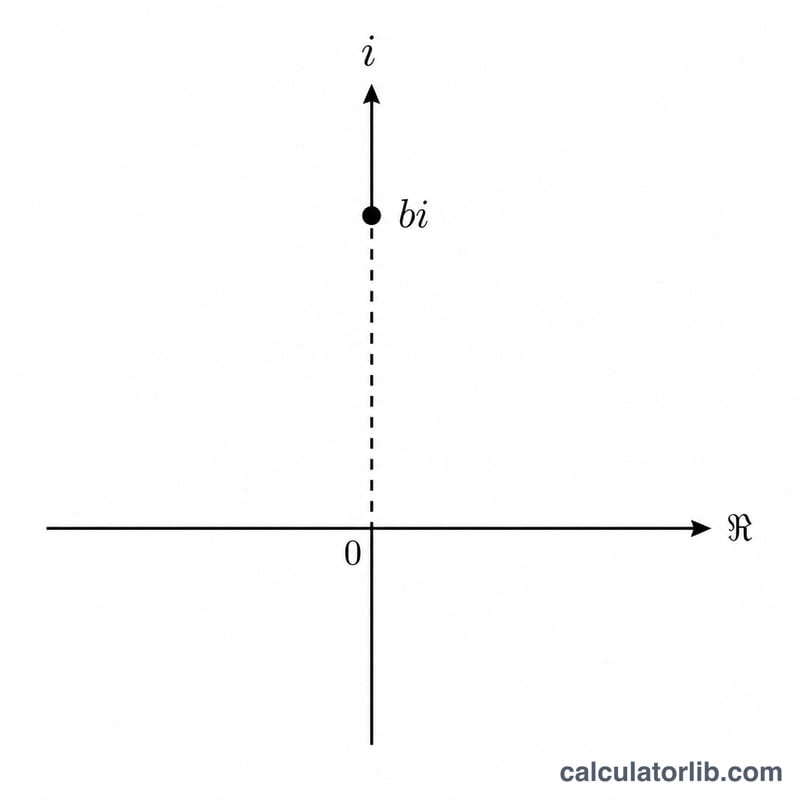
The square root of a negative number is not a real number, but it is well defined in the complex numbers as a pure imaginary value. This tool takes any real number you enter and returns its square root. If the number is negative, the answer is expressed in the form \(bi\), where \(b\) is the square root of the absolute value and \(i\) is the imaginary unit. If the number is zero or positive, you simply get the ordinary real square root.
How to use it
Type a number into the input box and submit. For example, enter \(-16\) to get \(4i\), or enter \(-2\) to get approximately \(1.414214i\). Positive inputs such as \(25\) return the real result \(5\).
The formula explained
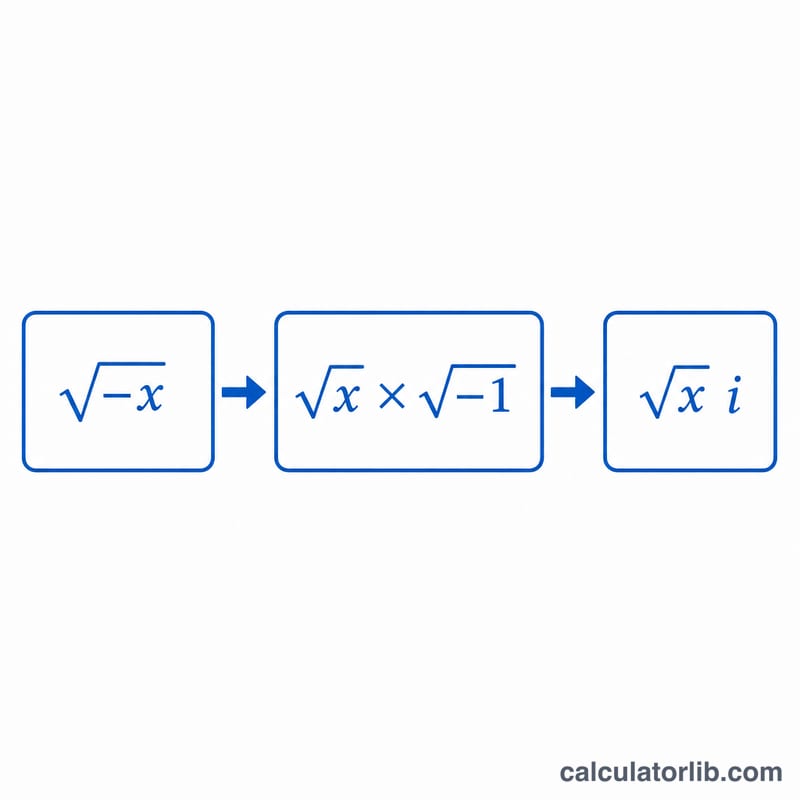
For any \(x\) greater than 0, the square root of negative \(x\) factors as the square root of \(x\) times the square root of negative one. Since the square root of negative one is defined as the imaginary unit \(i\), we get the clean rule:
$$\sqrt{-x} = \sqrt{x}\;i$$This works because \(i^2 = -1\), so \((bi)^2 = b^2 \cdot (-1)\), which recovers the original negative number.
Worked example
Take \(-16\). The absolute value is \(16\), and the square root of \(16\) is \(4\). Because the original number was negative, the answer is \(4i\). Check:
$$(4i)^2 = 16 \cdot i^2 = 16 \cdot (-1) = -16$$Correct.
FAQ
Why can negative numbers not have a real square root? Any real number squared is non-negative, so no real number squares to a negative value. We extend to imaginary numbers to handle this case.
What is \(i\)? The imaginary unit, defined by \(i^2 = -1\). It is the building block of complex numbers.
What if I enter a positive number? You get the ordinary real square root, with no imaginary part.