What Is Packet Loss?
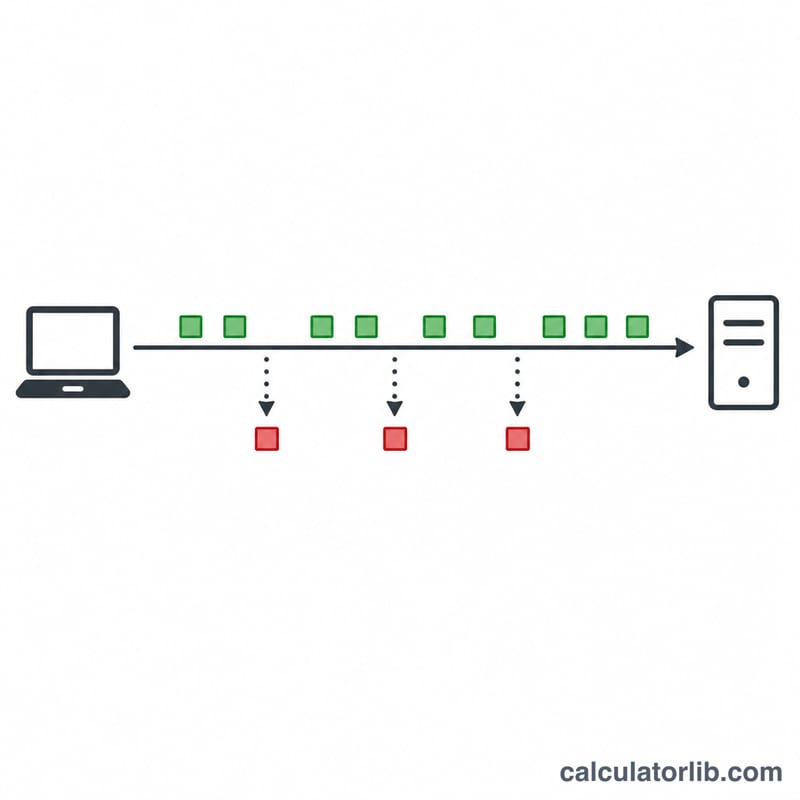
Packet loss happens when one or more data packets travelling across a network fail to reach their destination. It is a key indicator of network health, affecting everything from video calls and online gaming to VoIP and large file transfers. This calculator converts raw counts — how many packets you sent and how many were lost — into an easy-to-read loss percentage.
How to Use It
Enter the total number of packets sent (for example, the count reported by a ping test) and the number of packets lost. The calculator returns the packet loss percentage, the number of packets received, and the overall success rate. Tools like ping, mtr, or your router's diagnostics report these counts directly.
The Formula
The math is a simple ratio scaled to a percentage:
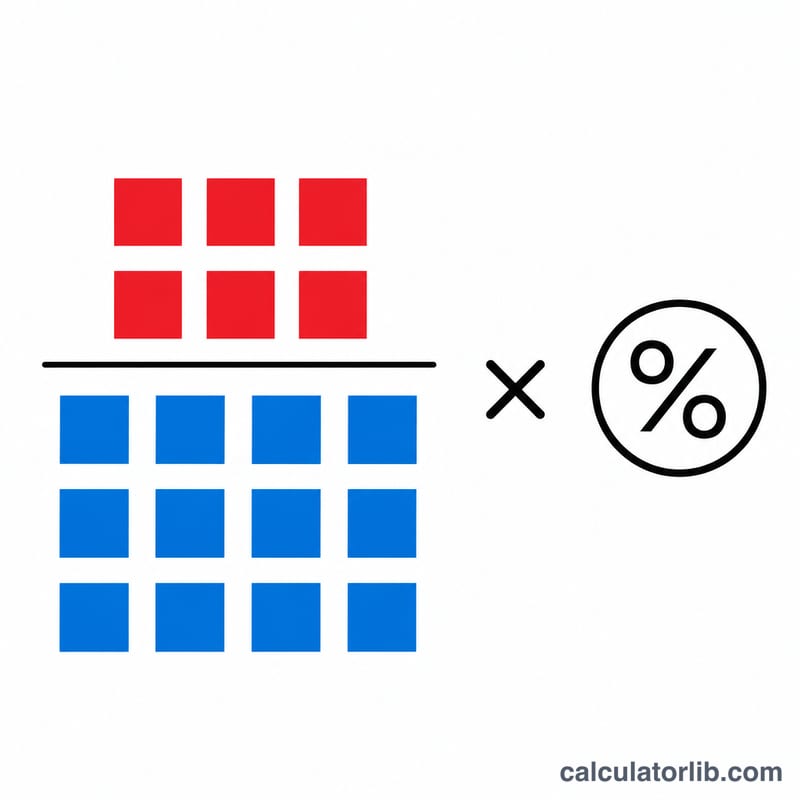
$$\text{packet\_loss\_\%} = \frac{\text{packets\_lost}}{\text{packets\_sent}} \times 100$$
The success rate is the complement: \((\text{packets\_received} / \text{packets\_sent}) \times 100\), where \(\text{packets\_received} = \text{packets\_sent} - \text{packets\_lost}\).
Worked Example
Suppose a ping test sends 1,000 packets and 25 come back as lost. The packet loss is $$\left(\frac{25}{1000}\right) \times 100 = 2.5\%$$ That means 975 packets were received, for a success rate of 97.5%. As a rule of thumb, under 1% loss is generally fine, 1–2.5% may cause noticeable issues for real-time traffic, and anything above 5% usually degrades the experience significantly.
Acceptable Packet Loss Ranges by Application
How much packet loss is tolerable depends on how the application handles missing data. The values below are commonly cited industry guidelines, not strict standards. Real tolerance varies with the codec, buffering, and error-correction or concealment techniques in use.
| Application | Typical tolerance | Why |
|---|---|---|
| Web browsing / file downloads | Up to ~1% | TCP retransmits lost packets, so data arrives intact, but throughput and page-load times drop as loss rises. |
| VoIP (voice calls) | Under 1%; quality often degrades noticeably beyond ~1-3% | Real-time audio cannot wait for retransmission. Codec loss concealment can hide only small gaps. (ITU-T G.114 is mainly about one-way delay, so loss guidance here is general industry practice.) |
| Video conferencing | Under 1%; noticeable above ~2% | Lost packets cause freezing, blockiness, or audio dropouts, since interactive video is latency-sensitive. |
| Online gaming | Under ~0.5-1% | Lost updates cause rubber-banding, teleporting, or missed actions, and fast-paced games are especially sensitive. |
| Video streaming (buffered) | Under ~1-2% | Buffering and retransmission over TCP-based protocols absorb moderate loss, though sustained loss lowers quality or triggers rebuffering. |
As a general rule, 0% is ideal, and any sustained loss on a wired connection is worth investigating. Check cabling, Wi-Fi signal quality, congestion, and hardware faults.
Packet Loss Scenarios Compared
Packet loss % = lost ÷ sent × 100. Packets received = sent − lost, and success rate = 100% − loss %.
| Packets sent | Packets lost | Packets received | Loss % | Success % | Note |
|---|---|---|---|---|---|
| 100 | 0 | 100 | 0% | 100% | Healthy connection |
| 100 | 1 | 99 | 1% | 99% | Borderline for real-time apps such as VoIP and gaming |
| 1,000 | 5 | 995 | 0.5% | 99.5% | Fine for most uses; may be noticeable in competitive gaming |
| 10,000 | 250 | 9,750 | 2.5% | 97.5% | Degraded; calls and video will likely suffer |
| 500 | 50 | 450 | 10% | 90% | Severe; connection is effectively unusable for real-time use |
Sample size matters. Small samples give coarse resolution: 1 lost packet out of 10 is already 10%, and out of 100 it is 1%. A short ping test can therefore overstate or understate real loss. For reliable diagnosis, send hundreds or thousands of packets, and repeat tests at different times of day.
FAQ
What is an acceptable packet loss rate? For most browsing and downloads, occasional loss under 1% is acceptable. Real-time applications like gaming and video calls are more sensitive and prefer loss below 0.5–1%.
Why am I losing packets? Common causes include network congestion, faulty cables or hardware, Wi-Fi interference, overloaded routers, and problems at your ISP.
Can packet loss be zero? Yes — on a healthy wired connection over a short test you can see 0% loss. Over long periods or busy networks, small amounts of loss are normal.