What Is the Paver Sand Calculator?
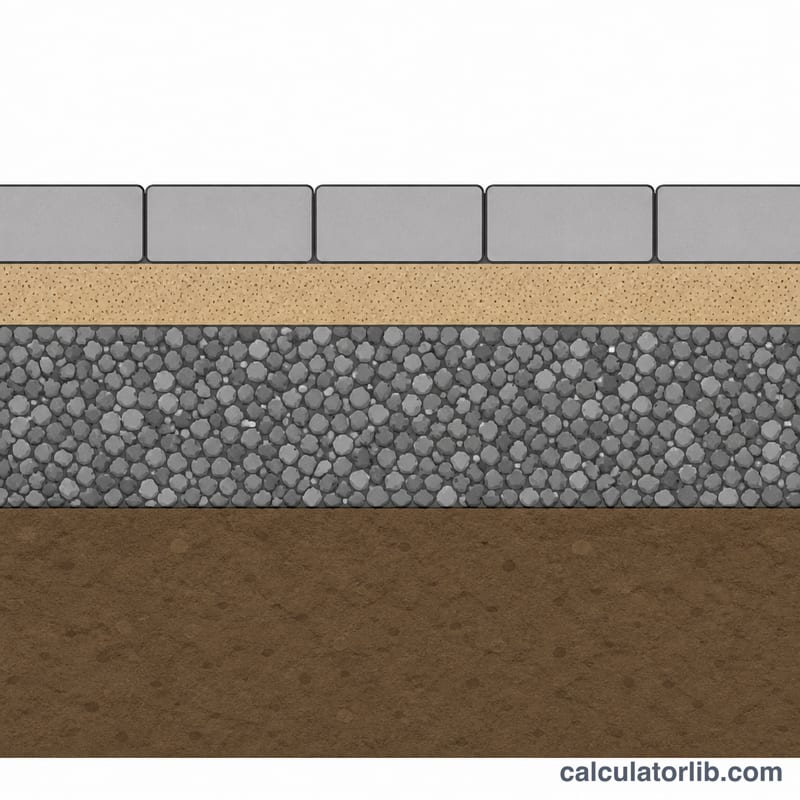
When installing pavers for a patio, driveway, or walkway, a layer of bedding sand is spread over the compacted base to create a smooth, level surface and to lock the pavers in place. This calculator estimates how much bedding sand you need based on the area you are covering and the depth of the sand layer, giving results in cubic yards, cubic feet, and approximate weight.
How to Use It
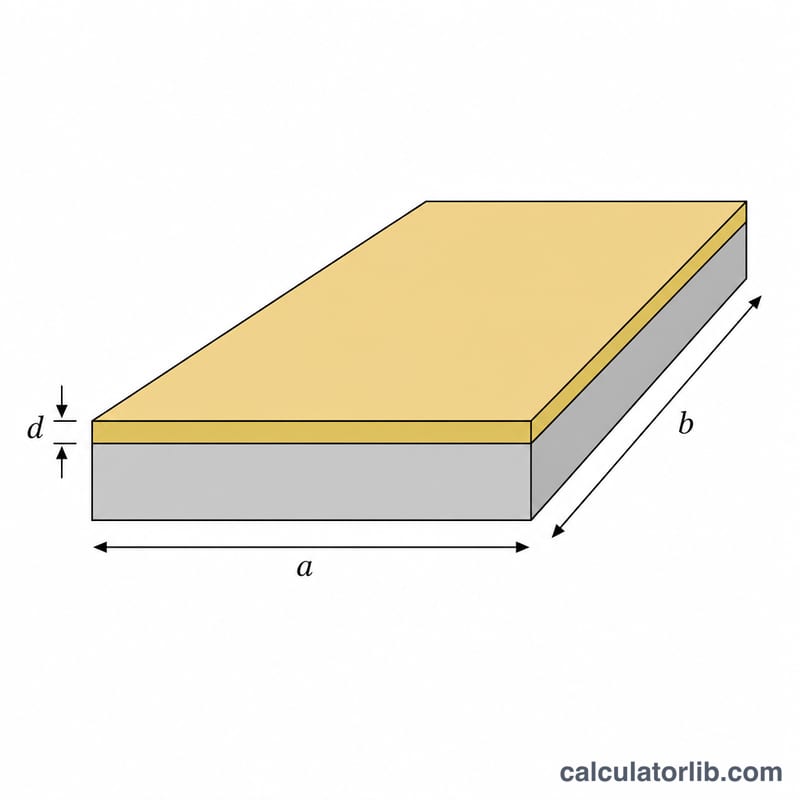
Enter the length and width of your paver area in feet, then enter the desired sand bedding depth in inches (a typical depth is 1 inch). The calculator multiplies the area by the depth (converted to feet) to find the volume, then converts to cubic yards and estimates weight assuming dry sand weighs about 100 pounds per cubic foot.
The Formula Explained
First the area is found: \(\text{Area} = \text{Length} \times \text{Width}\). The sand depth in inches is converted to feet by dividing by 12. Multiplying area by this depth gives cubic feet of sand:
$$\text{Volume} = \text{Area} \times \frac{\text{Depth}}{12}$$Dividing by 27 converts cubic feet to cubic yards, the unit suppliers typically use.
Worked Example
For a 10 ft × 10 ft patio with a 1-inch sand layer: Area = 100 sq ft. Depth = \(1 \div 12 = 0.0833\) ft. Volume:
$$\text{Volume} = 100 \times 0.0833 = 8.33 \text{ cubic feet}$$In cubic yards that is \(8.33 \div 27 \approx 0.31 \text{ yd}^3\). Estimated weight \(\approx 8.33 \times 100 = 833 \text{ lbs}\).
Bedding Sand Needed by Project Size and Depth
The table below uses the formula \(\text{Volume (cu ft)} = \text{Area (sq ft)} \times \frac{ \text{Depth (in)} }{12}\), converts to cubic yards by dividing by 27, and estimates weight at 100 lb per cu ft for dry sand. Figures are in US units (feet, inches, pounds) and exclude the 10% extra you should add for waste and uneven base.
| Area (sq ft) | Depth (in) | Cubic feet | Cubic yards | Approx. weight (lb) |
|---|---|---|---|---|
| 50 | 1 | 4.17 | 0.154 | 417 |
| 50 | 1.5 | 6.25 | 0.231 | 625 |
| 100 | 1 | 8.33 | 0.309 | 833 |
| 100 | 1.5 | 12.5 | 0.463 | 1,250 |
| 200 | 1 | 16.67 | 0.617 | 1,667 |
| 200 | 1.5 | 25.0 | 0.926 | 2,500 |
| 400 | 1 | 33.33 | 1.235 | 3,333 |
| 400 | 1.5 | 50.0 | 1.852 | 5,000 |
| 800 | 1 | 66.67 | 2.469 | 6,667 |
| 800 | 1.5 | 100.0 | 3.704 | 10,000 |
Example: a 20 ft × 20 ft patio (400 sq ft) with 1.5 in of sand needs \(20 \times 20 \times \frac{1.5}{12} = \) 50 cubic feet, or about 1.85 cubic yards, before the 10% extra.
Weights are for dry sand; damp sand is noticeably heavier, so a delivered load may weigh more than the table suggests.
Ordering and Installation Tips
- Add about 10% extra to the calculated volume to cover waste, spillage and slight variations in the base. Example: 400 sq ft at 1 in is 33.33 cu ft; with 10% extra that is 36.67 cu ft, or about 1.36 cu yd.
- Bulk delivery: round up to the next half or whole cubic yard (the example above would be ordered as 1.5 cu yd). Bulk is usually cheaper per unit for anything beyond about a cubic yard, but you need a place to dump it and a tarp to cover it.
- Bagged sand: bags are typically 0.5 cu ft and about 50 lb each, so roughly 54 bags make one cubic yard. Bags suit small patios, walkways and touch-ups; the example above would need about 74 bags.
- Use the right sand: coarse concreting or washed sand meeting ASTM C33 (US standard) is the usual choice. Avoid play sand (too fine and rounded) and stone dust (holds water and can compact unevenly).
- Screed at a consistent depth: lay pipe or rail guides on the compacted base, fill between them with sand, and drag a straight board across them. Then remove the guides and fill the gaps lightly without stepping on the screeded sand.
- Keep sand dry and covered until it is placed, so it screeds evenly and does not become heavy or clumpy.
- Do not compact the sand layer before laying pavers. Compact only the base beneath; the pavers are then set and vibrated into the sand, which settles slightly.
This is general information; always follow the paver manufacturer's instructions and local building requirements.
Constants and Reference Values Used
| Value | Number |
|---|---|
| Cubic feet per cubic yard | 27 cu ft (3 × 3 × 3) |
| Inches per foot | 12 in |
| Dry bedding sand density | about 100 lb per cu ft (about 2,700 lb per cu yd) |
| Damp or wet sand density | about 110–130 lb per cu ft |
| Typical bedding depth | 1 in (range 3/4 in to 1.5 in) |
| Pounds per US short ton | 2,000 lb |
Using these values, one cubic yard of dry sand weighs about \(27 \times 100 = 2{,}700\) lb, or about 1.35 US short tons. These are typical figures; actual density varies with sand type and moisture, so check your supplier's data. Units here are US customary.
FAQ
How deep should paver bedding sand be? A 1-inch layer of bedding sand is standard for most paver installations.
Should I add extra sand? Yes — order about 10% extra to account for compaction, uneven base, and waste.
Does this include joint sand? No, this estimates bedding sand only. Polymeric joint sand for filling gaps between pavers is calculated separately.