
What is a permutation (nPr)?
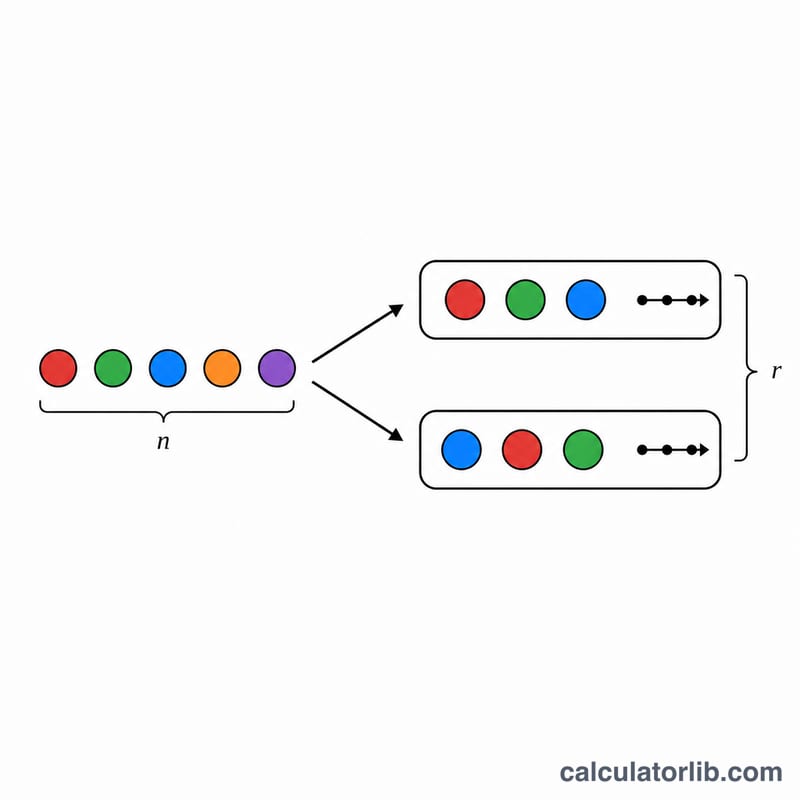
A permutation counts the number of ways to arrange r items selected from a set of n distinct items, where the order matters. For example, choosing a 1st, 2nd, and 3rd place winner from a group of runners is a permutation problem — swapping two finishers gives a different outcome. This calculator computes nPr (also written P(n, r)) instantly for any valid values.
How to use this calculator
Enter the total number of available items n and the number you want to arrange r. Press calculate to see the number of distinct ordered arrangements. The value of r must be less than or equal to n; if r is larger than n, the result is 0 because you cannot arrange more items than you have.
The formula explained
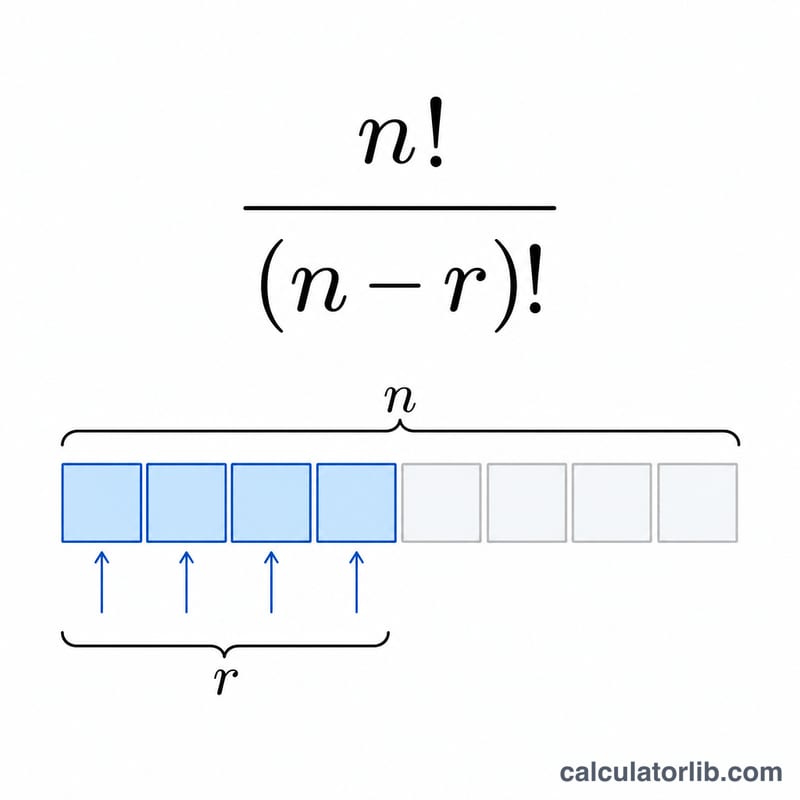
The permutation formula is:
$$P(n, r) = \frac{n!}{(n - r)!}$$
Here \(n!\) (n factorial) is the product of all positive integers up to \(n\). Dividing \(n!\) by \((n - r)!\) cancels the arrangements of the items you do not pick, leaving only the ordered selections of \(r\) items. In practice this simplifies to a product of \(r\) descending factors: \(n \times (n-1) \times \ldots \times (n-r+1)\).
Worked example
Suppose you have 10 books and want to know how many ways you can place 3 of them on a shelf in order. Then:
$$P(10, 3) = \frac{10!}{7!} = 10 \times 9 \times 8 = 720$$
So there are 720 distinct ordered arrangements.
FAQ
What is the difference between permutation and combination? In permutations the order matters; in combinations it does not. A combination \(C(n, r)\) equals \(P(n, r)\) divided by \(r!\).
What does P(n, 0) equal? It equals 1 — there is exactly one way to choose and arrange nothing (the empty arrangement).
Can r be greater than n? No. If r exceeds n the result is 0, since you cannot arrange more items than are available.