What Is the Power Bank Charge Count Calculator?
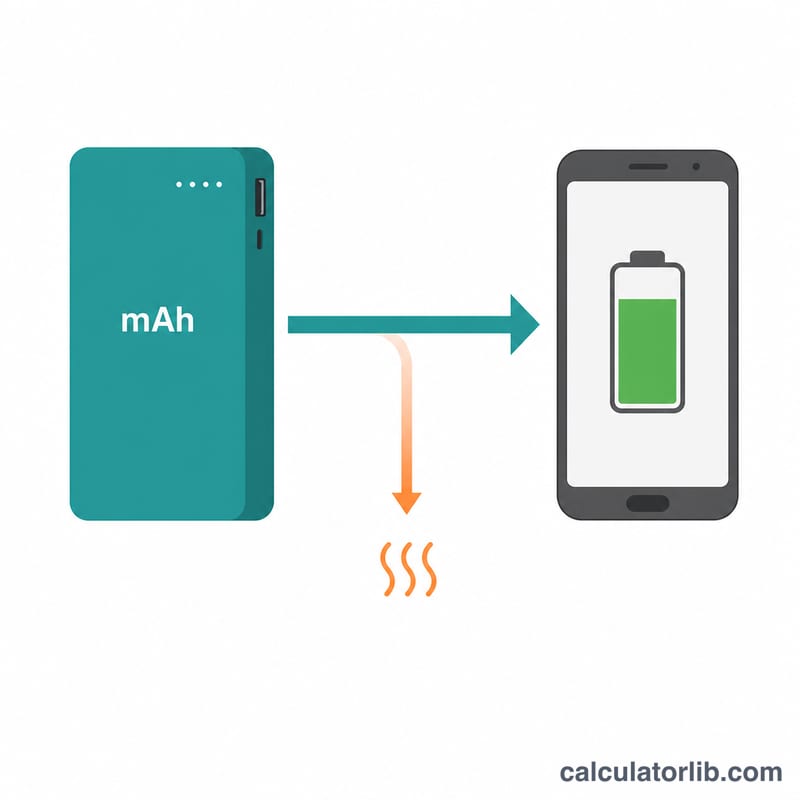
This tool estimates how many times a power bank can fully recharge your phone. Although a power bank's label shows its rated capacity in mAh, you never get 100% of that energy into your phone. Voltage conversion, heat, and circuitry losses mean only about 60–90% is actually usable. This calculator factors that efficiency in to give a realistic charge count.
How to Use It
Enter your power bank capacity (e.g. 10000 mAh), your phone's battery capacity (e.g. 3000 mAh), and a charging efficiency percentage. If unsure, 85% is a good default for quality power banks. The result shows how many full charges you can expect plus the usable capacity after losses.
The Formula Explained
The calculation is straightforward: multiply the power bank's rated capacity by the efficiency (as a decimal) to get usable mAh, then divide by your phone's battery capacity.
$$\text{Charges} = \frac{\text{Power Bank (mAh)} \times \dfrac{\text{Efficiency (\%)}}{100}}{\text{Phone (mAh)}}$$
Worked Example
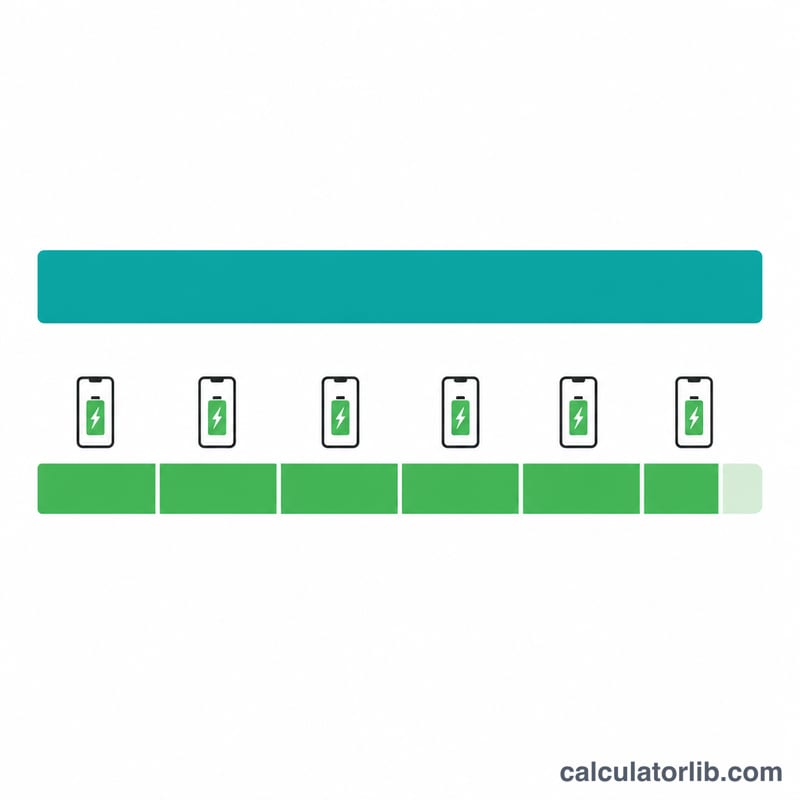
A 10,000 mAh power bank charging a 3,000 mAh phone at 85% efficiency: usable capacity = \(10{,}000 \times 0.85 = 8{,}500\) mAh. Charges = \(8{,}500 \div 3{,}000 \approx 2.83\). So you can fully charge the phone about 2.8 times before the power bank is empty.
Typical Phone and Power Bank Battery Capacities
To estimate how many charges a power bank will deliver, you need two numbers: the capacity of the power bank and the capacity of the device battery, both in milliamp-hours (mAh). The table below lists typical ranges by device class. These are representative figures across recent consumer devices, not values for any specific model — always check your device's spec sheet, the label printed on the power bank, or the regulatory text on the back of the phone for exact values.
| Device class | Typical battery capacity (mAh) | Notes |
|---|---|---|
| Compact / small-screen phones | 3,000 – 3,300 | Smaller-body and older flagship models |
| Standard flagship phones | 4,000 – 4,500 | The most common size for 6.1–6.5 in. handsets |
| Large "Max" / "Ultra" / "Plus" phones | ~5,000 | 5,000 mAh is a very common headline figure |
| Tablets | 7,000 – 10,000 | Often need higher-wattage output to charge at full speed |
| Wireless earbuds (charging case) | 500 – 800 | Case capacity, not the individual buds |
| Smartwatches | 300 – 600 | Usually charged via a proprietary magnetic puck |
Common power bank tiers
| Power bank tier | Rated capacity (mAh, at 3.7 V) | Energy (Wh) | Typical use |
|---|---|---|---|
| Pocket / lipstick | 5,000 | 18.5 | Roughly one top-up of a phone |
| Everyday carry | 10,000 | 37 | The most popular all-round size |
| Weekend / multi-device | 20,000 | 74 | Several phone charges or a tablet |
| High capacity | 26,800 | ≈99.2 | Sized to stay just under the 100 Wh threshold |
| Airline carry-on ceiling | ≈27,000 | ≈100 | See the note below |
The 100 Wh rule. Lithium batteries in carry-on baggage are limited to 100 Wh per battery under the widely adopted IATA Dangerous Goods Regulations, which most airlines and civil aviation authorities follow; batteries from 100 Wh to 160 Wh generally need airline approval. At the nominal cell voltage of 3.7 V, 100 Wh corresponds to about 27,000 mAh — which is exactly why so many large power banks are rated 26,800 mAh. Rules and enforcement differ by carrier and country, so confirm with your airline before flying.
Worked example. A 20,000 mAh power bank charging a 4,000 mAh phone at a realistic 65% end-to-end efficiency gives
$$\text{Charges} = \frac{20{,}000 \times \dfrac{65}{100} }{4{,}000} = \frac{13{,}000}{4{,}000} = 3.25$$so roughly 3.25 full charges — three complete charges plus a partial one, not the five you would get from dividing the raw numbers.
FAQ
Why isn't efficiency 100%? Power banks store energy at 3.7V but charge phones at 5V; this voltage step-up wastes energy as heat, typically losing 10–40%.
What efficiency should I use? Premium power banks reach 80–90%; cheaper or older units may be 60–70%.
Does cold weather affect this? Yes — low temperatures reduce battery output, so real-world charges may drop below the estimate.