What Is a Proof Gallon?
A proof gallon is the standard unit used by distillers and tax authorities to measure the amount of pure alcohol in a batch of spirits. One proof gallon equals one US liquid gallon of spirit that is exactly 100 proof (50% alcohol by volume) at 60 degrees Fahrenheit. Because excise tax is levied on the alcohol content rather than the total liquid volume, converting bulk (wine) gallons into proof gallons is essential for accurate reporting.
The Formula
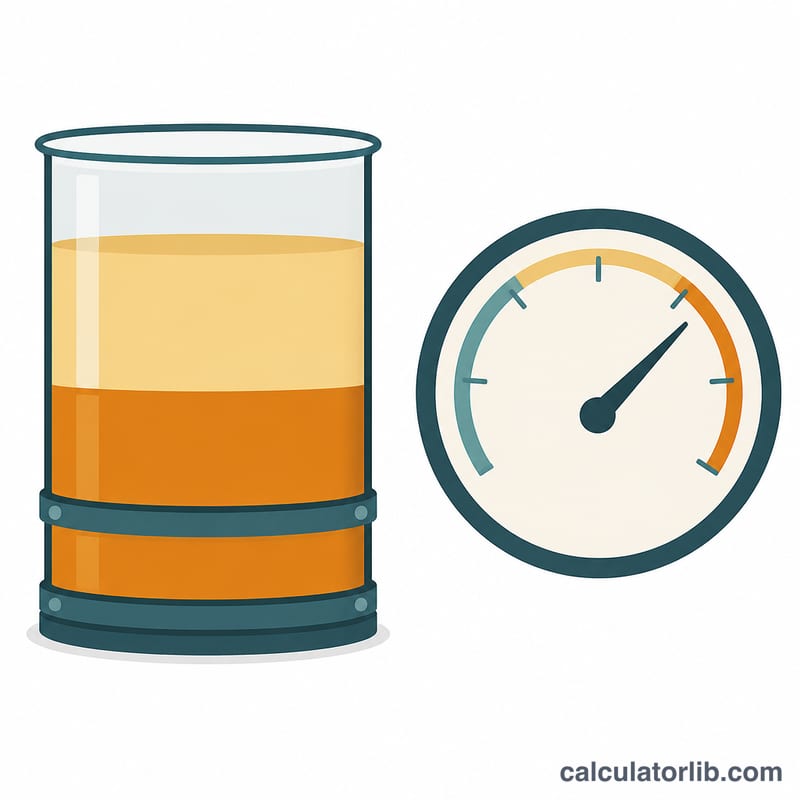
Proof gallons are found by scaling the bulk volume by the proof. With \(\text{WG}\) = wine (bulk) gallons and \(\text{Proof}\) = the US proof of the spirit:
$$\text{PG} = \text{WG} \times \frac{\text{Proof}}{100}$$Since US proof is twice the alcohol by volume, you can also recover concentration with \(\text{ABV} = \tfrac{\text{Proof}}{2}\).
How to Use the Calculator
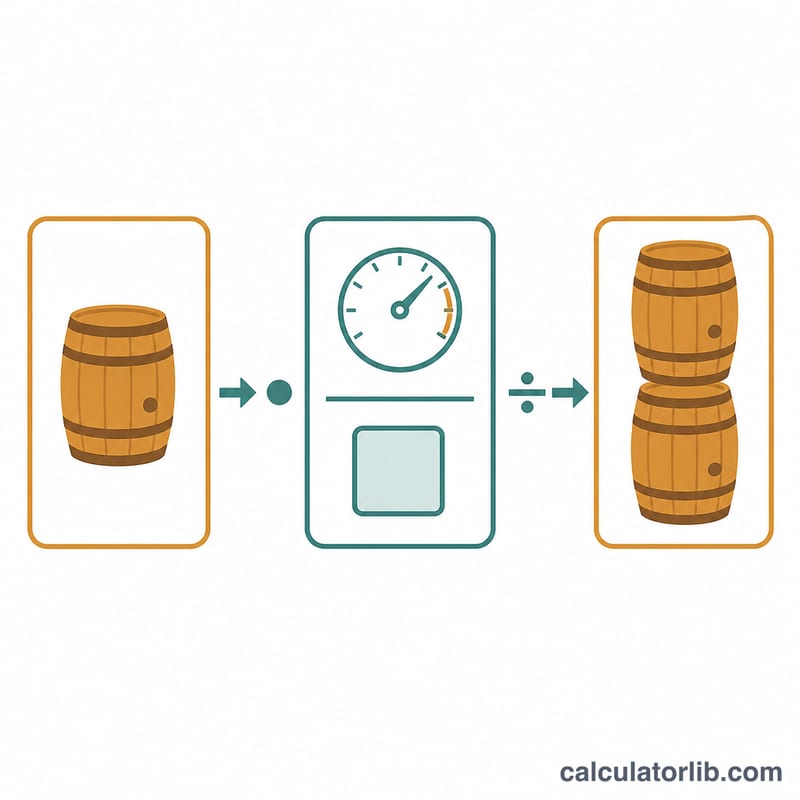
Enter the measured spirit volume in US gallons and the proof of the product. The calculator multiplies the two per the formula above and returns the proof gallons, along with the original bulk volume and the equivalent ABV for reference. Use accurate gauged volumes and temperature-corrected proof for tax filings.
Worked Example
Suppose you have 50 gallons of spirit at 80 proof. Then:
$$\text{PG} = 50 \times \frac{80}{100} = 40\,\text{proof gallons}$$The 80 proof spirit is \(\tfrac{80}{2} = 40\%\) ABV, so 50 bulk gallons contain the alcohol equivalent of 40 gallons at 100 proof.
TTB Excise Tax Rates per Proof Gallon
In the United States, distilled spirits are taxed by the proof gallon (PG) under 26 U.S.C. 5001, administered by the Alcohol and Tobacco Tax and Trade Bureau (TTB). One proof gallon is one U.S. liquid gallon of spirits at 100 proof (50% alcohol by volume) measured at 60°F. Under the Craft Beverage Modernization Act (CBMA), the federal rate is tiered by the number of proof gallons produced or removed by a distiller during the calendar year. These rates apply to domestic production and removals; imported spirits are handled under separate CBMA import provisions.
| CBMA tier (proof gallons per calendar year) | Federal excise tax rate per proof gallon |
|---|---|
| First 100,000 PG | $2.70 |
| Next 22,130,000 PG (100,001 to 22,230,000) | $13.34 |
| Above 22,230,000 PG | $13.50 |
Source: 26 U.S.C. 5001 and TTB tax rate guidance. This is U.S. federal tax information only; state excise taxes and other jurisdictions apply separate rates and are not reflected above.
Interpreting Your Proof Gallon Result
The proof gallon (PG) figure this calculator returns is the tax base used for U.S. federal distilled-spirits excise tax. To estimate excise liability, you multiply the number of proof gallons by the applicable per-PG rate for your CBMA tier. For example, a batch of 50 gallons at 80 proof yields \(50 \times \frac{80}{100} = \) 40 proof gallons, and at the lowest CBMA tier that base produces an estimated \(40 \text{ PG} \times \$2.70 = \$108\) in federal excise tax.
Proof gallons are the quantity reported on TTB production and removal filings (for example, the monthly report of processing and storage operations and the excise tax return), so the PG value is what flows through to your reported tax liability. Under U.S. TTB gauging rules, the reportable figure is based on temperature-corrected measurements: both the volume and the proof must be gauged and corrected to 60°F before computing proof gallons, because the alcohol content of a spirit by volume changes with temperature. Enter your gauged, 60°F-corrected volume and proof to match the figure a distillery would report.
This is general factual information about how proof gallons are computed and reported, not tax advice. Consult TTB guidance or a qualified professional for filing and liability decisions.
FAQ
Is a proof gallon the same as a wine gallon? No. A wine (bulk) gallon measures total liquid volume, while a proof gallon measures alcohol content. They are equal only when the spirit is exactly 100 proof.
Why do distilleries track proof gallons? Federal excise tax on distilled spirits is assessed per proof gallon, so producers must report production and removals in proof gallons.
What if my spirit is above 100 proof? Then each bulk gallon yields more than one proof gallon. For example, 10 gallons at 120 proof equals 12 proof gallons.