What the Rainfall Calculator Does
This Rainfall Calculator estimates how much water you can collect from a surface during a rain event. You enter two values — the rainfall amount in millimetres (mm) and the catchment area in square metres (m²) — and it returns the collected water volume in cubic metres (m³), along with the equivalent volume in litres. It uses metric (SI) units, so it works anywhere rainfall is reported in millimetres, which is most of the world outside the United States.

The Inputs Explained
- Rainfall Amount (mm): The depth of rain that falls, as reported by a weather station, forecast, or rain gauge. One millimetre of rain means one litre falls on every square metre.
- Catchment Area (m²): The flat (plan) area of the surface collecting the rain — for example, a roof footprint, a paved yard, or a field. Use the horizontal projected area, not the sloped surface area.
The Formula
The calculator applies a simple, exact relationship:
$$V = \frac{\text{Rainfall (mm)} \times \text{Area (m}^2\text{)}}{1000}$$
The division by 1000 converts millimetres to metres so the units line up to cubic metres. To express the result in litres, the tool multiplies the volume by 1000:
$$\text{Litres} = \text{Volume (m}^3\text{)} \times 1000 = \text{Rainfall (mm)} \times \text{Area (m}^2\text{)}$$
That means a quick mental shortcut: litres of water equals rainfall in mm multiplied by area in m².
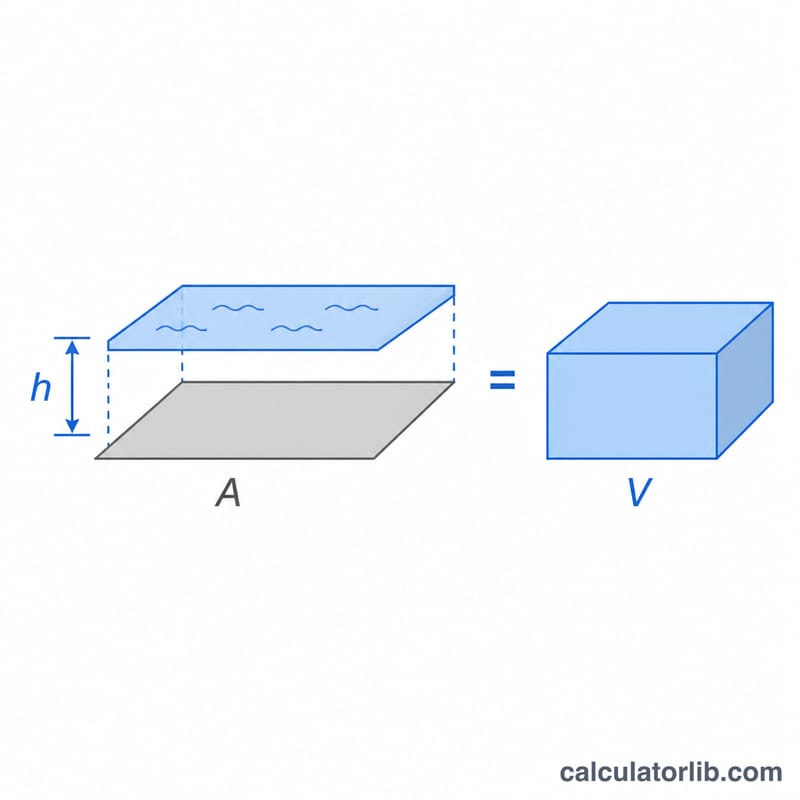
The total volume is all the rain falling on the area. Part of it splashes, evaporates or soaks in, so the water you can collect is the total × the runoff coefficient. 1 inch of rain on 1 ft² is about 0.623 US gallons.
Worked Example
Suppose 25 mm of rain falls on a roof with a footprint of 80 m².
- $$\text{Volume} = \frac{25 \times 80}{1000} = \frac{2000}{1000} = \mathbf{2 \text{ m}^3}$$
- $$\text{Litres} = 2 \times 1000 = \mathbf{2000 \text{ litres}}$$
So a single 25 mm downpour could fill a 2,000-litre tank from that roof.
Runoff Coefficients by Surface Type
The basic calculator computes the theoretical rainfall volume that falls on a catchment. In practice you never collect all of it: some water evaporates off a warm roof, some soaks into porous material, some is lost in the gutter, the downpipe and the first-flush diverter, and some overshoots the gutter in intense rain. Engineers account for this with a dimensionless runoff (or collection efficiency) coefficient \(C\), applied as a simple multiplier.
The ranges below are widely used rules of thumb for rainwater harvesting and small-site drainage design. They are not a single national standard — different design codes (for example national rainwater-harvesting guidance in Australia, India, Germany or the US) publish slightly different values, so check the code that applies where you build.
| Surface type | Typical \(C\) | Notes on losses |
|---|---|---|
| Metal / corrugated steel sheet roof | 0.90 – 0.95 | Smoothest and best-performing surface; almost no absorption. Losses are mainly first-flush diversion and gutter overshoot in heavy rain. |
| Concrete or clay tile roof | 0.80 – 0.90 | Unglazed tile absorbs water until saturated, so short showers yield less. Joints trap debris; moss growth lowers \(C\) over time. |
| Asphalt / bitumen shingle roof | 0.80 – 0.85 | Rough granular surface retains a thin film of water. Grit shedding means a first-flush diverter is strongly recommended before storage. |
| Green / vegetated roof | 0.25 – 0.50 | Substrate stores a large fraction of each event by design. Highly variable: near 0 for small showers on dry substrate, higher once saturated. |
| Concrete paving / sealed yard | 0.80 – 0.90 | Efficient but ground-level water picks up dust, oil and organic matter — treat as non-potable unless properly filtered. |
| Gravel or compacted soil | 0.40 – 0.60 | Substantial infiltration into voids; heavily dependent on how wet the surface already is and on slope. |
| Bare ground / lawn | 0.10 – 0.30 | Most rainfall infiltrates or is taken up by vegetation. Runoff rises sharply once the soil saturates or if the soil is clay-heavy. |
The adjusted collection formula is:
$$V = \frac{R \times A \times C}{1000}$$where \(R\) is rainfall depth in millimetres, \(A\) is the horizontal (plan) catchment area in square metres, \(C\) is the runoff coefficient, and \(V\) is the collected volume in cubic metres. Use the plan area — the footprint seen from above — not the sloping surface area, because rain falls vertically.
Applied example
A 25 mm rain event falls on a 100 m² metal sheet roof with \(C = 0.90\).
Theoretical volume (what the calculator returns):
$$V = \frac{25 \times 100}{1000} = 2.5\ \text{m}^3 = 2{,}500\ \text{L}$$So the raw catch is 2.5 m³. Applying the coefficient:
$$V = \frac{25 \times 100 \times 0.90}{1000} = 2.25\ \text{m}^3 = 2{,}250\ \text{L}$$Roughly 250 L is lost to first flush, wetting and spillage. A practical way to use this: size your tank from the adjusted figure, and size your gutters and overflow from the theoretical one.
Rainfall, Area and Volume Unit Conversions
Rainfall is reported in millimetres in most of the world and in inches in the United States; catchment areas come in square feet, square yards, acres or hectares. Convert everything to millimetres and square metres before using \(V = R \times A / 1000\). Factors marked exact are defined by international agreement; the rest are rounded for practical use.
Rainfall depth
| Conversion | Factor | Exact or rounded |
|---|---|---|
| 1 inch | 25.4 mm | Exact (by definition of the international inch) |
| 1 centimetre | 10 mm | Exact |
| 1 mm | 0.03937 in | Rounded (exactly 1 ÷ 25.4) |
Catchment area
| Conversion | Factor | Exact or rounded |
|---|---|---|
| 1 square foot | 0.092903 m² | Rounded (exact value 0.09290304 m²) |
| 1 square yard | 0.836127 m² | Rounded (exact value 0.83612736 m²) |
| 1 acre | 4,046.86 m² | Rounded (exact value 4,046.8564224 m²) |
| 1 hectare | 10,000 m² | Exact |
Volume
| Conversion | Factor | Exact or rounded |
|---|---|---|
| 1 cubic metre | 1,000 litres | Exact |
| 1 cubic metre | 264.172 US liquid gallons | Rounded (1 US gal = 3.785411784 L, exact) |
| 1 cubic metre | 219.969 imperial (UK) gallons | Rounded (1 imp gal = 4.54609 L, exact) |
Note that the US liquid gallon and the imperial gallon differ by about 20%, so always state which one you mean — a tank quoted as "500 gallons" holds 1,893 L in the US and 2,273 L in the UK.
Rainfall-on-area shortcuts
| Rule | Result | Exact or rounded |
|---|---|---|
| 1 mm of rain over 1 m² | 1 litre (0.001 m³) | Exact — the most useful mental shortcut |
| 1 mm of rain over 1 hectare | 10 m³ (10,000 L) | Exact |
| 1 inch of rain over 1 ft² | 0.6234 US gallons (2.3597 L) | Rounded |
| 1 inch of rain over 1,000 ft² | 623.4 US gallons | Rounded |
The 1 mm · 1 m² = 1 L identity is why the calculator divides by 1,000: millimetres times square metres gives litres directly, and dividing by 1,000 converts litres to cubic metres.
Collection Volume Across Common Scenarios
Every row below is computed directly from \(V = R \times A / 1000\), with no rounding shortcuts. The last column applies a representative runoff coefficient of \(C = 0.85\) — a reasonable middle value for a clean tiled or shingled roof — to show the difference between what falls and what you can realistically store.
| Scenario | Rainfall (mm) | Catchment area (m²) | Theoretical volume | Realistic volume at \(C = 0.85\) |
|---|---|---|---|---|
| Light shower on a garden shed roof | 5 | 50 | 0.25 m³ (250 L) | 0.2125 m³ (212.5 L) |
| Moderate rain day on a small house roof | 25 | 80 | 2 m³ (2,000 L) | 1.7 m³ (1,700 L) |
| Heavy storm on a family house roof | 50 | 150 | 7.5 m³ (7,500 L) | 6.375 m³ (6,375 L) |
| Brief rain on a warehouse roof | 10 | 1,000 | 10 m³ (10,000 L) | 8.5 m³ (8,500 L) |
| Monsoon-day downpour on a large roof | 100 | 200 | 20 m³ (20,000 L) | 17 m³ (17,000 L) |
| Rain over one hectare of field | 20 | 10,000 | 200 m³ (200,000 L) | 170 m³ (170,000 L) |
How the rows are calculated
Heavy storm on a 150 m² roof:
$$V = \frac{50 \times 150}{1000} = \frac{7500}{1000} = 7.5\ \text{m}^3$$and with the coefficient applied, \(7.5 \times 0.85 = 6.375\) m³.
One hectare of field under 20 mm of rain:
$$V = \frac{20 \times 10000}{1000} = \frac{200000}{1000} = 200\ \text{m}^3$$Reading the results
- The relationship is perfectly linear in both inputs. Doubling rainfall or doubling area doubles the volume, so you can scale any row mentally: 50 mm on 300 m² is simply twice the 150 m² row, or 15 m³.
- Area dominates over depth for large sites. A 10 mm shower on a warehouse roof yields more water than a 50 mm storm on a house roof — 10 m³ against 7.5 m³ — because the warehouse catchment is nearly seven times larger.
- Small events matter less than they look. A 5 mm shower on a shed produces about 250 L theoretical, but first-flush diversion and surface wetting can consume a large share of that, so very light events often contribute almost nothing to storage.
- Peak events size the overflow, not the tank. The 100 mm monsoon row shows 20,000 L arriving on one roof in a day. If your tank is smaller than that, gutters, downpipes and the overflow path must be able to carry the excess away safely — undersized drainage is a common cause of water damage.
- Field-scale numbers are large but diffuse. 200 m³ over a hectare only becomes usable water if there is a pond, swale or dam to capture it; on bare ground the effective coefficient is closer to 0.1–0.3, not 0.85.
Practical notes
Use the plan (footprint) area of the roof, not the sloping surface, and add any area that drains into the same gutter system. If you are sizing a storage tank, base it on typical monthly rainfall and your daily demand rather than on a single storm — a tank sized for one big event will sit empty most of the year in a dry-season climate. Rainfall figures also vary enormously by location, so use local meteorological records rather than a global average.
This is general planning information. Harvested rainwater is not automatically safe to drink: potability depends on roof material, filtration, disinfection and local regulations, and many jurisdictions restrict or license rainwater collection. Consult local authorities and a qualified professional before designing a potable or large-scale system.
Frequently Asked Questions
Does the calculator account for losses? No. It gives the theoretical maximum. In practice, evaporation, splash, first-flush diversion, and gutter overflow reduce real collection, so multiply the result by a runoff coefficient (typically 0.8–0.9 for a good roof) for a realistic figure.
What if I only know rainfall in centimetres or inches? Convert first: \(1 \text{ cm} = 10 \text{ mm}\), and \(1 \text{ inch} = 25.4 \text{ mm}\). Enter the converted millimetre value.
Should I use sloped roof area? No — use the horizontal footprint (the area seen from directly above). The slope does not increase the rain captured, since rain falls vertically.