
What Are Heart Rate Training Zones?
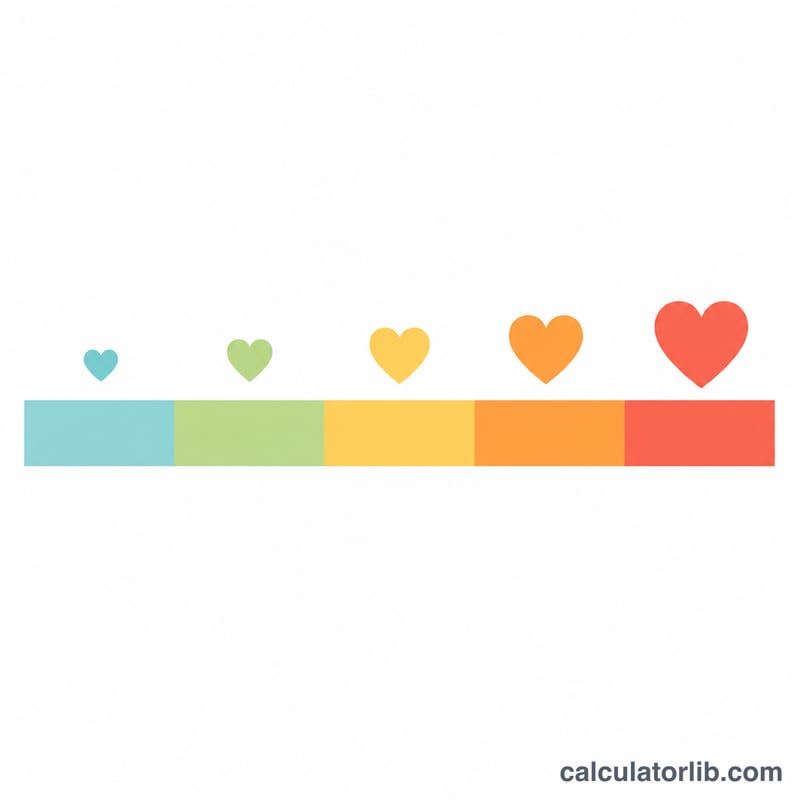
Heart rate zones divide your effort into five intensity bands, each defined as a percentage of your maximum heart rate (MHR). Training in the right zone helps you target a specific goal — recovery, fat burning, endurance, speed, or peak power — instead of guessing how hard to push. This calculator splits your MHR into the standard five zones used by most fitness coaches and sports watches.
How to Use This Calculator
Choose a method. Select Estimate from age and enter your age, and the tool estimates your maximum heart rate as 220 minus your age. If you already know your true max heart rate from a lab or field test, choose Enter max HR and type it in for more accurate zones. The calculator then shows the beats-per-minute range for each of the five zones.
The Formula Explained
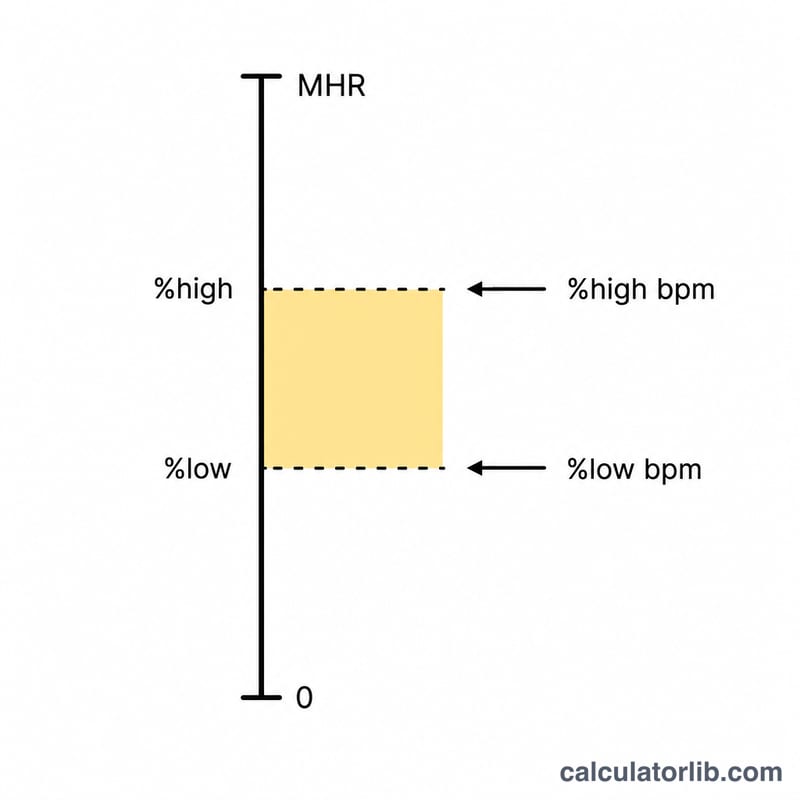
First the maximum heart rate is found: $$\text{MHR} = 220 - \text{age}$$ Each zone is then a band of that maximum: Zone 1 is 50–60%, Zone 2 is 60–70%, Zone 3 is 70–80%, Zone 4 is 80–90% and Zone 5 is 90–100%. A zone boundary is simply $$\text{Zone} = \text{MHR} \times \%$$
Worked Example
For a 30-year-old: $$\text{MHR} = 220 - 30 = 190 \text{ bpm}$$ Zone 2 (light / fat burn) runs from \(190 \times 0.60 = 114\) bpm up to \(190 \times 0.70 = 133\) bpm. Zone 4 (hard) runs from \(190 \times 0.80 = 152\) bpm to \(190 \times 0.90 = 171\) bpm.
FAQ
Which zone burns the most fat? Zones 2–3 use a higher proportion of fat for fuel, which is why they are popular for steady endurance work, though total calorie burn rises with intensity.
Is 220 − age accurate? It is a useful average but can be off by 10–20 bpm for any individual. A measured max heart rate gives the most reliable zones.
How often should I train in Zone 4 or 5? High-intensity zones are demanding; most plans keep the bulk of training in Zones 2–3 and use Zones 4–5 sparingly for intervals.