What Is the Rounds Per Minute Calculator?
This calculator converts a measured burst — a number of rounds fired over an elapsed time — into a standardized rounds per minute (RPM) rate of fire. RPM is the universal way to compare the cyclic or sustained cadence of firearms, airsoft and paintball markers, nail guns, and any cyclic mechanical system, regardless of how long the test interval actually lasted.
How to Use It
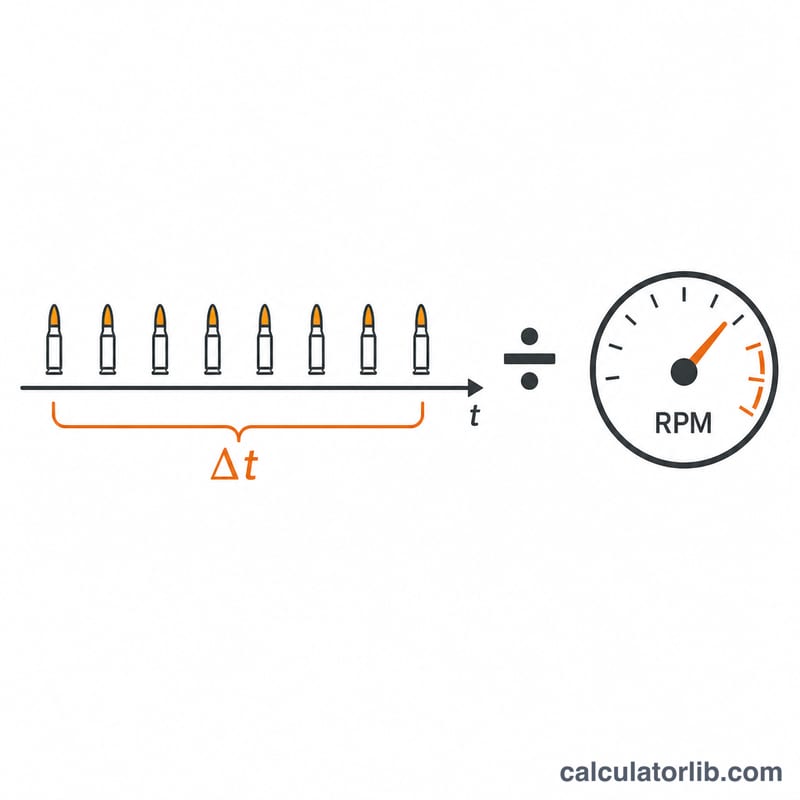
Enter the total number of rounds (or cycles) fired, then enter the time it took in seconds. The tool divides rounds by seconds to get rounds per second, then multiplies by 60 to express the cadence over a full minute. It also reports the rounds-per-second figure for short bursts.
The Formula Explained
The math is a simple rate conversion:
$$\text{RPM} = \frac{\text{Rounds Fired}}{\text{Time (s)}} \times 60$$
Because there are 60 seconds in a minute, multiplying the per-second rate by 60 projects the observed cadence onto a one-minute window. You do not have to fire for a full minute — a 5-second burst is enough to estimate the rate.
Worked Example
Suppose a system fires 30 rounds in 5 seconds. Rounds per second = \(30 \div 5 = 6\). Rounds per minute = \(6 \times 60 = 360\) 360 RPM. So that burst corresponds to a 360 rounds-per-minute cadence.
Typical Rates of Fire by Weapon and Tool Type
The figures below are approximate, widely published values. They vary by model, ammunition, condition and configuration, so treat them as ranges rather than specifications. "Cyclic" means the mechanical rate while the trigger is held down, ignoring reloads and pauses. "Practical" means the rate a shooter can realistically achieve.
| Category / Example | Approx. RPM | Type of rate |
|---|---|---|
| Bolt-action rifles | about 10-15 | Practical |
| Semi-automatic pistols and rifles | about 40-120 | Practical semi-auto fire |
| AK-47 | about 600 | Cyclic |
| M16 / M4 | about 700-950 | Cyclic |
| M60 general-purpose machine gun | about 500-650 | Cyclic |
| MG42 general-purpose machine gun | about 1,200 | Cyclic |
| M134 minigun | up to about 6,000 | Cyclic |
| Airsoft AEGs (automatic electric guns) | about 600-1,200 | Depends on setup |
| Paintball markers | about 600-900 (about 10-15 balls per second) | Depends on marker and mode |
Values differ between variants, barrel lengths, gas settings, batteries and firing modes. Use your own measured count and time in the calculator for an observed figure.
RPM to Rounds Per Second Conversion Table
Rounds per second is \(\text{RPM} / 60\), and the time between rounds in milliseconds is \(60000 / \text{RPM}\).
| RPM | Rounds per second | Time between rounds (ms) |
|---|---|---|
| 60 | 1 | 1,000 |
| 120 | 2 | 500 |
| 300 | 5 | 200 |
| 600 | 10 | 100 |
| 750 | 12.5 | 80 |
| 900 | 15 | about 66.7 |
| 1,200 | 20 | 50 |
| 3,000 | 50 | 20 |
| 6,000 | 100 | 10 |
Interpreting Your RPM Result
The calculator uses \(\text{RPM} = \frac{ \text{rounds} }{ \text{seconds} } \times 60\). For example, 30 rounds in 3 s gives \(\frac{30}{3} \times 60 = \)600 RPM.
Timing error
Short bursts give rough estimates because any timing error is a large fraction of the total. A 0.2 s error on a 2 s burst is 10% of the time, which changes the RPM by roughly 10%. For 10 rounds, 2.0 s gives 300 RPM, 2.2 s gives about 272.7 RPM, and 1.8 s gives about 333.3 RPM.
Number of rounds
Fewer rounds give a less reliable result, since one slow or fast shot shifts the average noticeably. More rounds over a longer period average out these variations.
Rounds versus intervals
When timing from the first shot to the last shot, the clock covers intervals, which number one less than the rounds fired. For 10 rounds timed over 2 s, use 9: \(\frac{9}{2} \times 60 = \)270 RPM, rather than 300 RPM. If the timer starts before the first shot and stops after the last, use the full count of rounds.
Types of rate
- Cyclic rate: the mechanical rate of fire during continuous automatic fire, ignoring reloads and pauses.
- Sustained rate: the average rate over a longer period, including pauses, magazine or belt changes and cooling.
- Effective or practical rate: the rate at which aimed fire can actually be delivered, usually well below cyclic.
A measured RPM is an observed cadence for that specific run, not a manufacturer specification. It can differ from published figures depending on the rounds counted, the timing method and the equipment condition.
FAQ
Does the interval need to be a full minute? No. Any time interval works because the formula scales the rate to one minute mathematically.
What is the difference between cyclic and sustained rate? Cyclic rate is the theoretical maximum measured over a very short burst, while sustained rate accounts for reloading and cooling. This calculator returns whatever rate your measured interval implies.
Can I use this for non-firearms? Yes — it works for any repeating event count over time, such as machine cycles or shots from a tool.