What Is the Seconds to HH:MM:SS Calculator?
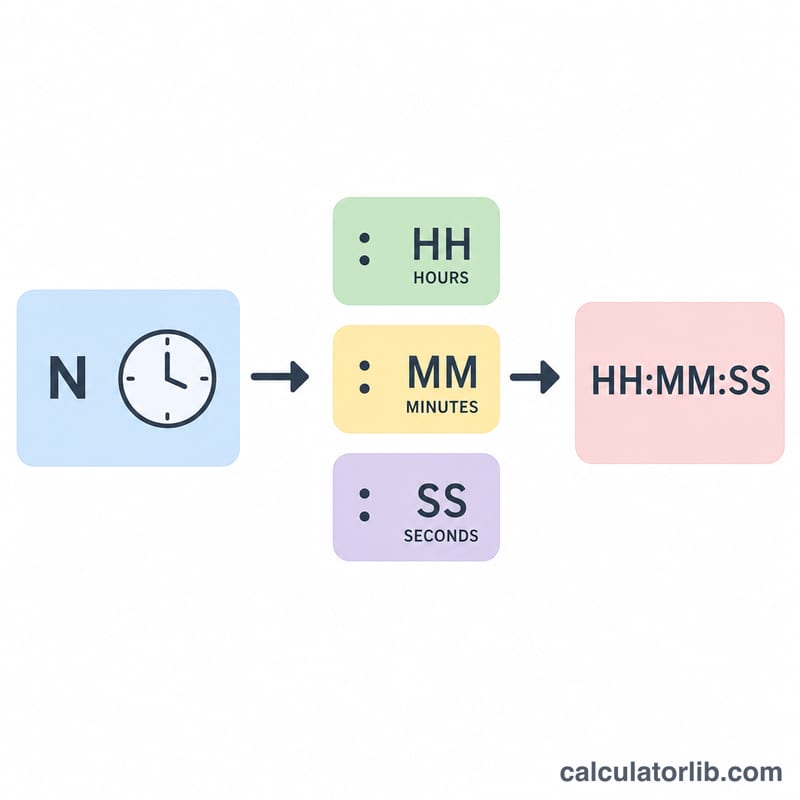
This tool converts a raw count of seconds into a familiar clock-style time format: hours, minutes, and seconds (HH:MM:SS). It is useful for programmers parsing durations, video editors working with timecodes, athletes converting split times, and anyone who has a stopwatch value in seconds and wants a readable duration.
How to Use It
Enter the total number of seconds you want to convert and the calculator instantly returns the equivalent time. The headline shows the zero-padded HH:MM:SS string, while the breakdown table lists the individual hours, minutes, and seconds components.
The Formula Explained
There are 3600 seconds in an hour and 60 seconds in a minute. The number of whole hours is the total seconds divided by 3600 (rounded down). The remaining seconds after removing full hours are found with the modulo operator (\(s \bmod 3600\)); dividing that remainder by 60 gives the minutes, and \(s \bmod 60\) gives the leftover seconds.
$$\begin{gathered} \text{HH:MM:SS} \\[1.5em] \text{where}\quad \left\{ \begin{aligned} \text{HH} &= \left\lfloor \dfrac{\text{Total Seconds}}{3600} \right\rfloor \\ \text{MM} &= \left\lfloor \dfrac{\text{Total Seconds} \bmod 3600}{60} \right\rfloor \\ \text{SS} &= \text{Total Seconds} \bmod 60 \end{aligned} \right. \end{gathered}$$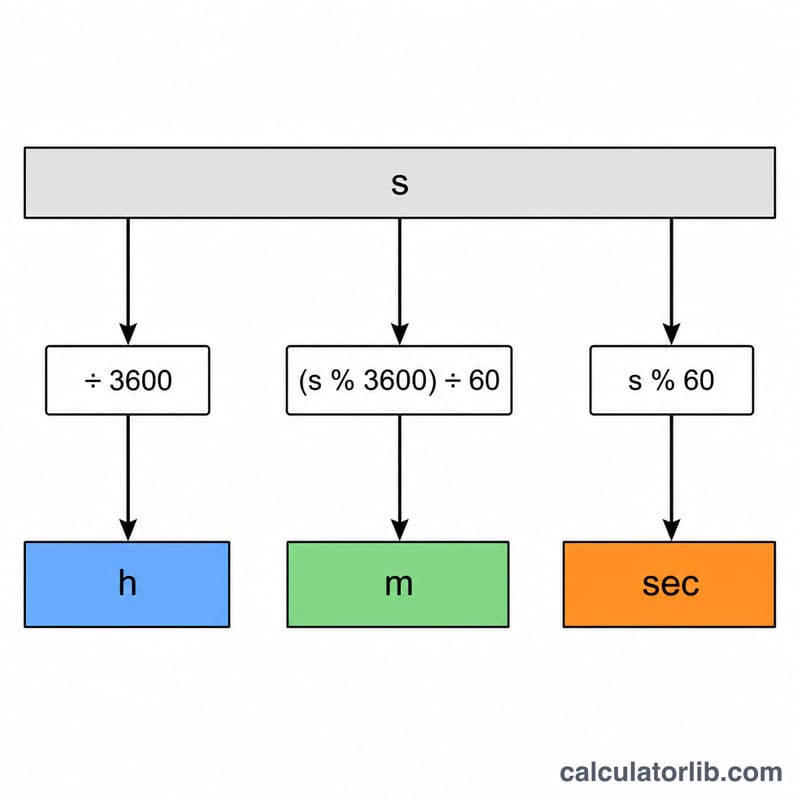
Worked Example
Take 3661 seconds. Hours = \(\left\lfloor 3661 / 3600 \right\rfloor = 1\). The remainder is \(3661 - 3600 = 61\) seconds. Minutes = \(\left\lfloor 61 / 60 \right\rfloor = 1\). Seconds = \(61 \bmod 60 = 1\). So 3661 seconds equals 01:01:01.
Common Seconds to HH:MM:SS Conversions
The table below lists exact conversions for common durations. Hours are not capped at 24, so a full day shows as 24:00:00 and a full week as 168:00:00. The calculator works the same way. Each value comes from \(\text{HH} = \lfloor s / 3600 \rfloor\), \(\text{MM} = \lfloor (s \bmod 3600) / 60 \rfloor\) and \(\text{SS} = s \bmod 60\).
| Total seconds | HH:MM:SS | Plain-language duration |
|---|---|---|
| 1 | 00:00:01 | 1 second |
| 30 | 00:00:30 | Half a minute |
| 60 | 00:01:00 | 1 minute |
| 90 | 00:01:30 | 1 minute 30 seconds |
| 300 | 00:05:00 | 5 minutes |
| 600 | 00:10:00 | 10 minutes |
| 900 | 00:15:00 | Quarter of an hour |
| 1800 | 00:30:00 | Half an hour |
| 3600 | 01:00:00 | 1 hour |
| 5400 | 01:30:00 | 1 hour 30 minutes |
| 7200 | 02:00:00 | 2 hours |
| 10800 | 03:00:00 | 3 hours |
| 43200 | 12:00:00 | Half a day |
| 86400 | 24:00:00 | 1 day |
| 604800 | 168:00:00 | 1 week (7 × 24 hours) |
Useful reference points: 1 minute is 60 seconds, 1 hour is 3,600 seconds, 1 day is 86,400 seconds and 1 week is 604,800 seconds.
More Worked Examples
Each example below uses floor division (\(\lfloor \cdot \rfloor\), which drops the fractional part) and the modulo operation (mod, the remainder). Each part of the result is padded with a leading zero to two digits where needed.
Example 1: 7,325 seconds
- Hours: $$\text{HH} = \left\lfloor \frac{7325}{3600} \right\rfloor = \lfloor 2.0347\ldots \rfloor = 2$$
- Remaining seconds: $$7325 \bmod 3600 = 7325 - 2 \times 3600 = 7325 - 7200 = 125$$
- Minutes: $$\text{MM} = \left\lfloor \frac{125}{60} \right\rfloor = \lfloor 2.0833\ldots \rfloor = 2$$
- Seconds: $$\text{SS} = 125 \bmod 60 = 125 - 2 \times 60 = 5$$
- Zero-pad and combine: 2 → 02, 2 → 02, 5 → 05.
Result: 7,325 seconds = 02:02:05 (2 hours, 2 minutes, 5 seconds).
Check: \(2 \times 3600 + 2 \times 60 + 5 = 7200 + 120 + 5 = 7325\).
Example 2: 90,061 seconds (more than 24 hours)
- Hours: $$\text{HH} = \left\lfloor \frac{90061}{3600} \right\rfloor = \lfloor 25.0169\ldots \rfloor = 25$$
- Remaining seconds: $$90061 \bmod 3600 = 90061 - 25 \times 3600 = 90061 - 90000 = 61$$
- Minutes: $$\text{MM} = \left\lfloor \frac{61}{60} \right\rfloor = \lfloor 1.0166\ldots \rfloor = 1$$
- Seconds: $$\text{SS} = 61 \bmod 60 = 61 - 60 = 1$$
- Zero-pad and combine: 25 stays 25, 1 → 01, 1 → 01.
Result: 90,061 seconds = 25:01:01 (25 hours, 1 minute, 1 second).
Check: \(25 \times 3600 + 1 \times 60 + 1 = 90000 + 60 + 1 = 90061\).
This example shows that the hours field keeps counting past 24 instead of wrapping back to 00. HH:MM:SS here is a duration, not a time of day. To show it as days, divide the hours by 24: 25 hours is 1 day and 1 hour, or 1 day 01:01:01.
FAQ
What if I enter more than 24 hours of seconds? The hours field is not capped at 24 — 100000 seconds returns 27:46:40, showing the true elapsed hours rather than wrapping around a clock.
Can I enter decimal seconds? The calculator works in whole seconds; any fractional part is dropped before conversion.
What happens with negative numbers? Negative inputs are treated as zero, since a duration cannot be negative.