What Is the Sober Up Time Calculator?
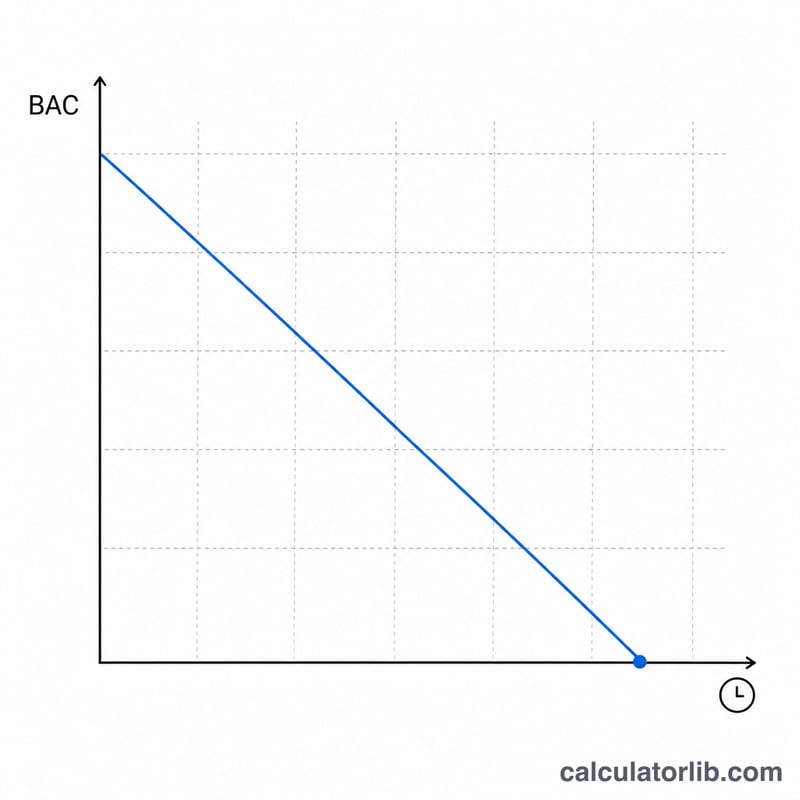
This tool estimates how long it will take for your blood alcohol concentration (BAC) to fall back to zero. The human body eliminates alcohol at a roughly constant rate, commonly cited as about 0.015% BAC per hour, regardless of coffee, cold showers, or sleep. By dividing your current BAC by that elimination rate, you get an approximate number of hours until you are fully sober.
How to Use It
Enter your current BAC as a percentage (for example, the common legal driving limit of 0.08). Then enter the metabolism rate — the default of 0.015 reflects the average adult. The calculator returns the total hours, broken down into whole hours and minutes.
The Formula Explained
The equation is simply $$\text{Hours} = \frac{\text{BAC (\%)}}{\text{Rate (\%/hr)}}$$ Because alcohol elimination follows roughly zero-order kinetics (a fixed amount removed per unit time rather than a percentage), the relationship is linear. A higher starting BAC means a proportionally longer wait.
Worked Example
Suppose your BAC is 0.08% and your body clears 0.015% per hour. Then $$0.08 \div 0.015 = 5.33 \text{ hours},$$ which is 5 hours and 20 minutes until your BAC reaches zero.
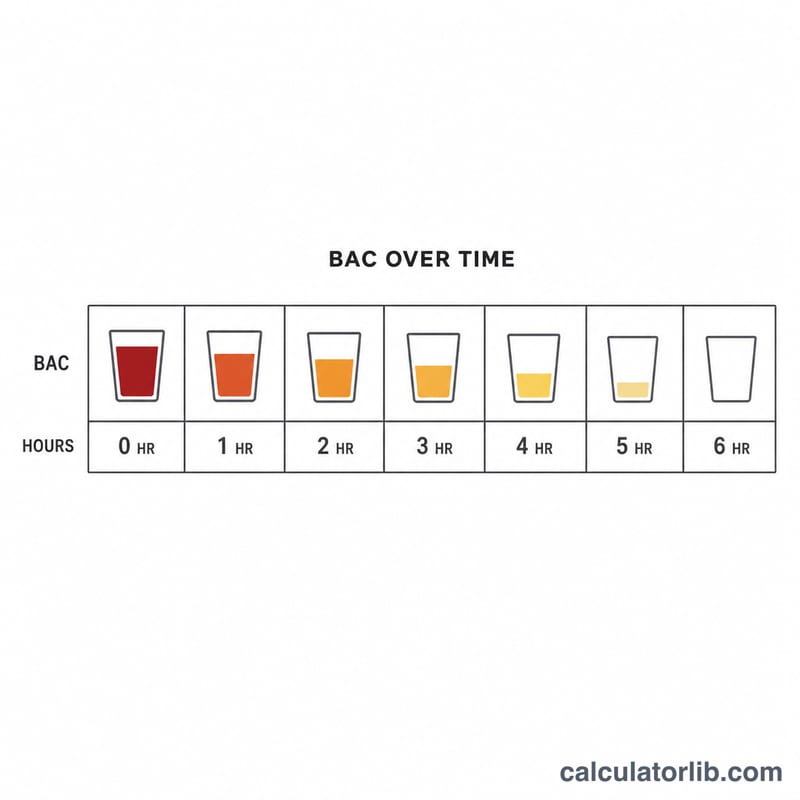
Sober-Up Time at Different BAC Levels and Elimination Rates
The calculator uses \(\text{Hours} = \frac{\text{BAC}}{\text{rate}}\), where BAC is in % and the rate is in % per hour. The table compares a slow rate (0.010 %/h), the commonly cited average (0.015 %/h) and a fast rate (0.020 %/h). Times are the hours needed to reach 0.00 from the starting BAC, assuming no more alcohol is absorbed.
| Starting BAC (%) | Slow: 0.010 %/h | Average: 0.015 %/h | Fast: 0.020 %/h |
|---|---|---|---|
| 0.02 | 2.0 h (2 h 0 min) | 1.33 h (1 h 20 min) | 1.0 h (1 h 0 min) |
| 0.05 | 5.0 h (5 h 0 min) | 3.33 h (3 h 20 min) | 2.5 h (2 h 30 min) |
| 0.08 | 8.0 h (8 h 0 min) | 5.33 h (5 h 20 min) | 4.0 h (4 h 0 min) |
| 0.10 | 10.0 h (10 h 0 min) | 6.67 h (6 h 40 min) | 5.0 h (5 h 0 min) |
| 0.15 | 15.0 h (15 h 0 min) | 10.0 h (10 h 0 min) | 7.5 h (7 h 30 min) |
| 0.20 | 20.0 h (20 h 0 min) | 13.33 h (13 h 20 min) | 10.0 h (10 h 0 min) |
| 0.30 | 30.0 h (30 h 0 min) | 20.0 h (20 h 0 min) | 15.0 h (15 h 0 min) |
Worked example: a BAC of 0.08 % at the average rate of 0.015 %/h gives \(\frac{0.08}{0.015} = \) 5.33 hours, which is about 5 hours 20 minutes (0.33 × 60 ≈ 20 min).
Interpreting Your BAC and Result
BAC is the percentage of alcohol in the blood. The effects below are general, documented patterns; individual responses differ.
- 0.02–0.03 %: mild effects such as relaxation, slight mood change and somewhat reduced attention on divided tasks.
- 0.05 %: reduced alertness and inhibition, impaired judgment and lower coordination. This is the legal driving limit in many countries (for example much of Europe and Australia). Utah, in the US, also uses 0.05 %.
- 0.08 %: the legal per se driving limit in most of the US and in several other countries, such as England and Wales. Impairment of balance, reaction time, speech and self-control is clear at this level.
- 0.10–0.20 %: markedly impaired motor control and judgment, slurred speech, and increasing risk of nausea and memory gaps.
- 0.30 % and above: confusion, stupor and a risk of loss of consciousness and life-threatening impairment of breathing. Levels around 0.40 % and higher can be fatal.
Legal limits vary by jurisdiction. They are often lower for commercial drivers (for example 0.04 % for US commercial drivers) and for drivers under 21, where many places apply zero or near-zero tolerance. Some countries set limits as low as 0.02 % or 0.00 %. Check the rules that apply where you are.
The result is an estimate for educational purposes only. The 0.015 %/h figure is an average. Actual elimination depends on body composition, sex, genetics, liver health, medications and habitual drinking. Food eaten before or while drinking mainly affects how quickly alcohol is absorbed, not how fast it is cleared. BAC can also keep rising for a while after the last drink, typically 30 to 90 minutes, so the starting value may understate the peak. Coffee, cold showers or exercise do not speed up elimination.
This tool cannot tell you whether it is safe or legal to drive or perform any other task. It is general information, not medical or legal advice. If someone may have alcohol poisoning (unconsciousness, vomiting while drowsy, slow or irregular breathing), seek emergency medical help.
FAQ
Can I speed up the process? No. Only time reliably lowers BAC; the liver metabolizes alcohol at a fairly fixed pace.
Is the 0.015 rate exact for everyone? No. Actual rates vary roughly between 0.010 and 0.020 per hour depending on body composition, sex, food intake, and liver health.
Is this safe to use for deciding to drive? No. This is an educational estimate only. Never rely on it to determine fitness to drive — when in doubt, do not drive.