
What this calculator does
This tool solves a quadratic equation of the form ax² + bx + c = 0 by the factoring (AC) method and reports the real roots. Factoring rewrites the trinomial as a product of two binomials so the equation can be solved by setting each factor to zero. When clean factors do not exist, the underlying quadratic formula still returns the exact roots.
How to use it
Enter the three coefficients: a (the x² term), b (the x term) and c (the constant). Press calculate. The result shows the two roots, the discriminant \(b^{2} - 4ac\), and whether the equation has two real roots, one repeated root, or complex roots.
The factoring formula explained
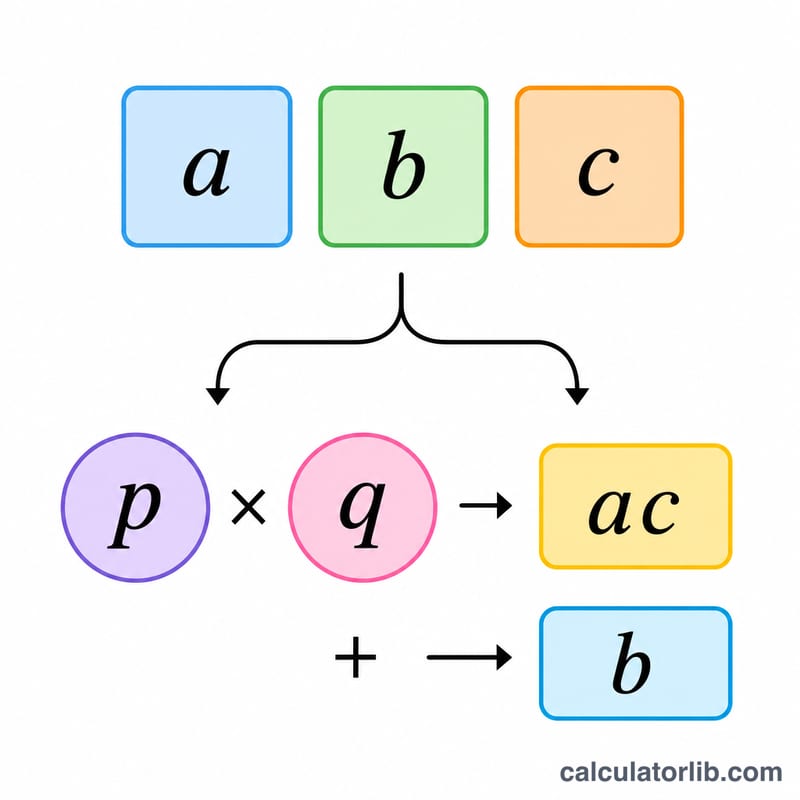
The AC method looks for two numbers p and q such that \(p \cdot q = a \cdot c\) and \(p + q = b\). The middle term bx is then split into px + qx, allowing the four terms to be grouped and factored. The roots produced this way are identical to those from the quadratic formula $$x = \frac{-b \pm \sqrt{b^{2} - 4ac}}{2a}$$ which this calculator uses internally so it works even when no integer factors exist.
Worked example
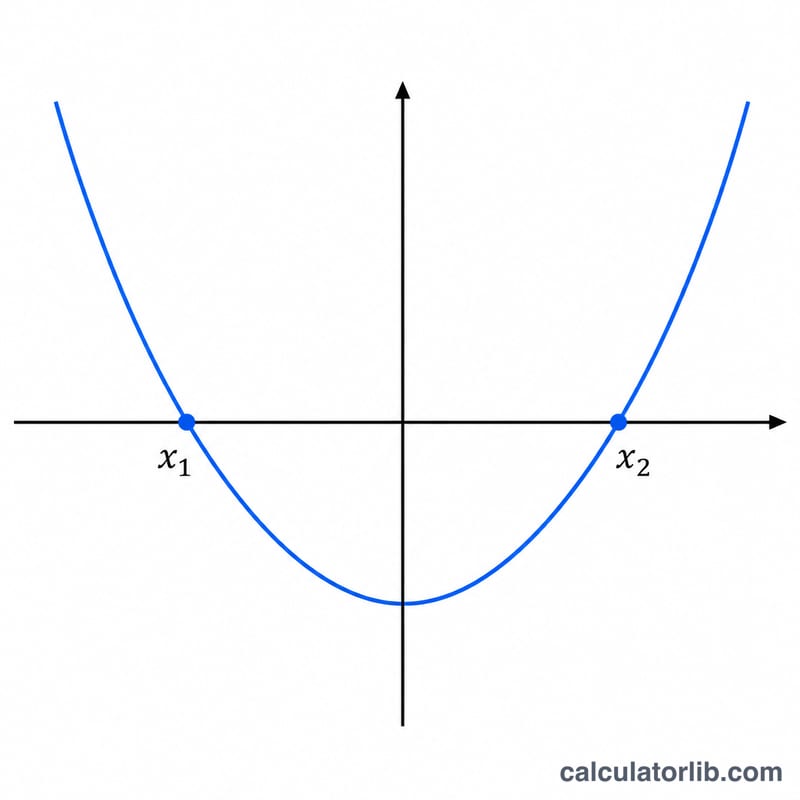
Solve \(x^{2} + 5x + 6 = 0\). Here a=1, b=5, c=6, so \(a \cdot c = 6\). We need \(p \cdot q = 6\) and \(p + q = 5 \rightarrow p = 2, q = 3\). The factors are \((x + 2)(x + 3) = 0\), giving roots \(x = -2\) and \(x = -3\). The discriminant is $$5^{2} - 4(1)(6) = 25 - 24 = 1 > 0$$ confirming two distinct real roots.
FAQ
What if a = 0? The equation is no longer quadratic; it becomes linear \(bx + c = 0\) with the single solution \(x = -c/b\).
What does a negative discriminant mean? When \(b^{2} - 4ac < 0\) the quadratic has no real roots — its solutions are complex conjugates, so this calculator reports no real roots.
Why are my roots decimals? Not every quadratic factors over the integers. The calculator returns exact real values from the quadratic formula, which may be irrational decimals.