
What this calculator does
This tool estimates statutory severance (indemnización) under Spain's Estatuto de los Trabajadores (RDL 2/2015, consolidated text). The main mode is unfair dismissal (despido improcedente, art. 56.1): 33 days of salary per year of service, pro-rated by months and capped at 24 monthly salaries. Contracts signed before 12/02/2012 follow the transitional rule of DT 11ª. Two further modes cover terminations under art. 40.4 and art. 41.3. A custom mode lets you enter your own rate and cap. The result is an estimate, not legal advice.
How to use it
Choose the type of termination. Enter the contract start date (seniority) and the last working day in YYYY-MM-DD format, then the gross annual salary in euros, including extra payments, supplements and pay in kind. Select the daily salary basis (annual/365 or annual/360) and how incomplete months are counted. The custom days per year and custom cap fields apply only to the Custom rate regime. Objective dismissal and end of temporary contract are not built in: their rates are not verified here, so use Custom rate and enter the rate that applies to you.
Formula
Daily and monthly salary are estimated from the annual salary \(A\):
$$S_d = \frac{A}{365}\ \text{(or } \frac{A}{360}\text{)}, \qquad S_m = \frac{A}{12}$$Days earned:
$$D = \frac{45 \times M_{pre}}{12} + \frac{r \times M_{post}}{12}$$Standard cap:
$$I = \min(D \times S_d,\ C \times S_m)$$Transitional cap (DT 11ª):
$$I = \min\left(\min\left(D,\ \max\left(720,\ \tfrac{45 M_{pre}}{12}\right)\right) \times S_d,\ 42 \times S_m\right)$$Here \(M_{pre}\) = months of service before 12/02/2012 (non-zero only under the transitional rule), \(M_{post}\) = months at the main rate, \(r\) = main rate in days per year (33, 20 or custom), and \(C\) = cap in monthly salaries (24, 12, 9 or custom).
Conventions and assumptions
- Rate: 33 days per year for contracts signed on or after 12/02/2012 and for service after that date in older contracts (art. 56.1).
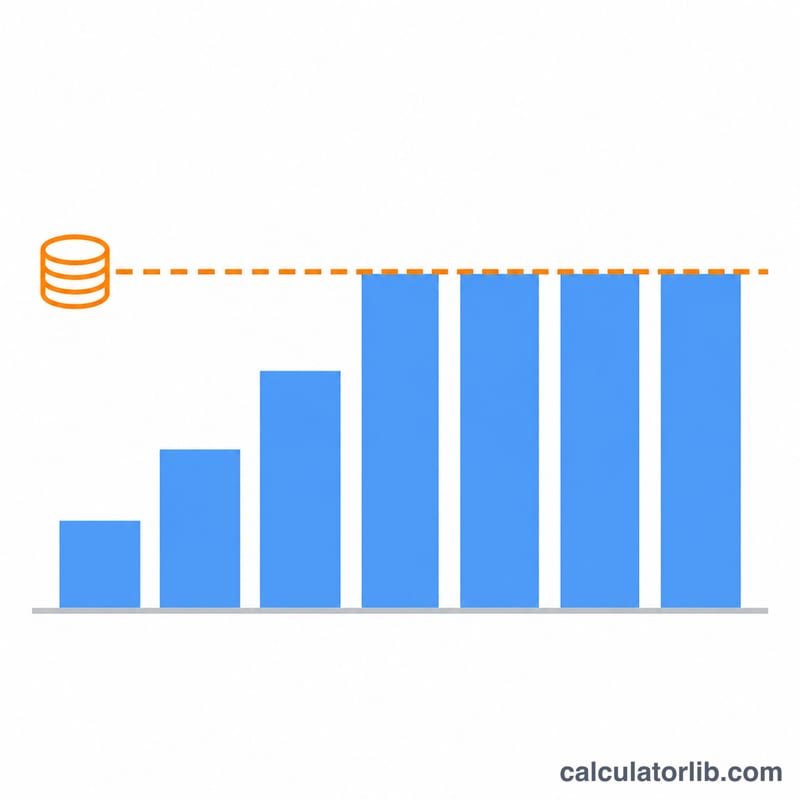
- Cap: 24 monthly salaries, with one monthly salary estimated as annual salary / 12. The cap in euros is an estimate, not a statutory figure.
- Pro-rata: service is counted in months; days earned = rate × months / 12.
- Incomplete months: by default a started month counts as a full month; the alternative counts complete months only. The law does not specify this, so both are offered. Under the transitional rule it is applied to each segment separately.
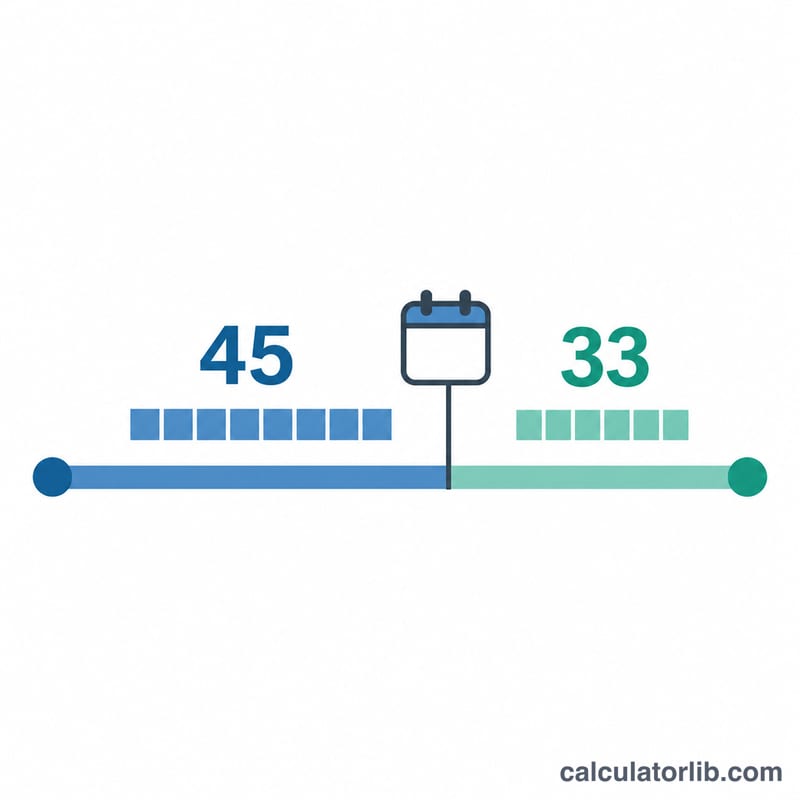
- Transitional rule: applies only to unfair dismissal when the start date is before 12/02/2012. Service up to 11/02/2012 earns 45 days per year, later service 33 days per year.
- Transitional caps: 720 days, or the pre-2012 days if these alone are higher, and never more than 42 monthly salaries.
- Daily salary: annual / 365 by default or annual / 360. Courts may compute the regulatory salary differently, so all amounts are estimates.
- Salary: full gross annual pay, including extra payments and pay in kind (art. 26.1).
- The last working day counts as worked.
- Art. 40.4 uses 20 days per year capped at 12 monthly salaries; art. 41.3 uses 20 days per year capped at 9. The transitional rule does not apply to them.
- Custom mode: the rate and cap are supplied by you and are not verified by this tool.
- Resignation over a serious employer breach gives the unfair-dismissal severance, so choose the unfair dismissal regime.
- No intermediate rounding; values are shown to 2 decimals.
Worked example
Unfair dismissal, start 2008-03-01, last day 2026-10-31, gross annual salary 30,000 EUR, divisor 365, started months rounded up. The transitional rule applies. Daily salary and monthly salary:
$$S_d = \frac{30000}{365} = 82.19\,\text{EUR}, \qquad S_m = \frac{30000}{12} = 2500\,\text{EUR}$$Months: 48 before 12/02/2012 and 177 after, 225 in total (18.75 years). Days earned:
$$D = \frac{45 \times 48}{12} + \frac{33 \times 177}{12} = 180 + 486.75 = 666.75\,\text{days}$$The total is below the 720-day cap, so no cap applies:
$$I = 666.75 \times 82.19 = 54{,}801.37\,\text{EUR}$$The estimated cap is 59,178.08 EUR, and 666.75 days are paid.
Reading the result
The main figure is the estimated severance after caps. Compare it with the amount before caps and the cap applied (none, 24, 12, 9 or custom months, 720 days, pre-2012 days, or 42 months). Pre-2012 rows appear only when the transitional rule applies. The daily salary basis is a convention, and the cap amount in euros is an estimate. Variable pay, court-determined salary, collective agreements, tax treatment and wages pending a ruling are not modelled. Check the figure with a labour lawyer or the competent body before relying on it.
FAQ
What is the unfair dismissal rate?
33 days of salary per year of service, pro-rated by months, up to 24 monthly salaries, for service from 12/02/2012.
Why does the pre-2012 part earn 45 days?
DT 11ª sets 45 days per year for service before 12/02/2012 on earlier contracts, with 720-day and 42-month limits.
Does it cover objective dismissal or temporary contracts?
Not directly. Their rates are not verified here, so use Custom rate and enter the days per year and cap that apply.
Should I use 365 or 360?
Both are estimates. 365 is the default; 360 equals monthly salary / 30. The result may differ from a court calculation.
How are incomplete months handled?
By default a started month counts as a full month. Choose complete months only for a stricter count.
Sources
- Real Decreto Legislativo 2/2015, Estatuto de los Trabajadores (arts. 26.1, 40.4, 41.3, 56.1, DT 11ª) – Agencia Estatal Boletín Oficial del Estado, consolidated text