What the Square Pyramid Volume Calculator Does
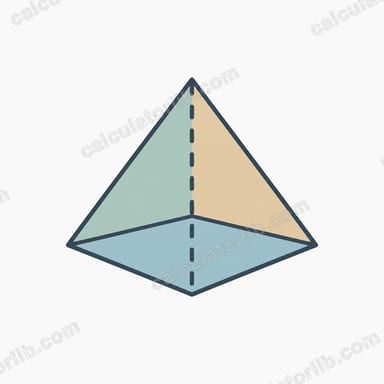
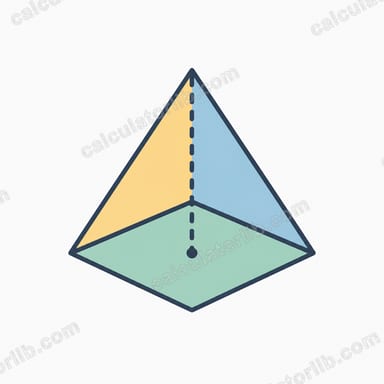
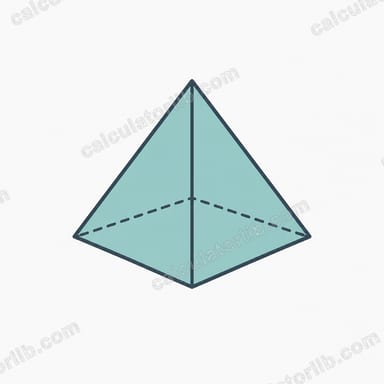
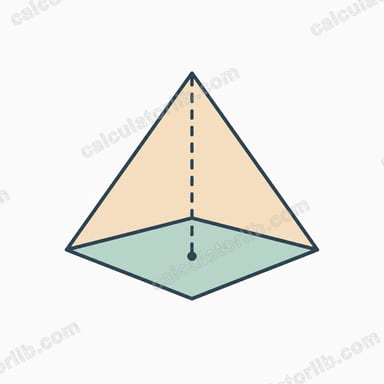
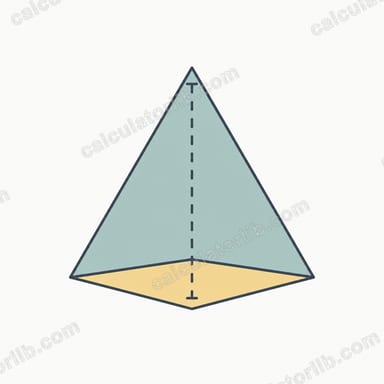
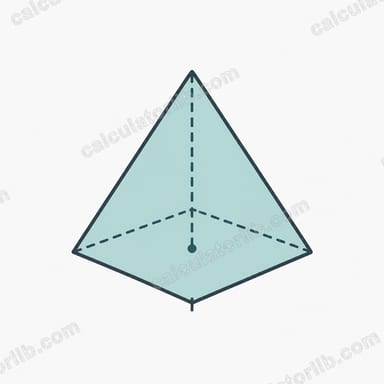
This calculator finds the volume of a square pyramid — a solid with a square base and four triangular faces that meet at a single apex. You only need to enter two measurements: the Base Edge (a), which is the length of one side of the square base, and the Height (h), the perpendicular distance from the centre of the base straight up to the apex. The tool instantly returns the volume, and behind the scenes it also computes the base area, slant height and total surface area for context.
The Formula Explained
The volume is calculated using the standard geometry formula:
$$V = \frac{1}{3} \cdot \text{Base Edge (a)}^{2} \cdot \text{Height (h)}$$
Here a² is the area of the square base, and multiplying by the height and one-third gives the volume. A pyramid always holds exactly one-third the volume of a prism (box) with the same base and height — that is why the 1/3 factor appears.
The calculator also derives some useful extras from your two inputs:
- Base area = \(a^2\)
- Slant height = \(\sqrt{h^2 + (a/2)^2}\) — the distance from the apex down the middle of a triangular face
- Surface area = \(a^2 + 2 \times a \times \sqrt{(a/2)^2 + h^2}\) — the base plus the four triangular sides

Worked Example
Suppose your pyramid has a base edge of 6 units and a height of 9 units.
- $$\text{Volume} = \frac{1}{3} \times 6^2 \times 9 = \frac{1}{3} \times 36 \times 9 = 108 \text{ cubic units}$$
- Base area = \(6^2 = 36\) square units
- Slant height = \(\sqrt{9^2 + 3^2} = \sqrt{90} \approx 9.49\) units
- Surface area = \(36 + 2 \times 6 \times 9.49 \approx 149.9\) square units
Just match the units you enter (cm, m, inches) and the volume comes out in the cubed version of that unit.
How to Calculate Square Pyramid Volume Step by Step
A square pyramid has a square base and four triangular faces meeting at a single apex. Its volume is exactly one third of the volume of a prism (box) with the same base and the same height:
$$V = \frac{1}{3} \, a^2 h$$
where \(a\) is the length of one base edge and \(h\) is the perpendicular height. Work through the steps in order:
- Measure one base edge \(a\). In a square pyramid all four base edges are equal, so a single measurement is enough — but measure a second edge as a sanity check. If the four edges differ, the base is not square and this formula does not apply.
- Measure the perpendicular height \(h\). This is the vertical distance from the centre of the base straight up to the apex — not the slant height along a face and not the length of a lateral edge. Using slant height here is the single most common error and always overstates the volume.
- Put both measurements in the same unit. Convert first if one is in centimetres and the other in metres (100 cm = 1 m), or inches and feet (12 in = 1 ft). Mixing units silently scales the answer by a factor of 100, 1,000 or more.
- Square the base edge to get the base area: \(A = a^2\).
- Multiply the base area by the height to get \(a^2 h\) — the volume of the surrounding prism.
- Divide by 3 to get the volume \(V\). Multiplying by 0.3333 is a usable shortcut, but it is only an approximation of \(1/3\) and introduces a small error (about 0.01%); dividing by 3 is exact.
- Label the answer in cubic units of the input. Metres in gives cubic metres (m³), centimetres give cm³, inches give in³. The unit is never optional — a bare "108" means nothing.
Worked example
A pyramid has a base edge \(a = 6\) m and a perpendicular height \(h = 9\) m.
$$V = \frac{1}{3} \times (6\ \text{m})^2 \times 9\ \text{m} = \frac{1}{3} \times 36\ \text{m}^2 \times 9\ \text{m} = \frac{324}{3} = 108\ \text{m}^3$$
The volume is 108 m³.
If you only know the slant height
The slant height \(l\) is measured along the middle of a triangular face, from the apex down to the midpoint of a base edge. It forms a right triangle with the perpendicular height and half the base edge, so:
$$h = \sqrt{l^2 - \left(\frac{a}{2}\right)^2}$$
For example, with \(a = 6\) m and \(l = 9\) m: \(h = \sqrt{81 - 9} = \sqrt{72} \approx 8.485\) m, giving \(V = \frac{1}{3} \times 36 \times 8.485 \approx 101.8\) m³ — noticeably less than the 108 m³ you would get by wrongly treating \(l\) as \(h\). Note that \(l\) must always be greater than \(a/2\), otherwise the shape cannot close.
If instead you know the lateral edge \(e\) (apex to a base corner), use the half-diagonal \(a\sqrt{2}/2\): \(h = \sqrt{e^2 - a^2/2}\).
Volume Across Common Square Pyramid Sizes
The table below applies \(V = a^2 h / 3\) to a range of sizes, from a small model to the Great Pyramid of Giza. Each row keeps the base edge and height in the same unit, so the volume carries that unit cubed.
| Base edge (a) | Height (h) | Base area (a²) | Volume (a²h / 3) |
|---|---|---|---|
| 2 m | 3 m | 4 m² | 4.00 m³ |
| 4 m | 3 m | 16 m² | 16.00 m³ (double edge → 4× volume) |
| 2 m | 6 m | 4 m² | 8.00 m³ (double height → 2× volume) |
| 10 cm | 12 cm | 100 cm² | 400 cm³ |
| 5 in | 5 in | 25 in² | 41.67 in³ |
| 230.4 m (Great Pyramid of Giza) | 146.6 m (original height) | 53,084 m² | ≈ 2,594,000 m³ |
Check the Giza row by hand: \(230.4^2 = 53{,}084.16\ \text{m}^2\), times 146.6 m gives 7,782,138 m³, divided by 3 gives about 2,594,046 m³. The dimensions of the Great Pyramid are the commonly cited original values (the present-day height is lower, roughly 138.5 m, because the outer casing stones and capstone are gone), so treat the figure as a well-rounded estimate rather than an exact measurement.
How the volume scales: volume grows with the square of the base edge but only linearly with the height. Doubling the base edge multiplies the volume by four; doubling the height merely doubles it. Scaling both at once — a true similar enlargement — multiplies the volume by the cube of the scale factor, so a pyramid twice as large in every dimension holds eight times as much.
Cubic Unit Conversions
The calculator returns a volume in the cube of whatever unit you entered. Use the factors below to move between cubic units; metric values are exact by definition, while the metric–imperial factors derive from the exact definition 1 inch = 2.54 cm and are rounded here.
| From | Equivalent to |
|---|---|
| 1 m³ | 1,000,000 cm³ = 1,000 L = 35.3147 ft³ = 1.30795 yd³ |
| 1 cm³ | 1 mL = 0.0610237 in³ |
| 1 ft³ | 1,728 in³ = 28.3168 L = 0.0283168 m³ |
| 1 in³ | 16.3871 cm³ |
| 1 yd³ | 27 ft³ = 0.764555 m³ |
| 1 US liquid gallon | 231 in³ (exact) = 3.78541 L |
Cube the linear factor, never reuse it directly. A conversion factor between lengths must be raised to the third power before it applies to volumes. Since 1 in = 2.54 cm exactly:
$$1\ \text{in}^3 = (2.54)^3\ \text{cm}^3 = 16.387064\ \text{cm}^3$$
The same logic explains the other entries: 1 ft = 12 in, so \(1\ \text{ft}^3 = 12^3 = 1{,}728\ \text{in}^3\); 1 yd = 3 ft, so \(1\ \text{yd}^3 = 3^3 = 27\ \text{ft}^3\); 1 m = 100 cm, so \(1\ \text{m}^3 = 100^3 = 1{,}000{,}000\ \text{cm}^3\). Using 2.54 or 12 or 100 unchanged is a classic mistake that leaves the answer wrong by a factor of hundreds.
Worked conversion. The 5 in × 5 in pyramid above has a volume of 41.67 in³. In cubic centimetres:
$$41.67\ \text{in}^3 \times 16.3871\ \frac{ {\text{cm}^3}}{\text{in}^3} \approx 682.8\ \text{cm}^3 \approx 0.683\ \text{L}$$
A note on gallons: the US liquid gallon (231 in³ ≈ 3.78541 L) differs from the imperial gallon used in the United Kingdom, which is 4.54609 L exactly. Always state which gallon you mean — the two differ by about 20%. Likewise, "1 mL = 1 cm³" is exact under the SI definition of the litre, which makes litres a convenient bridge between metric volume and capacity.
Frequently Asked Questions
Do I use height or slant height? Use the perpendicular height (h) — the straight vertical line from the base centre to the apex. Slant height runs along the face and is longer; using it would overstate the volume.
What units should I use? Any unit works as long as both inputs share it. If you enter centimetres, the volume is in cubic centimetres (cm³).
Does this work for non-square pyramids? No. This tool assumes a perfectly square base where all four base edges equal a. For rectangular bases you would need a different formula, \(V = \frac{1}{3} \times \text{length} \times \text{width} \times h\).