What this calculator does
The Streaming Data Usage Calculator estimates how many gigabytes (GB) of internet data you consume while watching Netflix, YouTube, Disney+, or any other video service. By combining the stream's bitrate (in megabits per second, Mbps) with how long you watch, it shows your data use per hour, per day, and a projected monthly total — handy for staying under a mobile or home broadband data cap.
How to use it
Pick a streaming quality preset (the typical bitrate is shown for each), or choose "Custom bitrate" and enter your own Mbps value. Then enter how many hours you watch per day and over how many days. The calculator instantly returns your total data used and a 30-day projection.
The formula explained
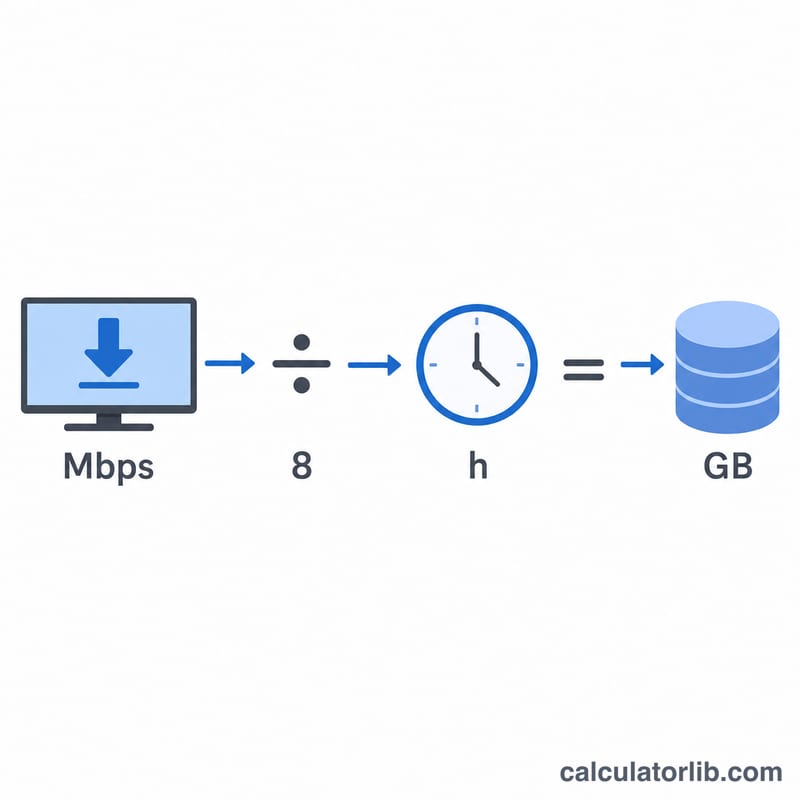
Video is measured in megabits per second (Mbps), but data caps are in gigabytes (GB). Multiplying Mbps by 3600 converts per-second to per-hour; dividing by 8 converts megabits to megabytes; dividing by 1000 converts megabytes to gigabytes:
$$\text{GB} = \frac{\text{bitrate}}{8} \times \text{hours} \times \frac{3600}{1000}$$
This simplifies to \(\text{GB per hour} = \text{bitrate} \times 0.45\). So a 5 Mbps Full HD stream uses about 2.25 GB every hour.
Worked example
Suppose you stream Full HD 1080p at 5 Mbps for 2 hours a day for 30 days. Per hour: $$\frac{5}{8} \times \frac{3600}{1000} = 2.25 \text{ GB}.$$ Over 2 hours/day that's 4.5 GB daily, and across 30 days that's 135 GB total.
Typical Streaming Bitrates and Data Use by Quality
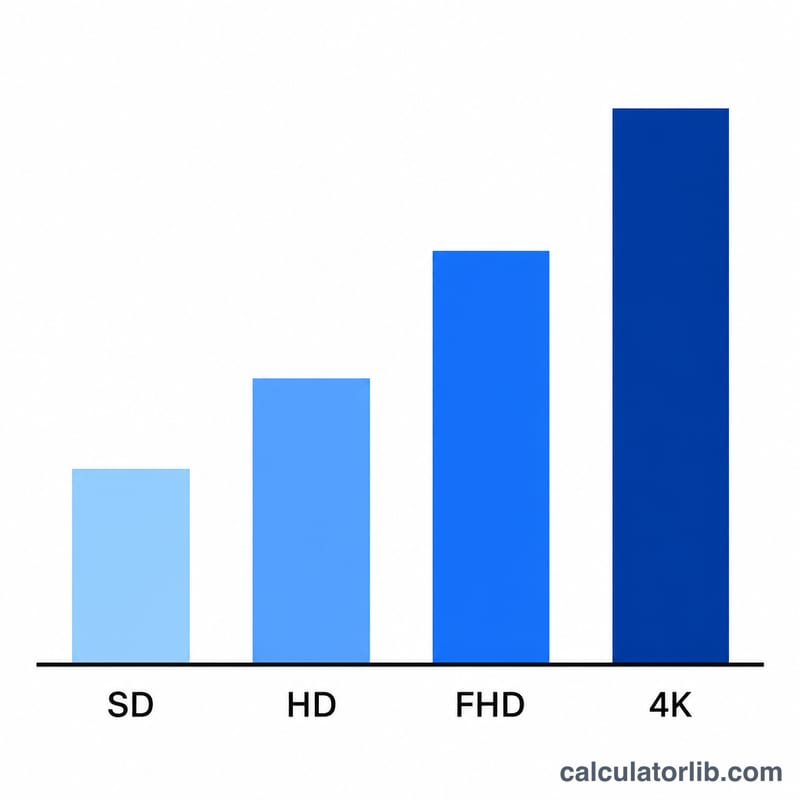
Streaming data use depends on the bitrate, the amount of data sent per second. Converting to gigabytes per hour uses \(\text{GB/hr} = \text{Mbps} \div 8 \times 3600 \div 1000 = \text{Mbps} \times 0.45\). The bitrates below are typical averages. Actual figures vary by service (Netflix, YouTube, Disney+ and others), codec (H.264, HEVC, VP9, AV1) and content, since fast action scenes need more data than static ones. Most services also adapt quality to your connection speed.
| Quality tier | Typical bitrate | Approx. GB per hour |
|---|---|---|
| SD (480p) | 1–3 Mbps | 0.45–1.35 GB |
| HD (720p) | 3–5 Mbps | 1.35–2.25 GB |
| Full HD (1080p) | 5–8 Mbps | 2.25–3.6 GB |
| 4K UHD (2160p) | 15–25 Mbps | 6.75–11.25 GB |
Service-published figures: Netflix gives its own rough estimates of about 1 GB per hour for SD, about 3 GB per hour for HD and about 7 GB per hour for 4K (Ultra HD). These can differ from the table because Netflix uses efficient encoding and its own quality ladder. Treat every number here as an estimate, not a guarantee.
Monthly Data Use: Scenario Comparison
Each total below uses \(\text{GB} = \text{Mbps} \times 0.45 \times \text{hours per day} \times \text{days}\) over 30 days. The cap columns show the total as a percentage of a 100 GB, 500 GB and 1 TB (1000 GB) monthly allowance. Anything above 100% would exceed that cap.
| Scenario | Bitrate | Calculation | 30-day total | vs 100 GB | vs 500 GB | vs 1 TB |
|---|---|---|---|---|---|---|
| 1 hr/day, low-end SD | 1 Mbps | \(1 \times 0.45 \times 1 \times 30\) | 13.5 GB | 13.5% | 2.7% | 1.35% |
| 2 hrs/day, HD | 3 Mbps | \(3 \times 0.45 \times 2 \times 30\) | 81 GB | 81% | 16.2% | 8.1% |
| 2 hrs/day, Full HD | 5 Mbps | \(5 \times 0.45 \times 2 \times 30\) | 135 GB | 135% | 27% | 13.5% |
| 4 hrs/day, Full HD | 5 Mbps | \(5 \times 0.45 \times 4 \times 30\) | 270 GB | 270% | 54% | 27% |
| 2 hrs/day, 4K UHD | 25 Mbps | \(25 \times 0.45 \times 2 \times 30\) | 675 GB | 675% | 135% | 67.5% |
Two hours of Full HD a day already exceeds a 100 GB cap, and daily 4K viewing can exceed a 500 GB cap. Other household streaming, video calls and downloads add to these totals.
FAQ
Are the preset bitrates exact? No — they are typical averages. Real bitrate varies by content, codec (H.264 vs HEVC vs AV1) and network conditions, so treat results as estimates.
Why divide by 8? Bitrate is in bits, but storage/data caps are in bytes, and \(1 \text{ byte} = 8 \text{ bits}\).
Does 4K really use that much? Yes — at ~25 Mbps, 4K uses roughly 11.25 GB per hour, which can exhaust a cap quickly.