What Is the Tap Water Cost Calculator?
This calculator works out how much your tap water costs based on the volume you use and the price your water supplier charges per liter. Water is often billed per cubic meter (1,000 liters), so divide your unit rate by 1,000 to get the price per liter before entering it here. The tool is universal and works with any currency.
How to Use It
Enter the total volume of water in liters and the price you pay per liter. The calculator multiplies the two to give the total cost, and also shows the equivalent cost per 1,000 liters (one cubic meter) so you can compare against your bill.
The Formula Explained
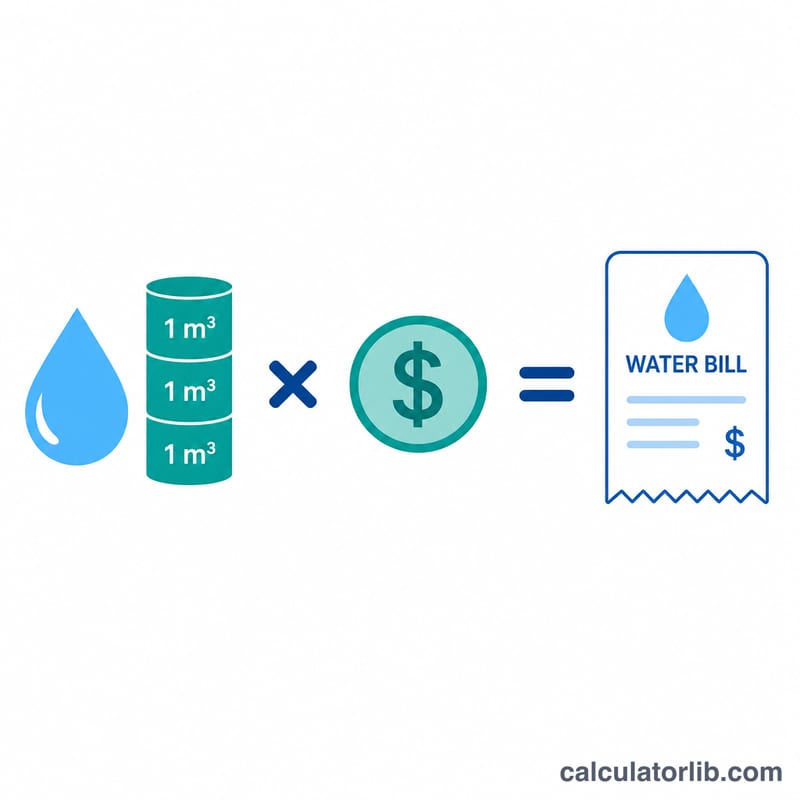
The math is simple: $$\text{Cost} = \text{Volume} \times \text{Price per liter}$$ If you know the price per cubic meter instead, divide it by 1,000 first. For example, a price of $2.00 per cubic meter equals $0.002 per liter.
Worked Example
Suppose you use 1,000 liters and your price is $0.002 per liter. The cost is $$1{,}000 \times 0.002 = \$2.00$$ That matches a typical rate of $2.00 per cubic meter.
Typical Water Use by Activity (Liters)
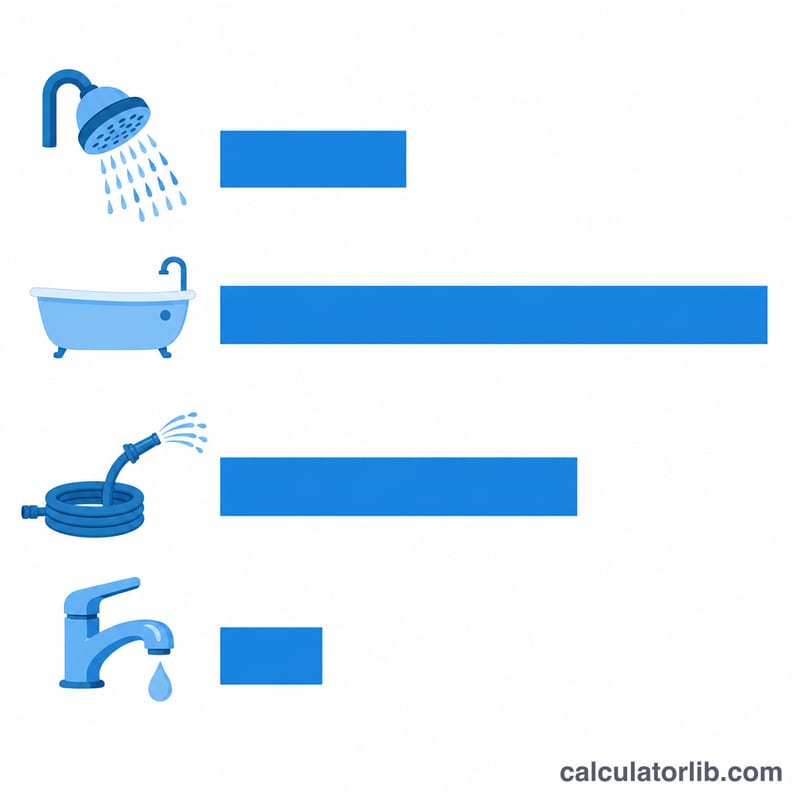
The table below lists typical volumes for common household water uses, together with the cost each volume would produce at an example price of $0.002 per liter (equivalent to $2.00 per cubic metre). Multiply any volume by your own price per liter to get your figure:
$$\text{Cost} = \text{Volume (L)} \times \text{Price per liter}$$
Ranges are indicative only. Actual volumes depend heavily on fixture flow rate, water pressure, appliance age and efficiency class, personal habits and, for gardens, on soil, climate and nozzle type. Water prices also vary enormously between countries, regions and utilities, so $0.002/L is purely an illustrative rate and not an average for any particular place — always check your own bill for the volumetric rate that applies to you.
| Activity | Typical volume (L) | Cost at $0.002/L |
|---|---|---|
| Shower, 8 min, standard head (~9–12 L/min) | 65–100 | $0.13–$0.20 |
| Shower, 8 min, low-flow head (6 L/min) | ≈ 48 | $0.10 |
| Full bath | 150–200 | $0.30–$0.40 |
| Toilet flush, modern dual-flush | 3–6 per flush | $0.006–$0.012 |
| Toilet flush, older single-flush cistern | 9–13 per flush | $0.018–$0.026 |
| Dishwasher, one cycle (efficient model) | 10–15 | $0.02–$0.03 |
| Washing dishes by hand in a running sink | 30–60 | $0.06–$0.12 |
| Washing machine, one cycle | 50–70 | $0.10–$0.14 |
| Running tap (kitchen/bathroom) | 6–10 per minute | $0.012–$0.020 per minute |
| Garden hose | 12–18 per minute | $0.024–$0.036 per minute |
| Garden sprinkler | 900–1,000 per hour | $1.80–$2.00 per hour |
Worked check on one row — an 8-minute shower at 10 L/min uses \(8 \times 10 = 80\) L, so the cost is \(80 \times \$0.002 = \$0.16\), or $0.16.
Water Volume and Price Unit Conversions
Water bills are rarely issued in liters. Utilities in continental Europe and much of Asia and Latin America bill in cubic metres (m³); UK and Australian bills often use kilolitres or "units"; US utilities commonly bill in CCF (hundred cubic feet), thousands of gallons, or single gallons. Because this calculator takes volume in liters and price per liter, convert both sides first.
Volume conversions
| Unit | In liters | Worked conversion |
|---|---|---|
| 1 cubic metre (m³) | 1,000 L | \(5 \text{ m}^3 \times 1{,}000 = 5{,}000\) L |
| 1 US gallon | 3.785 L | \(40 \times 3.785 = 151.4\) L |
| 1 imperial (UK) gallon | 4.546 L | \(40 \times 4.546 = 181.84\) L |
| 1 CCF (100 cubic feet) = 748 US gal | 2,832 L | \(3 \text{ CCF} \times 2{,}832 = 8{,}496\) L |
| 1 kilolitre / 1 UK–AU billing "unit" | 1,000 L | \(12 \text{ kL} \times 1{,}000 = 12{,}000\) L |
Price conversions (to price per liter)
| Rate on your bill | Divide by | Worked conversion |
|---|---|---|
| Price per m³ | 1,000 | \(\$2.20 \div 1{,}000 = \$0.0022\) per L |
| Price per CCF | 2,832 | \(\$6.00 \div 2{,}832 = \$0.00212\) per L |
| Price per US gallon | 3.785 | \(\$0.008 \div 3.785 = \$0.00211\) per L |
| Price per 1,000 US gallons | 3,785 | \(\$8.00 \div 3{,}785 = \$0.00211\) per L |
Example of using both conversions together: a US household uses 9 CCF in a billing period at $6.00 per CCF. In liters that is \(9 \times 2{,}832 = 25{,}488\) L, and the price per liter is \(\$6.00 \div 2{,}832 = \$0.00212\). Entering those two numbers gives \(25{,}488 \times \$0.00212 = \$54.03\), i.e. $54.03 — which matches \(9 \times \$6.00 = \$54.00\) apart from rounding of the per-liter rate.
Note that 1 US gallon = 3.785 L and 1 imperial gallon = 4.546 L are rounded to three decimals from the exact definitions (3.785411784 L and 4.54609 L); 1 CCF = 2,832 L is likewise rounded from 2,831.685 L. These roundings are far smaller than the uncertainty in typical usage estimates.
Cost Comparison Across Common Scenarios
Each row applies the same formula, \(\text{Cost} = \text{Volume} \times \text{Price per liter}\). The final column restates the result as cost per 1,000 L so scenarios of very different size can be compared on equal terms; at a flat volumetric rate it simply equals the price per liter × 1,000.
| Scenario | Volume (L) | Price per liter | Total cost | Cost per 1,000 L |
|---|---|---|---|---|
| One 8-minute shower | 80 | $0.002 | $0.16 | $2.00 |
| Daily showers for one person, 30 days | 2,400 | $0.002 | $4.80 | $2.00 |
| One full bath | 170 | $0.002 | $0.34 | $2.00 |
| Slow dripping tap, one month (low estimate) | 1,000 | $0.002 | $2.00 | $2.00 |
| Faster dripping tap, one month (high estimate) | 3,000 | $0.002 | $6.00 | $2.00 |
| Garden sprinkler, 2 hours at ~950 L/h | 1,900 | $0.002 | $3.80 | $2.00 |
| Household of four, one quarter | 45,000 | $0.002 | $90.00 | $2.00 |
| Household of four, one quarter — higher tariff | 45,000 | $0.004 | $180.00 | $4.00 |
Worked example — the monthly-showers row
Thirty showers of 80 L each give \(30 \times 80 = 2{,}400\) L. Substituting into the formula:
$$\text{Cost} = 2{,}400 \text{ L} \times \$0.002/\text{L} = \$4.80$$
Switching to a 6 L/min low-flow head cuts each shower to 48 L, so the month becomes \(30 \times 48 = 1{,}440\) L and \(1{,}440 \times \$0.002 = \$2.88\) — a saving of \(\$4.80 - \$2.88 = \$1.92\) on the water charge alone. Where the shower is heated, the energy saved is usually worth several times more than the water itself.
Reading these numbers correctly
- Tariff sensitivity dominates. The last two rows are the identical volume; doubling the rate doubles the bill. Because real volumetric rates worldwide span well over an order of magnitude, plugging in your own rate matters far more than fine-tuning volume estimates.
- These figures exclude fixed charges. Most bills add a standing/service charge per billing period that you pay regardless of consumption, and many add a separate sewerage or wastewater charge — often billed on the same metered volume, which can roughly double or more the effective cost per liter. Meter rental, stormwater levies and taxes such as VAT or sales tax may also apply.
- Block and seasonal tariffs break the flat assumption. If your utility uses tiered (increasing-block) pricing or higher summer rates, a single price per liter is only an approximation; use the rate for the block your usage actually falls in, or compute each block separately.
- Hot water costs more than the water. Showers, baths and hot-wash laundry also consume energy for heating, which is not included here.
This section is general information for estimating purposes and is not professional or financial advice; consult your own water bill or utility for the rates, charges and units that apply to your account.
FAQ
How many liters does a shower use? A typical 8-minute shower uses about 65–100 liters depending on the showerhead flow rate.
How do I find my price per liter? Check your water bill for the rate per cubic meter (m³) and divide by 1,000.
Does this include sewerage charges? No. Many bills add a separate wastewater (sewerage) charge; add that rate to your per-liter price if you want the all-in cost.