What Is a TDS Calculator?
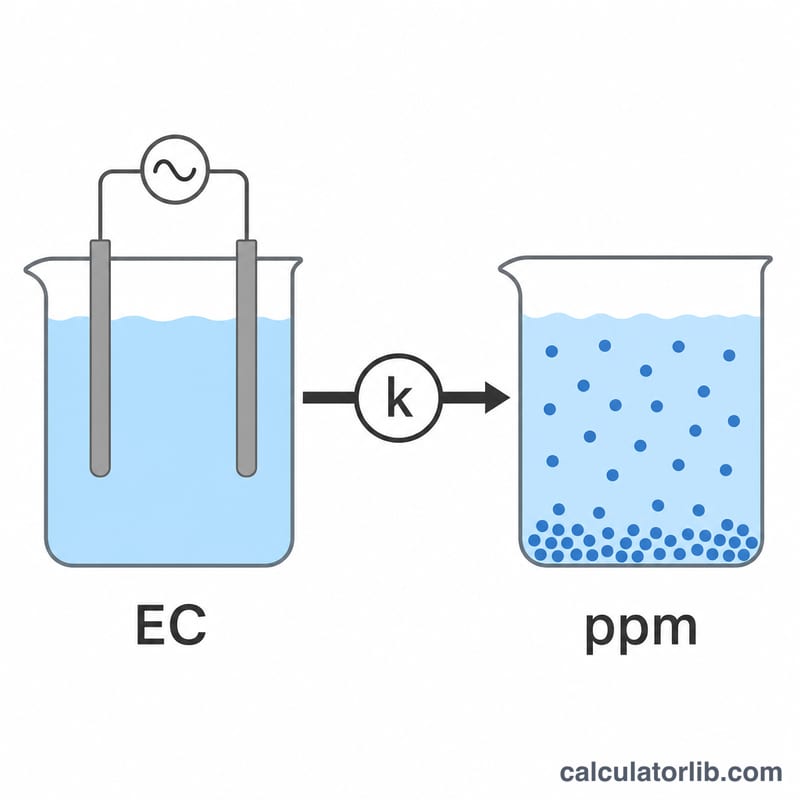
Total Dissolved Solids (TDS) measures the combined concentration of all dissolved inorganic and organic substances in water, expressed in parts per million (ppm) or milligrams per liter (mg/L). Since TDS is difficult to measure directly in the field, it is commonly estimated from a water sample's Electrical Conductivity (EC), which is measured in microsiemens per centimeter (µS/cm). This calculator converts EC to TDS using a simple conversion factor.
How to Use It
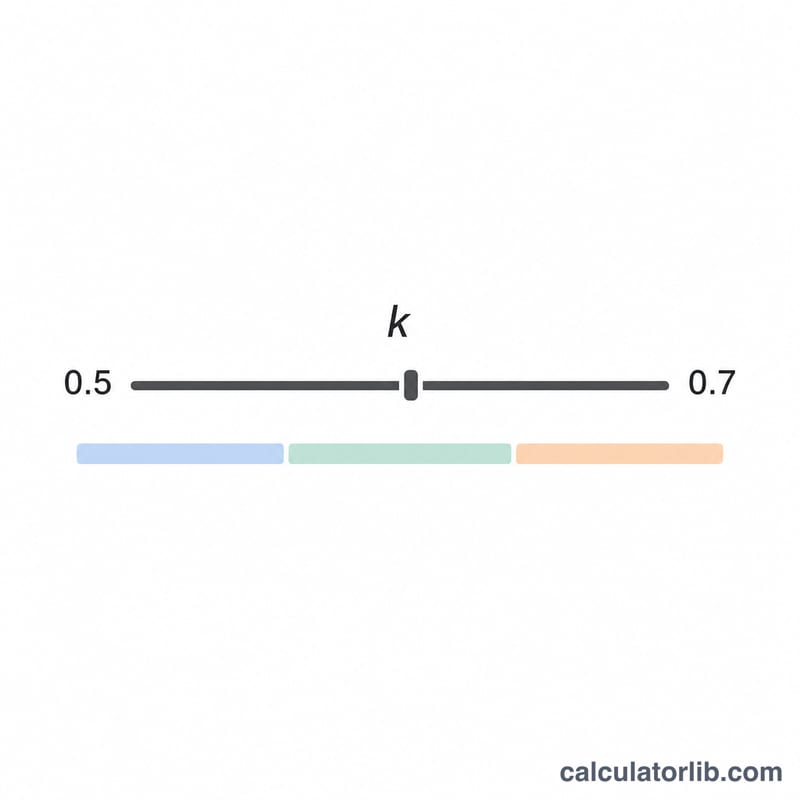
Enter your measured electrical conductivity in µS/cm and choose a conversion factor. Most TDS meters use a factor between 0.5 and 0.7: a factor of 0.5 (NaCl scale) is common in North America, while 0.64 (442 scale) and 0.7 (KCl scale) are used elsewhere. The calculator multiplies the two values to give TDS in ppm.
The Formula Explained
The relationship is linear: $$\text{TDS (ppm)} = \text{EC (µS/cm)} \times k$$ where \(k\) is the conversion factor. The factor accounts for the fact that different dissolved salts conduct electricity differently. Using the right factor for your water type improves accuracy, but any value in the 0.5–0.7 range gives a reasonable estimate.
Worked Example
Suppose a hydroponics reservoir reads 1,500 µS/cm and you use the common 0.5 factor. $$\text{TDS} = 1{,}500 \times 0.5 = 750 \text{ ppm}$$ If you switched to the 0.7 KCl factor, $$\text{TDS} = 1{,}500 \times 0.7 = 1{,}050 \text{ ppm}$$ — showing why the chosen factor matters when comparing readings.
Interpreting Your TDS Result
The calculator multiplies electrical conductivity (EC, in µS/cm) by a conversion factor k to estimate total dissolved solids (TDS, in ppm, roughly equal to mg/L). For example, a reading of 800 µS/cm with k = 0.5 gives 800 × 0.5 = 400 ppm.
Commonly cited TDS bands for drinking water, based on WHO taste-rating guidance:
- Under 300 ppm: excellent
- 300–600 ppm: good
- 600–900 ppm: fair
- 900–1,200 ppm: poor
- Above 1,200 ppm: unacceptable
In the United States, the EPA has a secondary (non-enforceable, aesthetic) standard of 500 mg/L for TDS in drinking water. Other countries and regions set their own guidelines.
Keep these limits in mind when reading the result:
- TDS here is an estimate calculated from EC, not a direct measurement such as evaporating a sample and weighing the residue.
- It does not tell you which solutes are present. Harmless minerals such as calcium and magnesium and harmful contaminants such as nitrate or lead can contribute alike, or not at all, to the number. A low TDS does not prove water is safe.
- The result depends on the factor you choose. The same EC can give a TDS that differs by 40% between k = 0.5 and k = 0.7.
- EC changes with temperature, by roughly 2% per °C. It is usually referenced to 25 °C, so check whether your meter applies temperature compensation before converting.
Conversion Factor Lookup by Scale and Water Type
| Scale | Factor k | Typical use / water type |
|---|---|---|
| NaCl scale | 0.5 | Hydroponics, aquarium and many handheld TDS meters; general-purpose estimates |
| 442 scale | about 0.64 | Natural fresh water (the 442 mixture is modeled on typical river and lake water ions) |
| KCl scale | 0.7 | Industrial and laboratory settings that calibrate against potassium chloride |
Natural waters often fall between 0.55 and 0.75, depending on which ions dominate. If you need a precise value for a specific source, compare an EC reading with a laboratory TDS (residue on evaporation) result for the same sample and derive k from the ratio. Check which scale your meter uses, since many consumer meters are fixed at 0.5 or 0.64.
Same EC, Different Factors: Scenario Comparison
TDS in ppm for the same EC reading using three common factors (TDS = EC × k):
| EC (µS/cm) | TDS at k = 0.5 | TDS at k = 0.64 | TDS at k = 0.7 |
|---|---|---|---|
| 100 | 50 | 64 | 70 |
| 500 | 250 | 320 | 350 |
| 1,000 | 500 | 640 | 700 |
| 1,500 | 750 | 960 | 1,050 |
| 2,500 | 1,250 | 1,600 | 1,750 |
At 1,000 µS/cm the estimate ranges from 500 to 700 ppm. Depending on the factor, the same water can land in the WHO “good” band or the “fair” band, so always note which factor was used when reporting TDS.
FAQ
Which conversion factor should I use? Check your meter's documentation. If unknown, 0.5 is the most widely used default.
Is ppm the same as mg/L? For dilute water solutions, yes — \(1 \text{ ppm} \approx 1 \text{ mg/L}\).
Can I convert TDS back to EC? Yes: \(\text{EC} = \text{TDS} \div k\). Just divide your ppm value by the same factor.