What this calculator does
This tool converts a single duration value, expressed in hours, minutes, or seconds, into a normalized representation: a whole number of days plus the remaining time of day formatted as hours:minutes:seconds. It is a pure mathematical time-unit conversion, so it works identically everywhere with no region-specific rules.
How to use it
Enter your time value, choose the unit it is expressed in (Hours, Minutes, or Seconds), and the calculator returns the equivalent number of whole days followed by the leftover hours, minutes, and seconds. Seconds is the default unit.
The formula explained
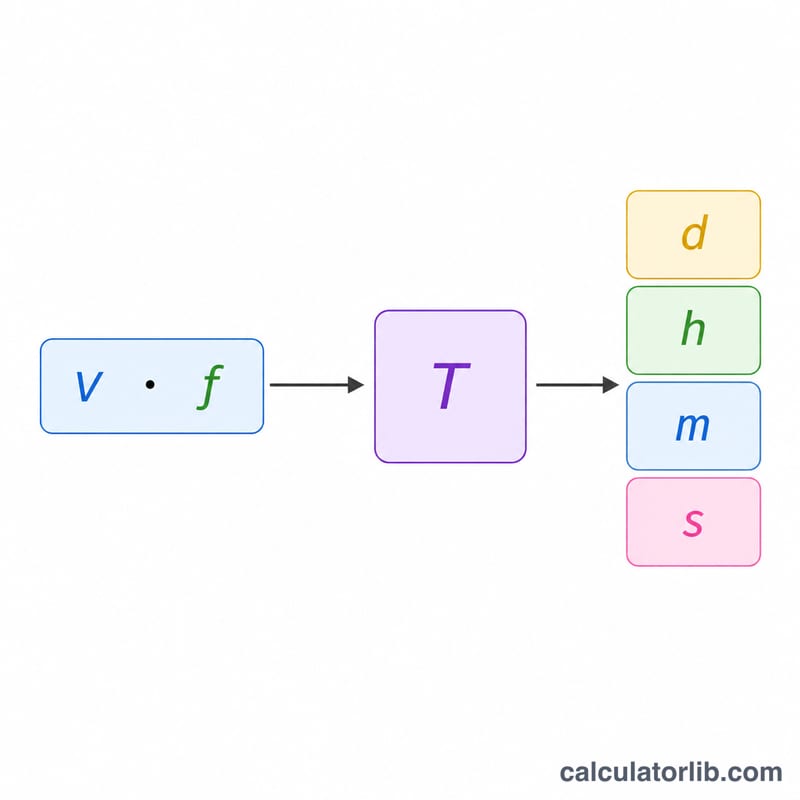
First the value is normalized to total seconds by multiplying by a factor: 3600 for hours, 60 for minutes, or 1 for seconds. Then the days are taken with a floor division by 86400 (the number of seconds in a day). The remaining seconds are split into hours (floor by 3600), minutes (floor by 60), and the leftover seconds, which may be fractional if your input had a fractional part.
$$\begin{gathered} T = \text{Time value} \times \text{Unit factor} \\[1.5em] \text{where}\quad \left\{ \begin{aligned} \text{Days} &= \left\lfloor \dfrac{T}{86400} \right\rfloor \\ \text{Hours} &= \left\lfloor \dfrac{T \bmod 86400}{3600} \right\rfloor \\ \text{Minutes} &= \left\lfloor \dfrac{T \bmod 3600}{60} \right\rfloor \\ \text{Seconds} &= T \bmod 60 \end{aligned} \right. \end{gathered}$$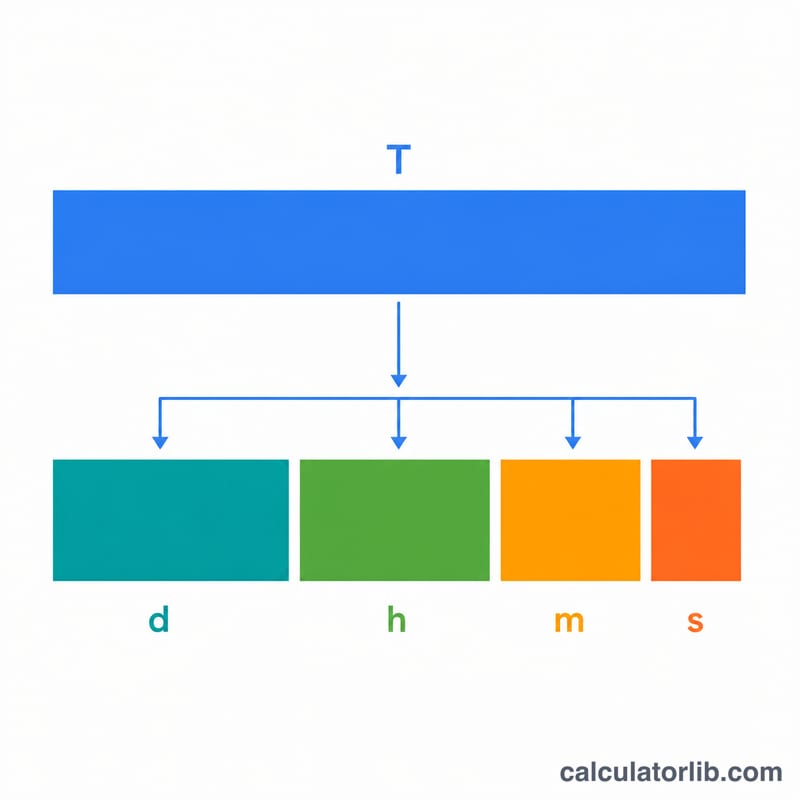
Worked example
For 100,000,000 seconds: total seconds = 100,000,000. Days = \(\left\lfloor 100000000 / 86400 \right\rfloor = 1157\). Remainder = \(100000000 - 1157 \times 86400 = 35{,}200 \text{ s}\). Hours = \(\left\lfloor 35200/3600 \right\rfloor = 9\), leaving 2,800 s. Minutes = \(\left\lfloor 2800/60 \right\rfloor = 46\), leaving 40 s. Result: 1157 days and 09:46:40.
Common Time Unit Conversions to Days and H:M:S
These equivalents are fixed by definition. They are used to turn any hours, minutes, or seconds value into total seconds \(T\) before splitting it into days and H:M:S. This tool treats a day as exactly 24 hours (86,400 seconds) and ignores leap seconds and daylight-saving shifts.
| Unit | In smaller units |
|---|---|
| 1 minute | 60 seconds |
| 1 hour | 60 minutes = 3,600 seconds |
| 1 day | 24 hours = 1,440 minutes = 86,400 seconds |
| 1 week | 7 days = 168 hours = 604,800 seconds |
Sample inputs
| Input | Total seconds | Days + H:M:S |
|---|---|---|
| 90 minutes | 5,400 | 0 d 01:30:00 |
| 1,000 minutes | 60,000 | 0 d 16:40:00 |
| 100 hours | 360,000 | 4 d 04:00:00 |
| 1,000,000 seconds | 1,000,000 | 11 d 13:46:40 |
Check of the last row: 11 × 86,400 = 950,400; 1,000,000 − 950,400 = 49,600. Then 13 × 3,600 = 46,800, leaving 2,800. Then 46 × 60 = 2,760, leaving 40 seconds. The result is 11 d 13:46:40.
Same Duration in Different Units
Entering the same length of time in hours, minutes, or seconds gives the same normalized result, because every input is first converted to total seconds.
| Input value | Unit | Total seconds | Days + H:M:S |
|---|---|---|---|
| 36 | hours | 129,600 | 1 d 12:00:00 |
| 2,160 | minutes | 129,600 | 1 d 12:00:00 |
| 129,600 | seconds | 129,600 | 1 d 12:00:00 |
| 50 | hours | 180,000 | 2 d 02:00:00 |
| 3,000 | minutes | 180,000 | 2 d 02:00:00 |
| 180,000 | seconds | 180,000 | 2 d 02:00:00 |
| 0.5 | hours | 1,800 | 0 d 00:30:00 |
| 30 | minutes | 1,800 | 0 d 00:30:00 |
| 1,800 | seconds | 1,800 | 0 d 00:30:00 |
Worked check for 50 hours: \(T = 50 \times 3600 = 180000\) s. Days = \(\lfloor 180000 / 86400 \rfloor = 2\). The remainder is \(180000 - 172800 = 7200\) s, which is 2 hours, 0 minutes, 0 seconds. The result is 2 d 02:00:00.
FAQ
What if I enter minutes? The value is multiplied by 60 first, then broken into days and H:M:S. For example, 1225 minutes = 73,500 seconds = 0 days and 20:25:00.
Can I enter a fractional value? Yes. Any sub-second remainder is preserved in the seconds field rather than rounded away.
What does zero return? Zero returns 0 days and 00:00:00.