What Is the Turtle Tank Size Calculator?
This calculator estimates the minimum aquarium size your pet turtle needs based on its shell length. It uses the popular aquarist rule of thumb of 10 gallons of water per inch of shell length. A properly sized tank gives your turtle room to swim, dive, and stay healthy, while making it far easier to keep the water clean.
How to Use It
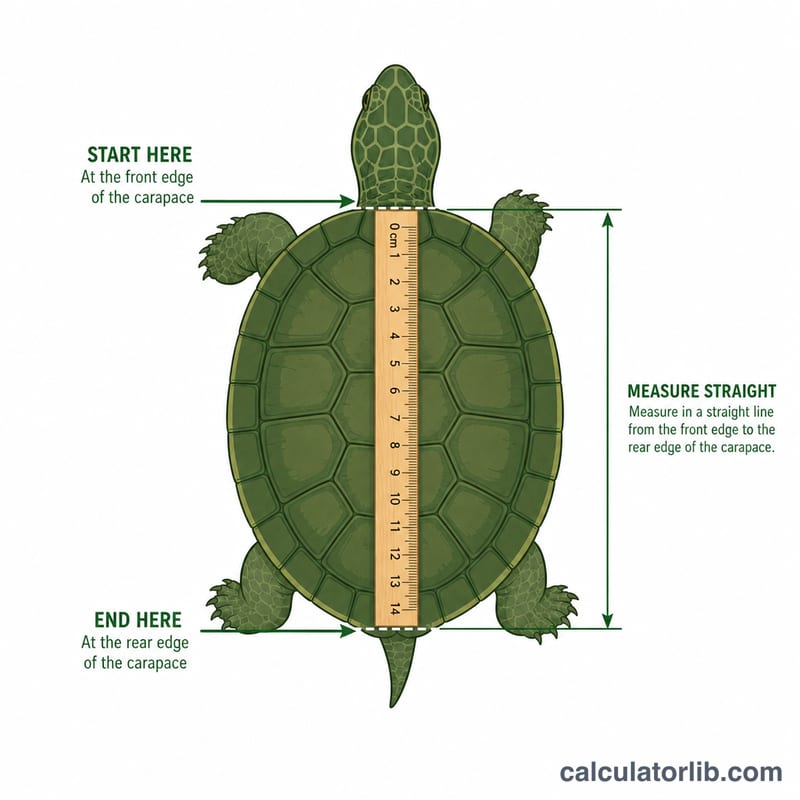
Measure the straight-line length of your turtle's carapace (top shell) in inches — measure across the shell, not over its curve. Enter that number, then choose how many turtles will share the tank. The result shows the minimum recommended volume in US gallons and the equivalent in liters. Always round up to the next available tank size; bigger is always better for water quality.
The Formula Explained
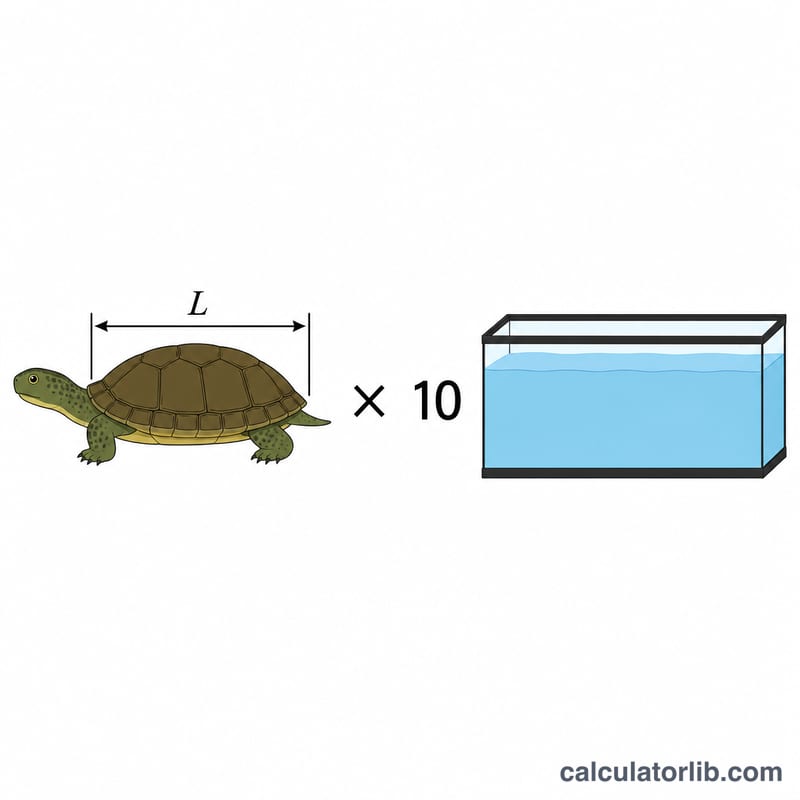
The core calculation is simple:
$$\text{Min Gallons} = \text{Shell Length (in)} \times 10$$
For more than one turtle, the calculator keeps the full requirement for the largest turtle and adds 50% of the base volume for each additional turtle, since turtles need both swimming space and territory.
Worked Example
A red-eared slider with a 6-inch shell needs: $$6 \times 10 = 60 \text{ gallons}$$ minimum. If you keep two turtles of that size, the second adds 30 gallons (50% of 60), for a total of 90 gallons.
Tank Size by Shell Length and Number of Turtles
The calculator uses the common rule of thumb of 10 US gallons per inch of shell (carapace) length for the first turtle. Each additional turtle adds 50% of that base volume: \(\text{Tank (gal)} = 10 \times L \times [1 + 0.5(n-1)]\). Liters use 1 US gal = 3.785 L. These figures are minimums, not ideal sizes.
| Shell length | 1 turtle (gal) | 1 turtle (L) | 2 turtles (gal) | 2 turtles (L) |
|---|---|---|---|---|
| 4 in | 40 | 151 | 60 | 227 |
| 6 in | 60 | 227 | 90 | 341 |
| 8 in | 80 | 303 | 120 | 454 |
| 10 in | 100 | 379 | 150 | 568 |
| 12 in | 120 | 454 | 180 | 681 |
Example: two turtles, with the larger at 6 in: \(10 \times 6 \times [1 + 0.5(2-1)] = 60 \times 1.5 = 90\) gal, and \(90 \times 3.785 \approx 341\) L. Use the longest turtle's shell length for the calculation.
Typical Adult Shell Lengths by Species
Adult sizes below are commonly documented approximate ranges. Individual turtles vary with genetics, diet, and sex, and females are usually larger than males. Minimum gallons apply to one turtle at adult size under the 10 gal/inch rule.
| Species | Approx. adult shell length | Minimum tank (1 adult) |
|---|---|---|
| Red-eared slider (female) | 10–12 in | 100–120 gal |
| Red-eared slider (male) | 8–9 in | 80–90 gal |
| Painted turtle | 5–10 in | 50–100 gal |
| Common musk turtle | 3–5 in | 30–50 gal |
| Common map turtle (male) | 4–6 in | 40–60 gal |
| Common map turtle (female) | 7–10 in | 70–100 gal |
| Yellow-bellied slider | 8–13 in | 80–130 gal |
Because the ranges are approximate, plan around the upper end of the range for your species and sex.
Practical Tank Setup Tips
- Round up to a standard tank size. Aquariums are commonly sold at sizes such as 55, 75, 90, 125, and 180 gallons. If the calculator gives 100 gal, choose the next size up (125 gal) rather than a smaller tank.
- Size for adult length, not current length. A hatchling grows quickly, so buying for the adult size avoids repeated upgrades.
- Allow for a basking area and headroom. The basking platform takes up space, and the water should not be filled to the brim. Leave room above the waterline so the turtle cannot easily climb out. Tank volume is therefore not the same as usable water volume, so go larger if in doubt.
- Use a strong filter. Turtles are messy. A common guideline is a filter rated for roughly 2× your tank volume (for example, one rated for about 200 gal on a 100-gal tank).
- Treat the result as a minimum. More water volume and floor area keep water quality more stable and give the turtle more room to swim.
This is general information, not veterinary advice. Needs vary by species, so check species-specific care guidance or consult a reptile vet.
FAQ
Is 10 gallons per inch enough? It's a sensible minimum for water volume. Aquatic turtles produce a lot of waste, so going larger improves water quality and reduces maintenance.
Does the tank need to be full of water? Aquatic turtles also need a dry basking area. The gallon figure refers to swimming water volume, so pick a tank that holds at least this much when filled to a safe level.
What about baby turtles? Hatchlings grow quickly. Buy a tank sized for the turtle's expected adult shell length to avoid frequent upgrades.