
What is the A260/A280 Ratio?
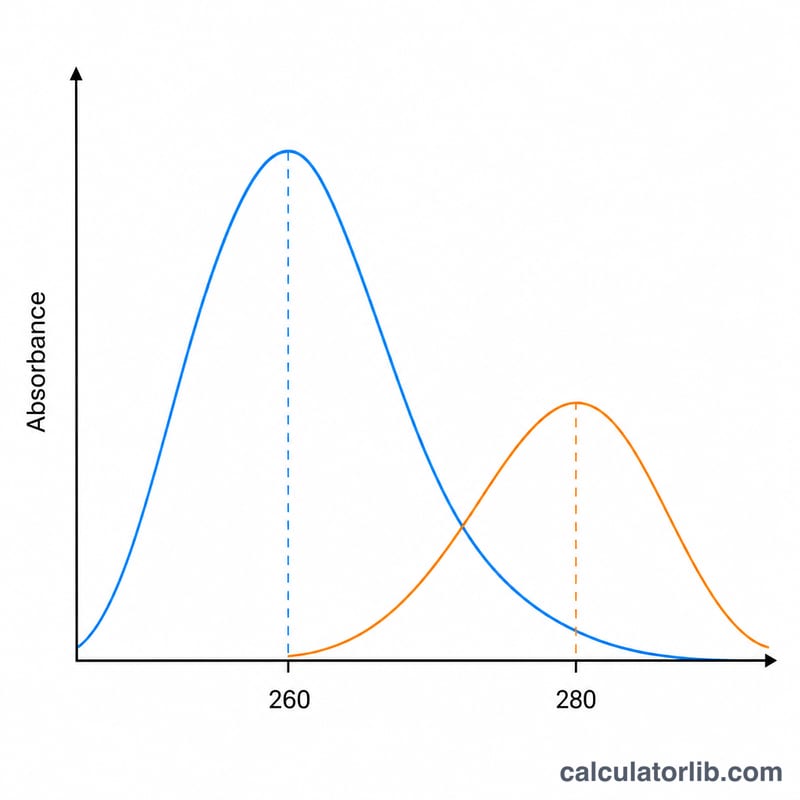
The A260/A280 ratio is a quick spectrophotometric measure of nucleic acid purity. Nucleic acids absorb ultraviolet light strongly at 260 nm, while proteins (due to aromatic amino acids like tryptophan and tyrosine) absorb at 280 nm. Dividing the absorbance at 260 nm by the absorbance at 280 nm gives a ratio that indicates how much protein or other contaminant is present in a DNA or RNA preparation.
How to Use This Calculator
Read your sample on a UV spectrophotometer (such as a NanoDrop) and note the absorbance values at 260 nm and 280 nm. Enter both numbers above and the calculator instantly returns the ratio. Use a blanked, properly diluted sample for accurate readings.
The Formula Explained
The calculation is simply $$\text{Ratio} = \dfrac{A_{260}}{A_{280}}$$ Because it is a ratio of two absorbances measured on the same sample, the path length and concentration largely cancel out, making it a robust quality indicator independent of how concentrated the sample is.
Interpreting the Result
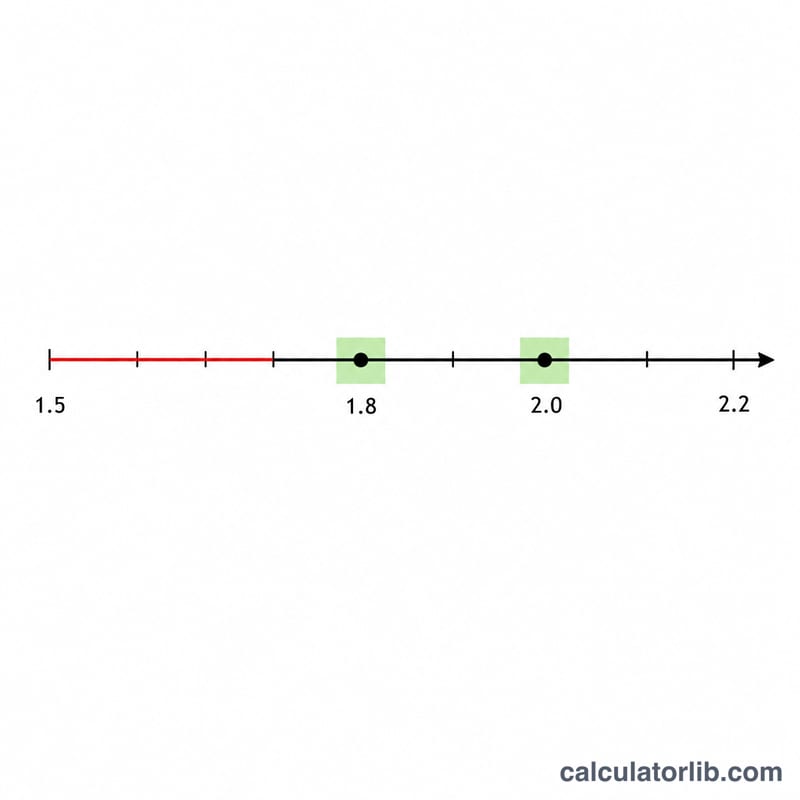
A ratio of ~1.8 is generally accepted as "pure" for DNA, and ~2.0 for RNA. A significantly lower ratio (e.g. below 1.7) may indicate protein, phenol, or other contaminants that absorb near 280 nm. Higher-than-expected ratios can occur with RNA contamination of a DNA sample.
Worked Example
Suppose a NanoDrop reports A260 = 1.8 and A280 = 1.0. The ratio is $$\frac{1.8}{1.0} = 1.8$$ indicating clean genomic DNA with little protein contamination.
A260/A280 Purity Reference Values
The A260/A280 ratio compares absorbance at 260 nm (the absorption maximum of nucleic acids) with absorbance at 280 nm (the absorption maximum of aromatic amino acids in protein). Because purified DNA and RNA have characteristic ratios, the value is a quick spectrophotometric check of how clean a sample is. The complementary A260/A230 ratio detects a different class of contaminants (organic compounds and chaotropic salts), so the two are usually reported together.
| Sample / condition | Expected A260/A280 | Expected A260/A230 | Interpretation |
|---|---|---|---|
| Pure double-stranded DNA (dsDNA) | ~1.8 | ~2.0–2.2 | Accepted target for clean genomic/plasmid DNA |
| Pure RNA | ~2.0 | ~2.0–2.2 | Accepted target for clean total/messenger RNA |
| Pure single-stranded DNA (ssDNA) / oligonucleotides | ~1.9 | ~2.0–2.2 | Falls between dsDNA and RNA depending on base composition |
| A260/A280 below ~1.7 | < 1.7 | — | Likely protein, phenol, or other 280 nm absorbers present |
| A260/A280 above ~2.0 (for DNA) | > 2.0 | — | Possible RNA carryover, degraded nucleotides, or alkaline pH |
| Low A260/A230 (e.g. < 1.8) | — | < 1.8 | Guanidine salts, phenol, EDTA, or carbohydrate contamination |
Common contaminants and their effect
- Protein — absorbs strongly at 280 nm (tryptophan, tyrosine, phenylalanine), lowering the A260/A280 ratio below 1.8.
- Phenol — a residue of phenol-chloroform extraction; it absorbs near 270–280 nm and also at 230 nm, depressing both ratios and inflating apparent yield.
- Guanidine / chaotropic salts and EDTA — absorb around 230 nm, chiefly lowering the A260/A230 ratio while leaving A260/A280 closer to normal.
- RNA in a DNA prep — pushes the A260/A280 ratio upward (toward 2.0) because RNA reads higher than DNA at this ratio.
Worked example: a spectrophotometer reports A260 = 0.452 and A280 = 0.251. The purity ratio is 1.80, indicating clean double-stranded DNA. Note that the ratio is only meaningful when readings are taken at pH ~7.5–8.5 with a proper buffer blank, since acidic conditions can artificially lower the value by up to ~0.2–0.3.
FAQ
What ratio means pure DNA? A value around 1.8 indicates pure double-stranded DNA.
What about RNA? Pure RNA typically shows a ratio of about 2.0.
Should I also check A260/A230? Yes — the A260/A230 ratio (ideally 2.0-2.2) helps detect organic contaminants like guanidine or phenol that the A260/A280 ratio may miss.