
What this calculator does
This tool solves any quadratic equation of the form \(ax^2 + bx + c = 0\) using the quadratic formula. It reports the discriminant and tells you whether the equation has two distinct real roots, one repeated real root, or a pair of complex conjugate roots.
How to use it
Enter the three coefficients \(a\), \(b\) and \(c\). The coefficient \(a\) must be non-zero for a true quadratic; if \(a\) is 0 the tool treats it as a linear equation. Click calculate to see the discriminant and the roots.
The formula explained
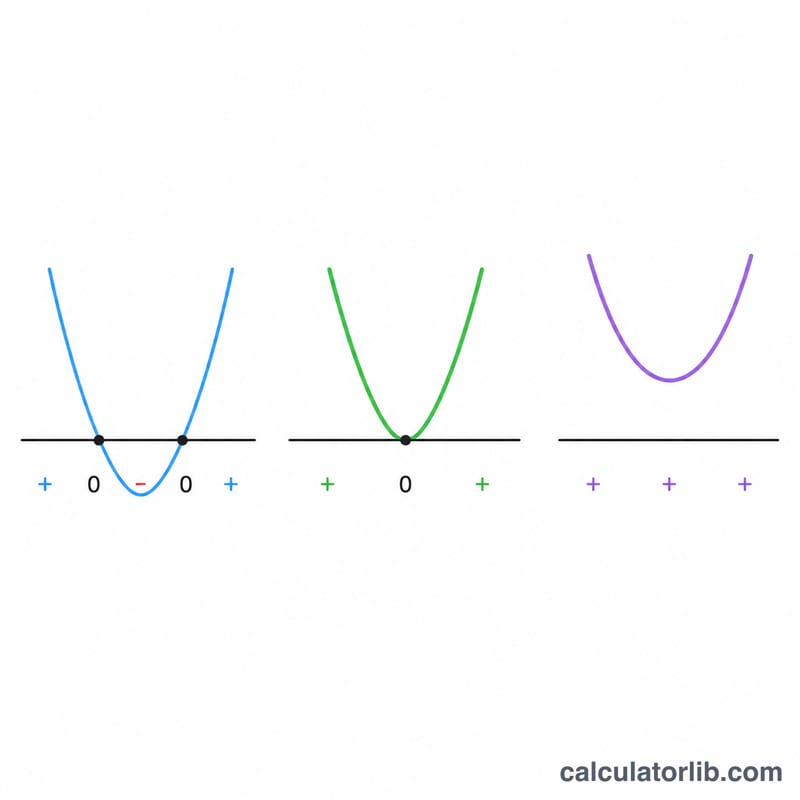
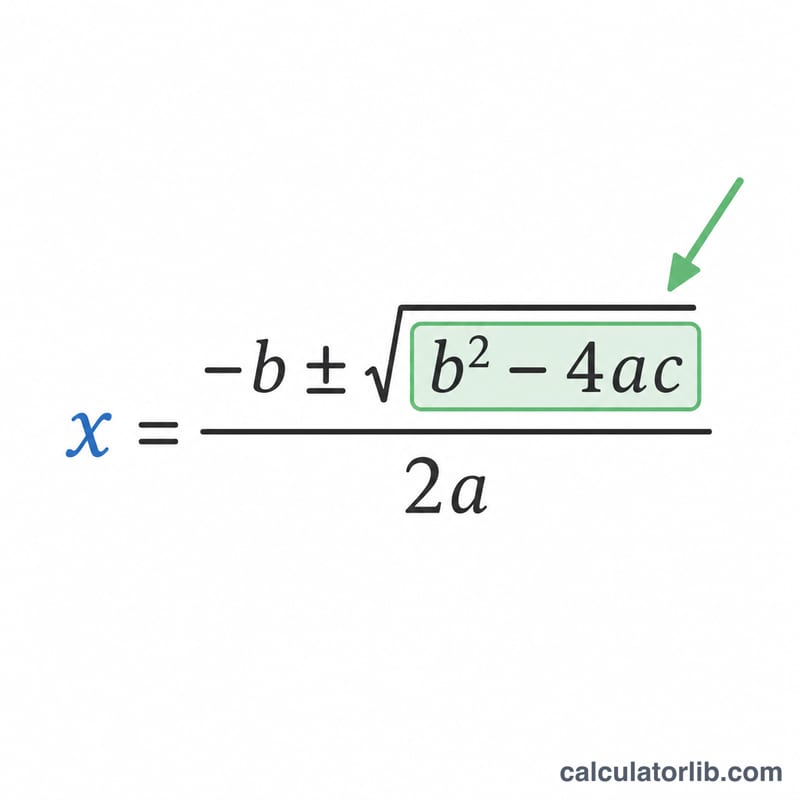
The roots are given by $$x = \frac{-b \pm \sqrt{b^2 - 4ac}}{2a}$$ The quantity under the square root, \(\Delta = b^2 - 4ac\), is the discriminant. When \(\Delta > 0\) there are two real roots; when \(\Delta = 0\) there is one repeated root; when \(\Delta < 0\) the roots are complex, written as a real part \(-\frac{b}{2a}\) plus or minus an imaginary part \(\frac{\sqrt{-\Delta}}{2a}\) times \(i\).
Worked example
For \(x^2 - 3x + 2 = 0\) we have \(a = 1\), \(b = -3\), \(c = 2\). The discriminant is $$(-3)^2 - 4(1)(2) = 9 - 8 = 1$$ So \(x = \frac{3 \pm 1}{2}\), giving \(x = 2\) and \(x = 1\).
FAQ
What if the discriminant is negative? The roots are complex conjugates of the form \(\text{realPart} \pm \text{imagPart} \cdot i\), and both parts are shown.
What if a is 0? The equation is linear (\(bx + c = 0\)) with the single solution \(x = -\frac{c}{b}\).
Are decimals allowed? Yes, all three coefficients accept decimal values.