
What is the modulus of a complex number?
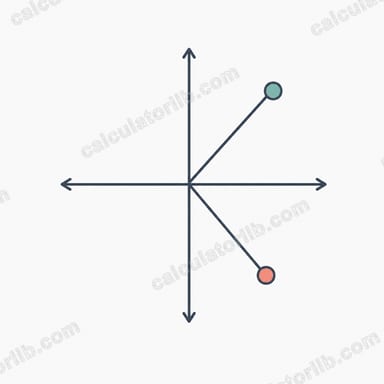
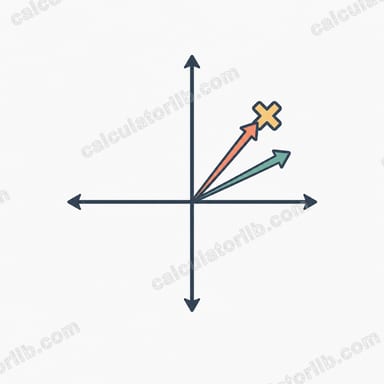
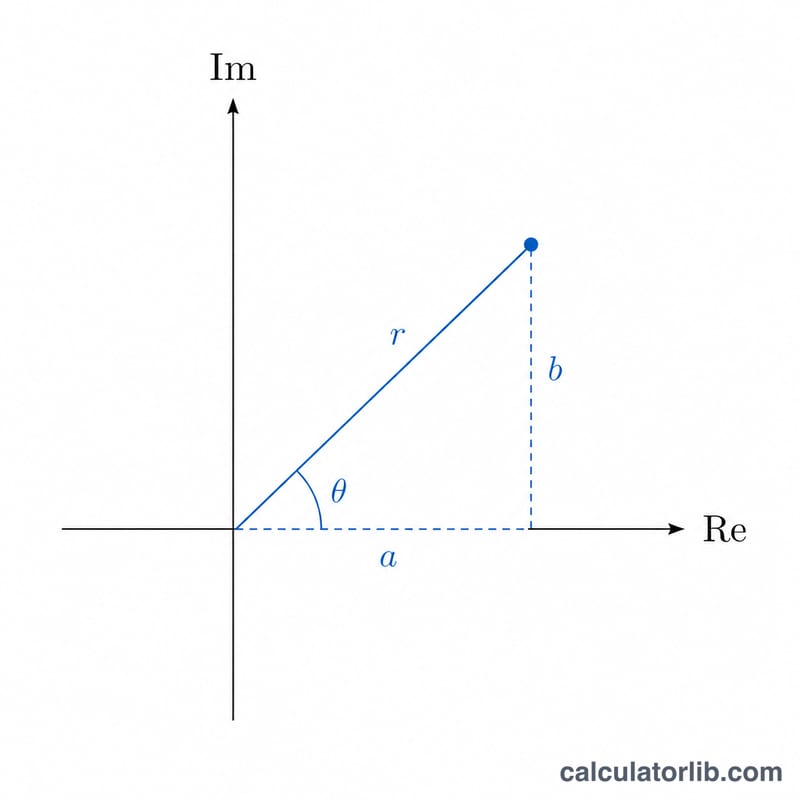
A complex number is written as \(a + bi\), where a is the real part and b is the imaginary part. The modulus (also called the absolute value or magnitude) is the distance from the origin to the point (a, b) in the complex plane. This calculator computes that distance and also reports the argument (the angle) of the number.
How to use this calculator
Enter the real part a and the imaginary part b of your complex number. The tool instantly returns \(|a + bi|\), the squared components a² and b² that go into the calculation, and the argument in both radians and degrees.
The formula explained
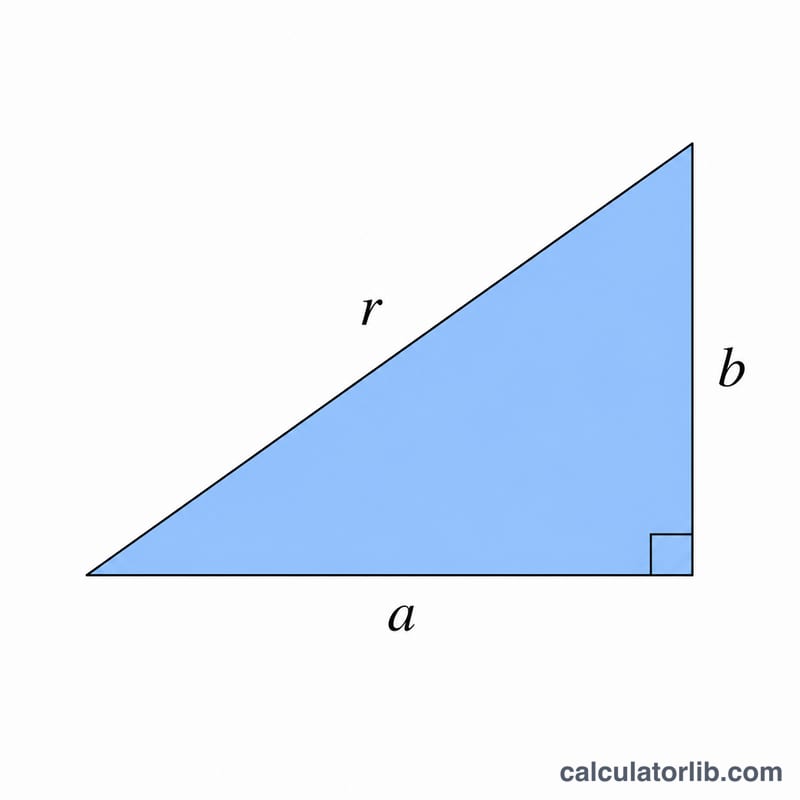
The modulus is given by $$|a + bi| = \sqrt{a^2 + b^2}.$$ This is a direct application of the Pythagorean theorem: a and b form the two legs of a right triangle, and the modulus is the hypotenuse. Because both terms are squared, the result is always non-negative. The argument is found with \(\operatorname{atan2}(b, a)\), which correctly handles every quadrant.
Worked example
For the complex number 3 + 4i, we compute \(a^2 = 9\) and \(b^2 = 16\). Adding them gives 25, and the square root of 25 is 5. So $$|3 + 4i| = 5.$$ The argument is \(\operatorname{atan2}(4, 3) \approx 0.9273\) radians, or about 53.13°.
Common Complex Numbers and Their Modulus
Moduli and arguments for frequently used complex numbers. Arguments use the principal value from \(\operatorname{atan2}(b,a)\), in the range \((-180^\circ, 180^\circ]\).
| \(a+bi\) | Modulus \(|a+bi|\) | Argument (radians) | Argument (degrees) |
|---|---|---|---|
| \(1+0i\) | 1 | 0 | 0° |
| \(0+1i\) | 1 | \(\pi/2 \approx 1.5708\) | 90° |
| \(1+i\) | \(\sqrt{2} \approx 1.4142\) | \(\pi/4 \approx 0.7854\) | 45° |
| \(3+4i\) | 5 | \(\approx 0.9273\) | \(\approx 53.13°\) |
| \(-1+i\) | \(\sqrt{2} \approx 1.4142\) | \(3\pi/4 \approx 2.3562\) | 135° |
| \(1-i\) | \(\sqrt{2} \approx 1.4142\) | \(-\pi/4 \approx -0.7854\) | −45° |
| \(-1-i\) | \(\sqrt{2} \approx 1.4142\) | \(-3\pi/4 \approx -2.3562\) | −135° |
| \(5+12i\) | 13 | \(\approx 1.1760\) | \(\approx 67.38°\) |
| \(0+0i\) | 0 | 0 (undefined) | 0° (undefined) |
Note: the argument of \(0+0i\) is undefined because the point is at the origin; most implementations return 0 by convention.
Key Terms
- Complex number
- A number of the form \(a + bi\), where \(a\) and \(b\) are real numbers and \(i\) is the imaginary unit satisfying \(i^2 = -1\).
- Real part (a)
- The component \(a\) of \(a+bi\) that lies along the horizontal (real) axis of the complex plane.
- Imaginary part (b)
- The real coefficient \(b\) of the imaginary unit in \(a+bi\); it lies along the vertical (imaginary) axis. Note that the imaginary part is the number \(b\), not \(bi\).
- Modulus / absolute value
- The distance from the origin to the point \((a,b)\) in the complex plane, written \(|a+bi| = \sqrt{a^2 + b^2}\). It is always non-negative.
- Argument
- The angle \(\theta\) between the positive real axis and the line from the origin to \((a,b)\), measured counterclockwise. Combined with the modulus it gives the polar form \(z = r(\cos\theta + i\sin\theta)\).
- Complex plane
- A two-dimensional plane (also called the Argand diagram) in which the horizontal axis represents the real part and the vertical axis represents the imaginary part, letting each complex number be plotted as a point.
- atan2 function
- A two-argument arctangent, \(\operatorname{atan2}(b, a)\), that returns the correct angle in all four quadrants (range \((-\pi, \pi]\)). Unlike plain \(\arctan(b/a)\), it uses the signs of both \(a\) and \(b\) to place the angle in the proper quadrant.
FAQ
Is the modulus ever negative? No. Because it is a square root of a sum of squares, the modulus is always zero or positive.
What if both a and b are zero? Then the modulus is 0 and the argument is conventionally taken as 0.
What is the difference between modulus and argument? The modulus is how far the number is from the origin, while the argument is the direction (angle) from the positive real axis.