
What Is Basal Area?
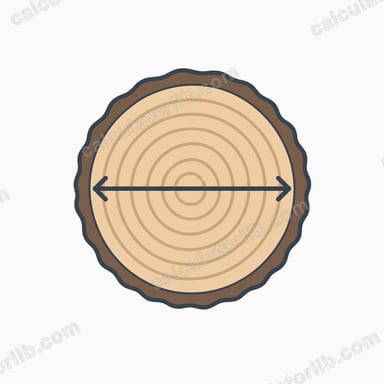
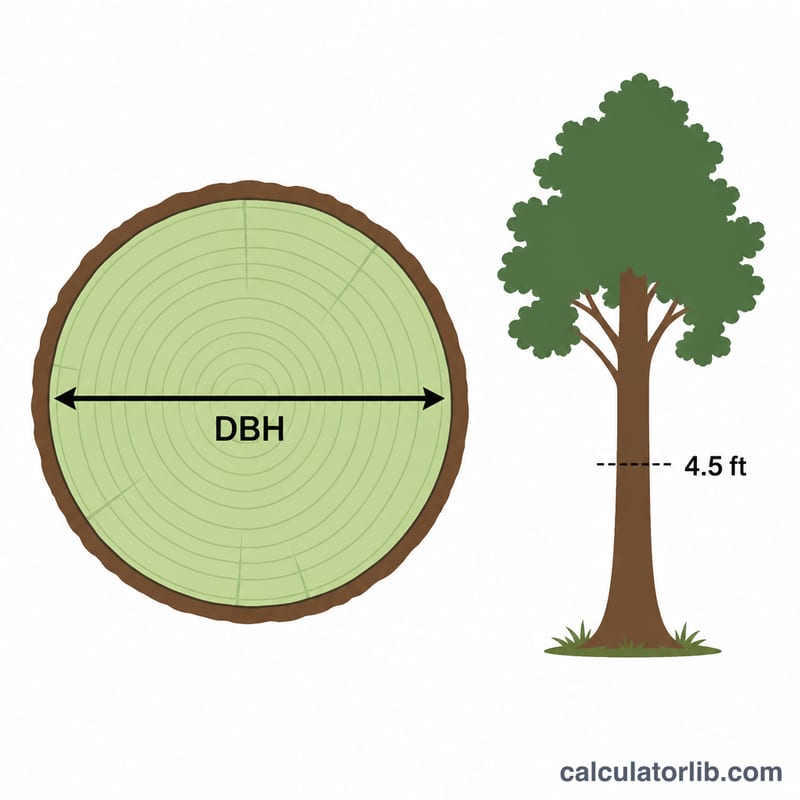
Basal area is the cross-sectional area of a tree trunk measured at breast height (4.5 ft / 1.37 m above the ground), expressed in square feet. Foresters use it to quantify tree density and stand stocking, plan thinning, and estimate timber volume. The measurement at this standard height is called the diameter at breast height, or DBH.
How to Use This Calculator
Enter the tree's DBH in inches. The calculator returns the basal area of a single tree in square feet. If you want a stand or plot total, enter the number of trees and the tool multiplies the per-tree value to give total basal area.
The Formula Explained
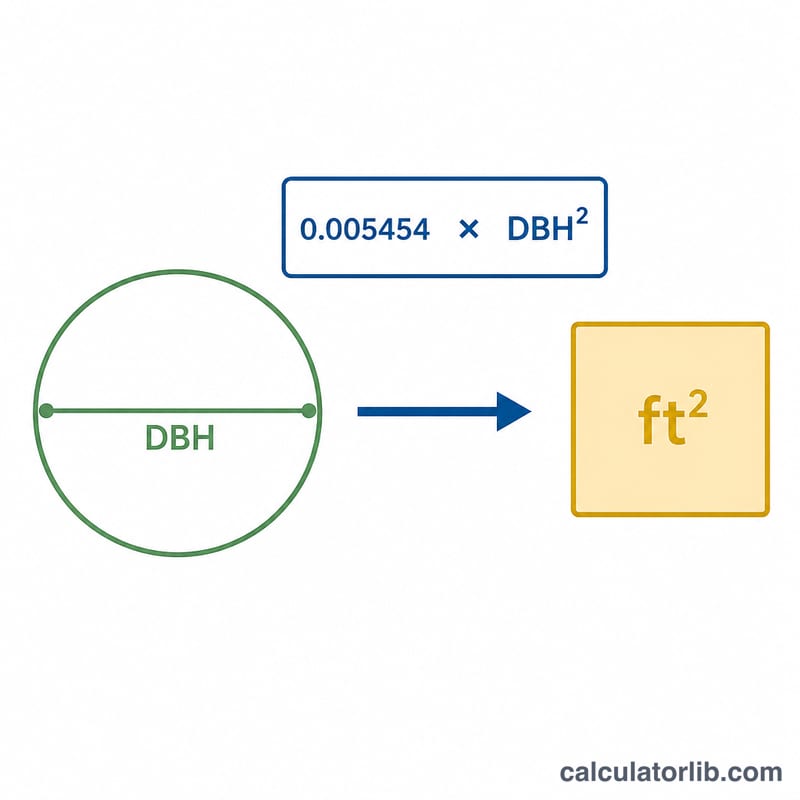
Basal area is simply the area of a circle, \(A = \frac{\pi}{4} \times d^2\). When the diameter is in inches and we want the answer in square feet, the conversion folds neatly into a single constant: $$A\,(\text{ft}^2) = \frac{\pi}{4} \times \frac{\text{DBH}^2}{144} = 0.005454 \times \text{DBH}^2$$ So the only input you need is the DBH in inches.
Worked Example
For a tree with a 12-inch DBH: $$0.005454 \times 12^2 = 0.005454 \times 144 = 0.7854 \text{ square feet}$$ A stand of 50 such trees would have a total basal area of $$0.7854 \times 50 = 39.27 \text{ square feet}$$
Basal Area by DBH Reference Table
Basal area (BA) is the cross-sectional area of a tree's stem measured at breast height (4.5 ft above ground). In U.S. forestry it is computed from diameter at breast height (DBH) in inches using the constant 0.005454, which converts \(\pi/4\) of square inches into square feet:
$$\text{BA}_{\text{tree}} = 0.005454 \times \text{DBH}^{2}$$
For example, a 10-inch tree has \(0.005454 \times 10^{2} = \) 0.5454 sq ft of basal area. The table below lists common DBH values and their per-tree basal area.
| DBH (in) | Per-Tree Basal Area (sq ft) |
|---|---|
| 2 | 0.0218 |
| 4 | 0.0873 |
| 6 | 0.1963 |
| 8 | 0.3491 |
| 10 | 0.5454 |
| 12 | 0.7854 |
| 14 | 1.0690 |
| 16 | 1.3962 |
| 18 | 1.7671 |
| 20 | 2.1816 |
| 24 | 3.1415 |
| 30 | 4.9086 |
Interpreting Your Basal Area Result
While per-tree basal area is a single stem's cross-section, the more useful management metric is basal area per acre — the sum of all stem basal areas on an acre, expressed in square feet per acre (sq ft/ac). It is a direct measure of stand density (stocking) and is widely used in forestry stocking guides to decide whether a stand is understocked, fully stocked, or overstocked.
Typical published ranges for managed timber stands generally fall between about 60 and 120 sq ft/ac after thinning and at rotation, though target levels vary by species, site quality, and management objective:
- Below ~60 sq ft/ac: Often considered understocked — growing space is not fully used, so individual trees grow fast but total wood production per acre is below potential.
- ~60–100 sq ft/ac: A common managed range for many sawtimber objectives, balancing individual tree growth with stand-level volume.
- Above ~120 sq ft/ac: Frequently signals an overstocked stand where competition slows diameter growth and increases susceptibility to insects, disease, and mortality — a typical trigger for a thinning treatment.
Many region- and species-specific stocking guides (such as those based on the Reineke stand density index and published USDA Forest Service stocking charts) set explicit thinning thresholds. As a general rule, thinning back to roughly 60–80 sq ft/ac of residual basal area is a common prescription to relieve competition while keeping the site productive. Always consult the stocking guide appropriate to your forest type and consult a professional forester for site-specific prescriptions; this is general educational information, not a management prescription.
Basal Area Across Stand Scenarios
The scenarios below show how DBH and tree count combine to produce total stand basal area. For mixed stands, per-tree basal area is computed for each size class and summed. All values use \(0.005454 \times \text{DBH}^{2}\).
| Scenario | DBH (in) | Tree Count | Per-Tree BA (sq ft) | Total BA (sq ft) |
|---|---|---|---|---|
| Young uniform stand | 10 | 100 | 0.5454 | 54.54 |
| Mature sawtimber | 16 | 50 | 1.3962 | 69.81 |
| Large legacy trees | 24 | 40 | 3.1415 | 125.66 |
| Mixed stand (12 in × 30) | 12 | 30 | 0.7854 | 23.56 |
| Mixed stand (16 in × 20) | 16 | 20 | 1.3962 | 27.92 |
| Mixed stand (20 in × 10) | 20 | 10 | 2.1816 | 21.82 |
| Mixed stand total | — | 60 | — | 73.30 |
The mixed stand sums the three size classes (23.56 + 27.92 + 21.82 = 73.30 sq ft). If these totals represent the trees tallied on one acre, the large-legacy and high-density scenarios approach or exceed the ~120 sq ft/ac overstocked threshold discussed above, while the young uniform stand at 54.54 sq ft/ac would be considered lightly stocked.
FAQ
Why 0.005454? It combines the circle-area factor \(\frac{\pi}{4}\) (\(\approx 0.7854\)) with the inch²-to-foot² conversion (\(\div 144\)), giving \(0.7854 \div 144 \approx 0.005454\).
Is DBH always in inches here? Yes. This US/imperial version expects DBH in inches and outputs square feet. For metric, basal area is usually \(g = \frac{\pi}{4} \times \left(\frac{\text{DBH}}{100}\right)^2\) with DBH in cm to get m².
What does total basal area tell me? Per-acre basal area is a key stocking metric: higher values mean a denser stand, which guides thinning and harvest decisions.