What this calculator does
The Date & Time Duration Calculator measures the exact length of time between two moments. You enter a Start Date & Time and an End Date & Time, and the tool returns the precise interval between them — broken down into days, hours, minutes and seconds. It is useful for project planning, hourly billing, shift tracking, event scheduling, and any situation where you need an accurate elapsed-time figure rather than a rough estimate. The calculator is region-flexible: it accepts ISO (yyyy-MM-dd), US (MM/dd/yyyy), and European (dd/MM/yyyy) styles, with or without a time component, and with 24-hour or AM/PM clocks.
How to use it
- Enter the Start Date & Time — for example
2024-03-01 09:00. - Enter the End Date & Time — for example
2024-03-04 17:30. - Submit to see the total duration between the two points.
If you leave the time off a date, the calculator treats it as midnight (00:00) at the start of that day. You can mix formats, but keeping both fields in the same style avoids ambiguity (for instance, 03/04 could be read as March 4 or April 3 depending on locale).
The formula explained
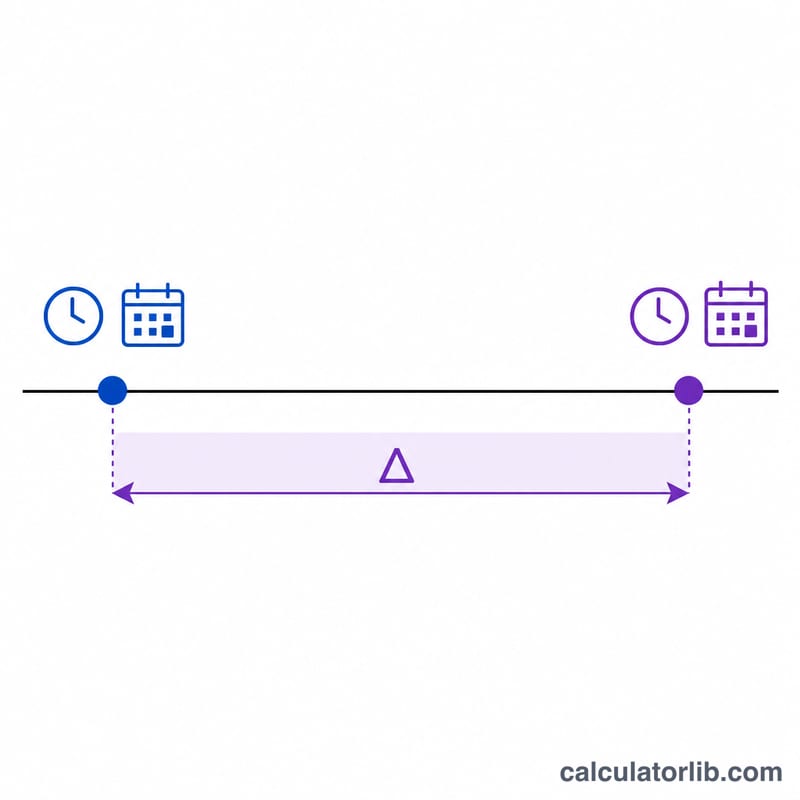
The calculation is simply the difference between the two timestamps: Duration = End − Start. Both dates are converted to a single point in time (effectively a count of milliseconds since a fixed reference), the start is subtracted from the end, and the result is converted into human-readable units. Because it works on absolute timestamps, it correctly accounts for month lengths and leap years.
Worked example
Start: 2024-03-01 09:00. End: 2024-03-04 17:30.
- Full days between the dates: 3 days (1st → 4th).
- Time difference within the day: 09:00 to 17:30 = 8 hours 30 minutes.
Total duration = 3 days, 8 hours and 30 minutes, or 80.5 hours.
Time Unit Conversion Table
The units below split into two groups. Seconds, minutes, hours, days and weeks are exact by definition — a duration expressed in one can always be converted to another with a fixed factor. Months and years are calendar units and have no fixed length, so any figure given for them is an average or a specific-case value and is marked approximate.
Exact conversions
| Unit | Seconds | Minutes | Hours | Days | Weeks |
|---|---|---|---|---|---|
| 1 second | 1 | 0.016667 | 0.000278 | 0.00001157 | 0.00000165 |
| 1 minute | 60 | 1 | 0.016667 | 0.000694 | 0.0000992 |
| 1 hour | 3,600 | 60 | 1 | 0.041667 | 0.005952 |
| 1 day | 86,400 | 1,440 | 24 | 1 | 0.142857 |
| 1 week | 604,800 | 10,080 | 168 | 7 | 1 |
Calendar units (approximate)
| Unit | Days | Hours | Seconds | Status |
|---|---|---|---|---|
| Average month | ≈ 30.44 | ≈ 730.5 | ≈ 2,629,746 | Approximate — real months run 28–31 days |
| Common year | 365 | 8,760 | 31,536,000 | Exact for that specific year |
| Leap year | 366 | 8,784 | 31,622,400 | Exact for that specific year |
| Average Gregorian year | 365.2425 | 8,765.82 | ≈ 31,556,952 | Approximate — long-run calendar average |
The average month follows directly from the average year: \(365.2425 \div 12 = 30.436875\) days, usually rounded to 30.44. Use these only for rough estimates; for billing or contracts, count the actual calendar days between the two dates.
One duration in several units
The same interval — 3 days, 8 hours, 30 minutes — written four ways:
| Mixed form | Hours | Minutes | Seconds |
|---|---|---|---|
| 3 d 8 h 30 min | 80.5 | 4,830 | 289,800 |
The arithmetic, step by step:
$$(3 \times 24) + 8 + \tfrac{30}{60} = 72 + 8 + 0.5 = 80.5\ \text{hours}$$$$80.5 \times 60 = 4{,}830\ \text{minutes} \qquad 4{,}830 \times 60 = 289{,}800\ \text{seconds}$$Duration Across Common Scenarios
The cases below cover the situations that most often produce a surprising answer: shifts that cross midnight, spans that contain 29 February, date-only entries, and days on which the local clock changes.
| Start | End | Result | Note |
|---|---|---|---|
| 2024-05-10 08:15 | 2024-05-10 17:45 | 9 hours 30 minutes | Same-day shift. Unpaid breaks are not deducted — subtract them yourself. |
| 2024-05-10 22:00 | 2024-05-11 06:30 | 8 hours 30 minutes | Overnight shift. The date rolls over, but the elapsed time is still under 9 hours. |
| 2024-02-28 12:00 | 2024-03-01 12:00 | 2 days (48 hours) | 2024 is a leap year, so 29 February sits inside the span. |
| 2023-02-28 12:00 | 2023-03-01 12:00 | 1 day (24 hours) | Identical dates, non-leap year — exactly one day shorter. |
| 2024-06-01 00:00 | 2024-06-15 00:00 | 14 days | Date-only entry: both ends default to midnight, so this is the exclusive count. Counting both endpoints as calendar days gives 15. |
| 2024-03-10 00:00 | 2024-03-11 00:00 | 24 hours (23 hours of local wall-clock time in US/Canada DST zones) | Spring-forward day in the United States and Canada; the European Union shifts on the last Sunday in March instead, and much of the world never shifts at all. |
Why the clock-change row differs
The calculator works on absolute timestamps — the true amount of time that passed — not on wall-clock arithmetic. On 10 March 2024 in a US time zone that observes daylight saving time, local clocks jumped from 02:00 to 03:00, so only 23 hours of real time elapsed between local midnight and the next local midnight, even though the labels differ by one calendar day. Enter times as they appear on the clock in a single consistent zone, and be explicit with anyone reviewing the figure about which zone that is. For payroll or contractual durations spanning a clock change, state whether you are billing elapsed hours or nominal calendar days.
Inclusive counting
The 1–15 June example is the classic trap. The subtraction gives
$$\text{15 June} - \text{1 June} = 14\ \text{days}$$which is right for interest accrual, rental nights or notice periods. Contexts that count both the first and last day — event lengths, some leave policies, some legal deadlines — add one, giving 15 days. Neither is more correct; check which convention your document uses before quoting a number.
Key Terms Explained
- Start date-time
- The earlier of the two moments, given as a calendar date plus a time of day. If no time is entered, most tools assume 00:00 (midnight at the beginning of that date).
- End date-time
- The later moment. If the end precedes the start, the result is a negative duration — usually a sign that the dates were swapped or a midnight rollover was missed.
- Duration (elapsed time)
- The amount of time that passed between the two moments, obtained by subtracting the start from the end. It is a length, not a position on the calendar, and can be expressed in any unit.
- Timestamp (epoch milliseconds)
- A single number representing an instant as the count of milliseconds since 1 January 1970 00:00:00 UTC — the Unix epoch. Converting both ends to timestamps and subtracting is how duration is computed internally, which is why clock changes and month lengths never distort the result.
- Inclusive vs. exclusive counting
- Exclusive counting counts the gaps between days (1 June to 3 June = 2 days); inclusive counting counts the days themselves, including both endpoints (= 3 days). Contracts, leave policies and legal deadlines vary in which they use.
- Calendar day vs. 24-hour period
- A calendar day is a dated block from midnight to midnight; a 24-hour period is a fixed span of 86,400 seconds starting at any moment. They coincide except on days when local clocks shift, when a calendar day may last 23 or 25 hours locally.
- Business day
- A working day, conventionally Monday to Friday excluding public holidays. Which days count as holidays is entirely country- and often region-specific, so a business-day count is never portable across jurisdictions without naming the holiday calendar used. Plain duration calculators count every day.
- UTC (Coordinated Universal Time)
- The global time standard against which all civil time zones are defined. It does not observe daylight saving time, which makes it the safe reference for logs, contracts and cross-border scheduling.
- Local time and UTC offset
- Local time is UTC shifted by a fixed offset, written like UTC+01:00 or UTC−05:00. A zone's offset can change during the year if it observes daylight saving time; a few zones use offsets that are not whole hours.
- Daylight saving time (DST)
- The seasonal practice of moving clocks forward in spring and back in autumn. Adoption and dates differ by country — the United States and Canada change in March and November, the European Union on the last Sundays of March and October, and large parts of Africa and Asia do not change at all. Never assume a clock change applies to a reader elsewhere.
- Leap year
- A year with a 29 February, so 366 days. In the Gregorian calendar a year is a leap year if it is divisible by 4, except century years, which must also be divisible by 400. So 2024 and 2000 are leap years; 1900 and 2100 are not.
- ISO 8601
-
The international standard format for dates and times, written largest unit first:
2024-05-10T17:45:00, optionally with a zone designator such asZfor UTC or+02:00. It sorts correctly as plain text and removes the ambiguity between day-first and month-first national conventions.
FAQ
Does it count leap years and varying month lengths? Yes. Because it compares actual calendar timestamps, February 29 and 30- or 31-day months are handled automatically.
What if I only enter a date with no time? The missing time defaults to midnight (00:00), so the duration is measured from the start of that day.
Can the end date be earlier than the start date? The calculator measures from start to end; for a clean positive result, put the earlier moment in the Start field and the later moment in the End field.