What is the Days Until December Calculator?
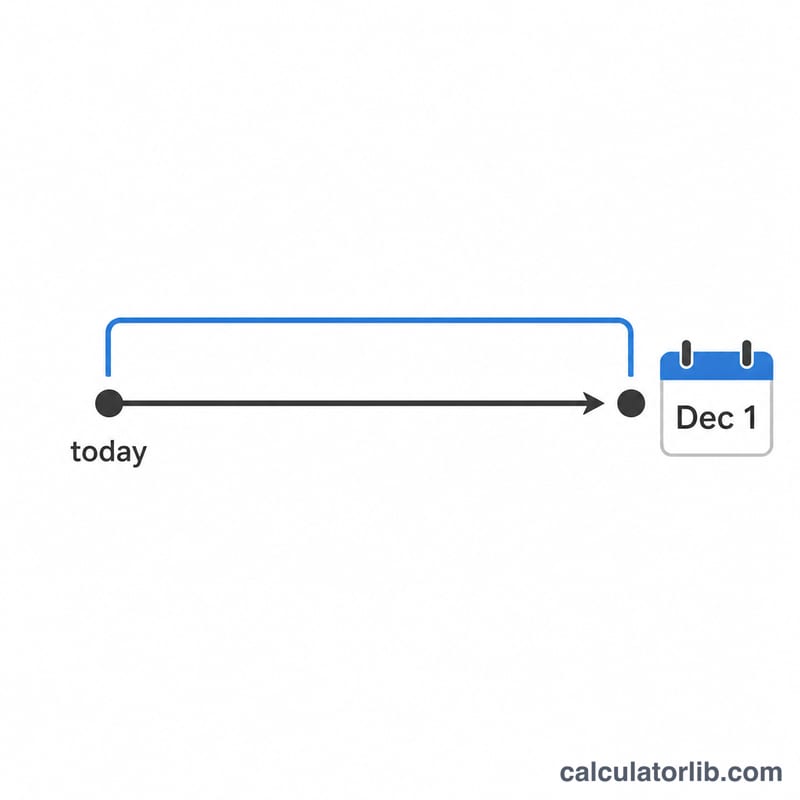
This tool tells you exactly how many days remain until the next December 1st. December is the start of the festive holiday season for many people, so counting down to it helps with shopping, travel planning, event scheduling, and gift preparation. Simply enter a starting date and the calculator returns the number of days (and weeks) until December 1st arrives.
How to use it
The "Count from date" field defaults to today's date. Leave it as is for a live countdown, or change it to any date you like — past or future — to see how many days separate that date from the upcoming December 1st. The result updates the day count, the equivalent number of weeks, and the exact target date (December 1 of the relevant year).
The formula explained
The calculation is a straightforward date difference: days = next December 1 − your date. If your date falls before December 1 of the same year, the calculator counts to that December. If your date is in December (after the 1st), it counts forward to December 1 of the following year, because this December has already begun. Each whole day is 24 hours measured from midnight to midnight.
$$\text{Days} = \text{Dec 1, } Y_{t} - \text{Count from date}$$
$$\begin{gathered} \text{Days} = \left\lfloor \frac{\text{Dec 1, } Y_{t} - \text{Count from date}}{1\ \text{day}} \right\rceil \\[1.5em] \text{where}\quad Y_{t} = \begin{cases} \text{year} + 1, & \text{if in December after Dec 1} \\ \text{year}, & \text{otherwise} \end{cases} \end{gathered}$$
Worked example
Suppose your chosen date is November 1, 2024. November has 30 days, so from November 1 to November 30 is 29 days, and one more day reaches December 1 — a total of 30 days. The calculator displays 30 days, which is about 4.29 weeks, with a target date of December 1, 2024.
$$\text{Days} = \text{Dec 1, 2024} - \text{Nov 1, 2024} = 30 \text{ days} \approx 4.29 \text{ weeks}$$
More Worked Examples
The countdown always targets December 1 at 00:00. The target year follows one simple rule: if the start date falls before December 1 of its own year \(Y\), the target is Dec 1 of \(Y\); if it falls on or after December 1, the target rolls forward to Dec 1 of \(Y+1\). Weeks are always reported as \(\text{days} \div 7\). The examples below use the Gregorian calendar (the civil calendar used in most of the world), and all day counts are exclusive of the start date and inclusive of the target day — i.e. the number of midnights between the two dates.
Example 1 — A start date inside December (the roll-forward case)
Count-from date: December 15, 2026. Because Dec 15, 2026 is already past December 1 of 2026, the rule selects the next December: target = Dec 1, 2027.
Split the span at the year boundary:
- Remaining days of 2026 after Dec 15: Dec 16 → Dec 31 = 16 days
- Days into 2027 up to the target: Dec 1, 2027 is the 335th day of 2027 (2027 is a common year, 365 days) = 335 days
So from Dec 15, 2026 there are 351 days until December.
$$\text{Weeks} = \frac{351}{7} = 50.142857\ldots \approx 50.1 \text{ weeks}$$Sanity check without any tables: Dec 15, 2026 → Dec 15, 2027 is exactly 365 days (no Feb 29 in between), and Dec 1 is 14 days earlier, so \(365 - 14 = 351\). ✓
Example 2 — A span that crosses a leap day
Count-from date: February 1, 2028. Feb 1 is before December 1 of the same year, so target = Dec 1, 2028 — the same year. 2028 is a leap year (divisible by 4 and not a century year), so February 29, 2028 is counted.
Month-by-month tally of whole months from Feb 1 to Dec 1:
| Month traversed | Days added | Running total |
|---|---|---|
| February 2028 (Feb 1 → Mar 1, includes Feb 29) | 29 | 29 |
| March (Mar 1 → Apr 1) | 31 | 60 |
| April | 30 | 90 |
| May | 31 | 121 |
| June | 30 | 151 |
| July | 31 | 182 |
| August | 31 | 213 |
| September | 30 | 243 |
| October | 31 | 274 |
| November (Nov 1 → Dec 1) | 30 | 304 |
The countdown from Feb 1, 2028 is therefore 304 days.
$$\text{Weeks} = \frac{304}{7} = 43.428571\ldots \approx 43.4 \text{ weeks}$$Day-of-year check: in a leap year Dec 1 is day 336 and Feb 1 is day 32, so \(336 - 32 = 304\). ✓ In a common year the same calendar span would be 303 days — the single extra day is Feb 29.
Example 3 — A mid-year start date
Count-from date: July 4, 2026. July precedes December, so target = Dec 1, 2026 (same year; 2026 is a common year).
Add the remainder of the starting month, then each full month, then the final day:
| Segment | Days |
|---|---|
| Rest of July (Jul 5 → Jul 31) | 27 |
| August | 31 |
| September | 30 |
| October | 31 |
| November | 30 |
| December 1 itself | 1 |
| Total | 150 |
From July 4, 2026 the result is 150 days until December.
$$\text{Weeks} = \frac{150}{7} = 21.428571\ldots \approx 21.4 \text{ weeks}$$Day-of-year check: in a common year Dec 1 is day 335 and July 4 is day 185, so \(335 - 185 = 150\). ✓ Expressed in whole weeks plus a remainder, that is 21 weeks and 3 days, which also means Dec 1, 2026 falls 3 weekdays later in the week than July 4, 2026.
What the three cases show
- Only the calendar date matters, never the time of day — the tool counts whole days to Dec 1.
- A start date in December (Dec 1 through Dec 31) always rolls the target to the following year, which is why Example 1 returns a number close to a full year rather than a small one.
- A February 29 inside the span adds exactly one day, so the same month-and-day pair can differ by one day between a leap year and a common year.
FAQ
What if today is already December 1? The result is 0 days — December has arrived.
What about December 15? Because December 1 has passed, the countdown moves to December 1 of next year.
Does it account for leap years? Yes. The difference is computed from actual calendar dates, so leap days in February are automatically included when relevant.