What Is the dBm to Watts Calculator?
This tool converts a power level expressed in dBm (decibels relative to one milliwatt) into watts and milliwatts. dBm is a logarithmic unit widely used in radio frequency (RF), microwave, fiber-optic, and audio engineering because it makes large dynamic ranges easy to read and lets you add gains and losses simply. This conversion is universal physics and applies anywhere.
How to Use It
Type the power level in dBm into the input box and submit. The calculator returns the equivalent power in watts and, for convenience, in milliwatts. Positive dBm values represent power above 1 mW; 0 dBm equals exactly 1 mW, and negative values (common in receiver sensitivity figures) represent very small power levels.
The Formula Explained
The defining relationship is:
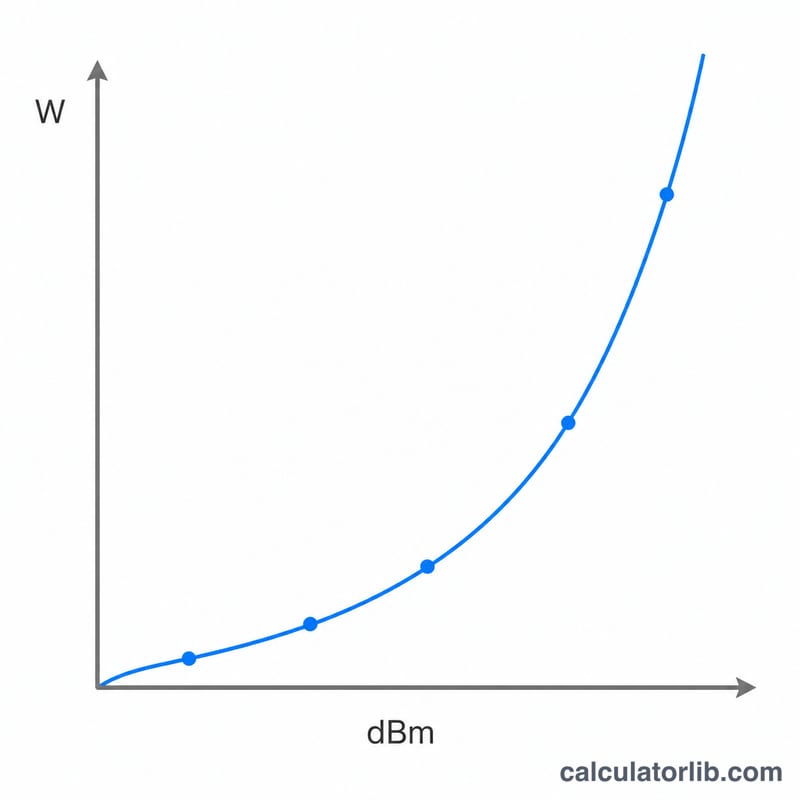
$$P_{(\text{W})} = 10^{\frac{\text{Power (dBm)} - 30}{10}}$$
The subtraction of 30 converts the milliwatt reference of dBm into watts (since 1 W = 1000 mW = 30 dB above 1 mW). The inverse is \(\text{dBm} = 10\cdot\log_{10}(P_{\text{watts}}) + 30\). Because the scale is logarithmic, every 10 dB step multiplies power by 10, and every 3 dB step roughly doubles it.
Worked Example
Convert 37 dBm to watts: $$P = 10^{\frac{37 - 30}{10}} = 10^{0.7} \approx 5.0119 \text{ W}.$$ So a cellular base station transmitting at 37 dBm puts out about 5 watts. Likewise, \(30 \text{ dBm} = 10^0 = 1 \text{ W}\) exactly.
Typical dBm Power Levels in Real Systems
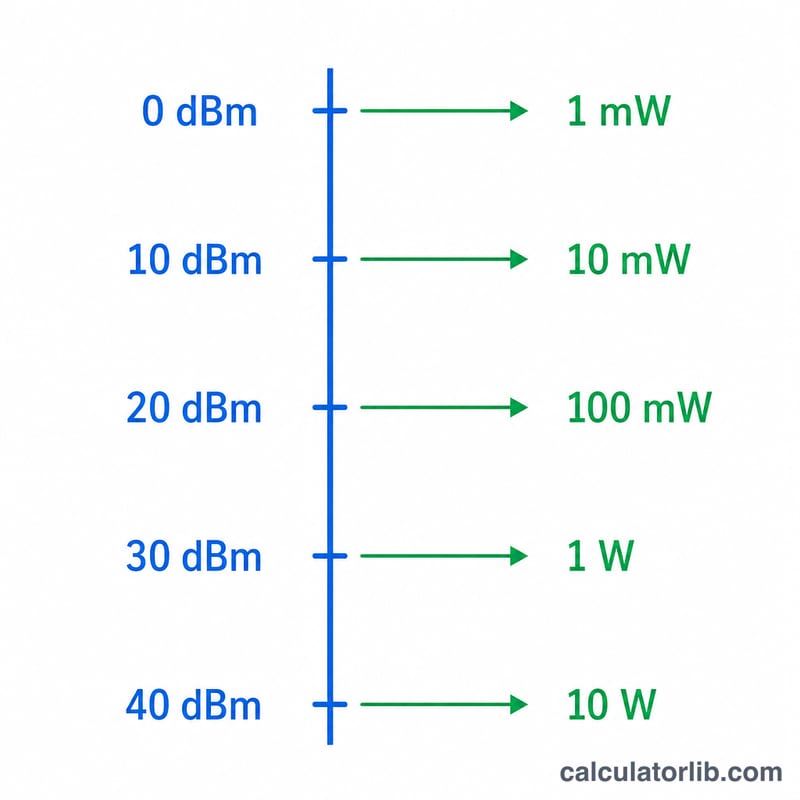
dBm expresses power relative to 1 mW, so \(0\text{ dBm} = 1\text{ mW}\) and every +10 dB is a tenfold increase. The figures below are approximate, rounded typical values. Actual limits and performance vary by standard, country, frequency band and device, so check the relevant specification or regulation (for example FCC in the US or ETSI in Europe) for exact numbers.
| System | Typical level (dBm) | Approximate power |
|---|---|---|
| Wi-Fi router/access point transmit power | about 15 to 23 dBm (capped by regional regulations) | about 32 mW to 200 mW |
| Bluetooth Class 2 transmitter | about 4 dBm | about 2.5 mW |
| Bluetooth Class 1 transmitter (maximum) | up to 20 dBm | up to 0.1 W (100 mW) |
| Cellular handset, maximum (e.g. LTE power class 3) | about 23 dBm | about 200 mW |
| Cellular base station (per carrier or port, macro cell) | about 40 to 46 dBm | about 10 W to 40 W |
| Wi-Fi received signal strength (RSSI) | about -30 dBm (very strong) to -90 dBm (near noise floor) | about 1 µW down to 1 pW |
| GPS signal at the receiver antenna | about -130 dBm | about \(10^{-16}\) W (0.1 fW) |
| Optical transmitter (typical fiber-optic modules) | roughly -10 to +5 dBm, depending on type and standard | about 0.1 mW to 3 mW |
| Optical receiver sensitivity | roughly -10 to -30 dBm, depending on data rate and type | about 100 µW to 1 µW |
Notes on reading these values:
- Transmit power (what a device sends) is much higher than received power (what arrives at the antenna after path loss). The two should not be compared directly.
- For Wi-Fi, signals around -67 dBm or stronger are commonly cited as good for streaming and calls, while signals near -80 dBm or weaker are usually unreliable. These are rules of thumb, not standards.
- Radio receivers can work with extremely weak signals (such as GPS) because of signal processing gain and spread-spectrum techniques.
- Optical links have a maximum input power (overload limit) as well as a minimum sensitivity, so too much power can degrade a receiver as well as too little.
FAQ
What is 0 dBm in watts? 0 dBm equals 1 milliwatt, or 0.001 W.
Is dBm the same as dB? No. dB is a ratio between two powers, while dBm is an absolute power referenced to 1 milliwatt.
Can dBm be negative? Yes. Negative dBm simply means power less than 1 mW, common for weak received signals such as \(-90\) dBm.