What Is the Diamond Weight Calculator?
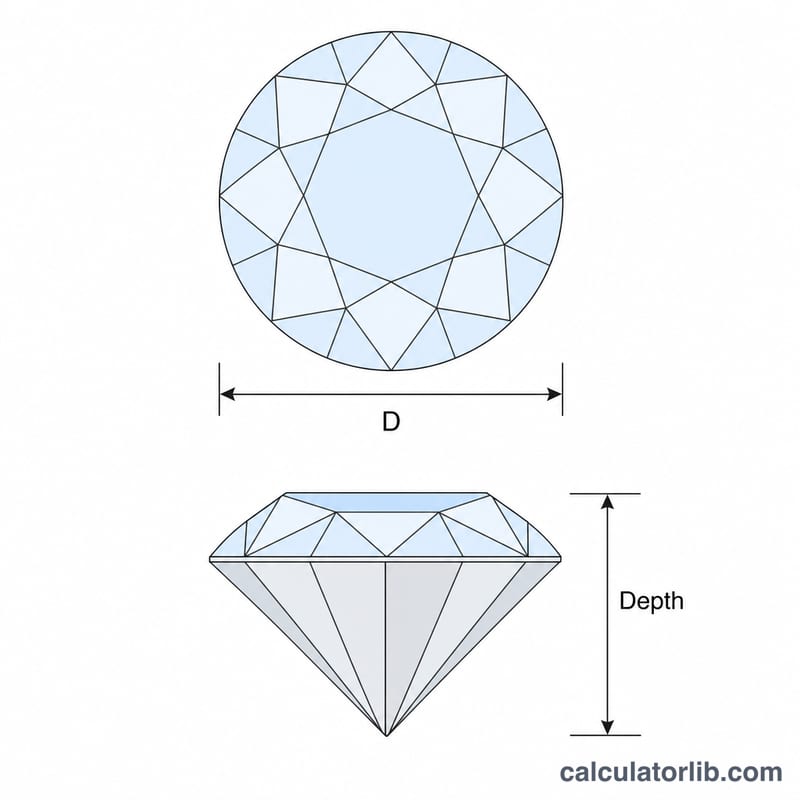
This calculator estimates the weight of a round brilliant cut diamond in carats based on its physical measurements: the average diameter and the depth, both in millimeters. It is a handy tool for jewelers, appraisers, and buyers who want to estimate carat weight without removing a stone from its setting, where a scale cannot be used.
How to Use It
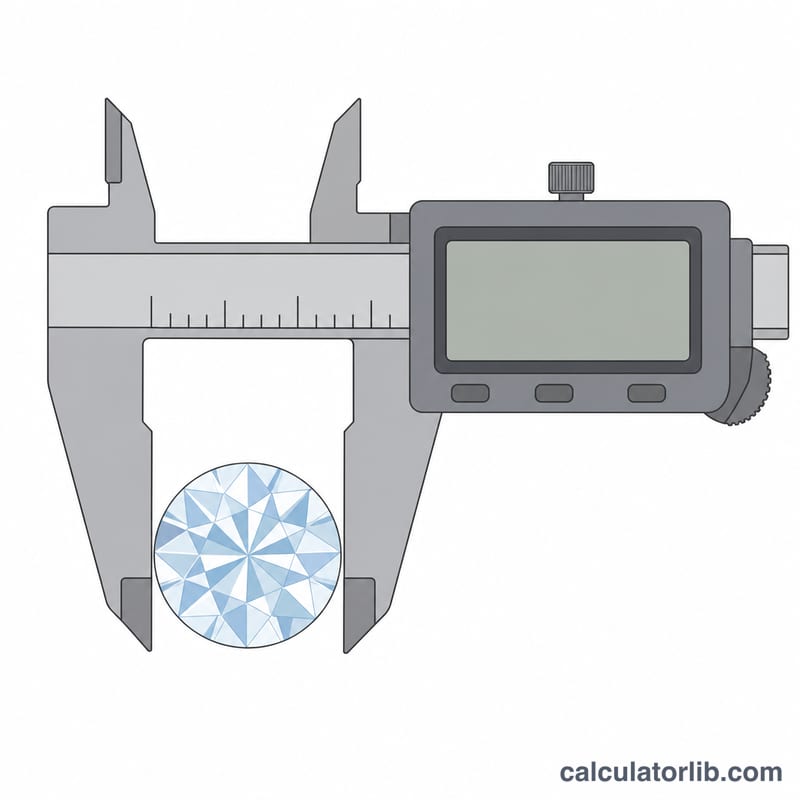
Measure the average girdle diameter of the round diamond in millimeters (average the maximum and minimum if the stone is slightly out of round). Then measure the depth from the table down to the culet. Enter both values and the calculator returns the estimated carat weight.
The Formula Explained
For a round brilliant diamond the standard estimation formula is:
$$\text{Carat} = \text{Diameter (mm)}^{2} \times \text{Depth (mm)} \times 0.0061$$
The factor 0.0061 combines the density of diamond with the geometric volume of a typical round brilliant. For stones with thick girdles or unusual proportions, a slightly higher factor (e.g. 0.0066) is sometimes used to improve accuracy.
Worked Example
Suppose a round diamond measures 6.5 mm in diameter and 4.0 mm in depth. The weight is $$6.5^{2} \times 4.0 \times 0.0061 = 42.25 \times 4.0 \times 0.0061 = 169 \times 0.0061 \approx 1.0309 \text{ carats}$$ — close to a 1-carat stone, which is typically about 6.5 mm wide.
Typical Round Brilliant Diameter by Carat Weight
The table lists approximate face-up diameters for well-cut round brilliant diamonds. Use it to sanity-check a result from the calculator. Diameter is measured across the girdle, and a typical total depth is about 59–62% of the diameter.
| Carat weight | Approx. diameter (mm) |
|---|---|
| 0.25 ct | ~4.1 |
| 0.33 ct | ~4.4 |
| 0.50 ct | ~5.1 |
| 0.75 ct | ~5.8 |
| 1.00 ct | ~6.4–6.5 |
| 1.50 ct | ~7.4 |
| 2.00 ct | ~8.1–8.2 |
| 3.00 ct | ~9.3 |
These values are approximate. Real stones vary with cut quality, girdle thickness and depth percentage, so two diamonds of the same weight can differ in diameter by a few tenths of a millimeter.
Correction Factors by Girdle Thickness and Proportions
The standard formula \(\text{Carat} = \text{Diameter}^2 \times \text{Depth} \times 0.0061\) assumes a round brilliant with a thin-to-medium girdle. A thicker girdle adds extra material, so the real weight is somewhat higher than the basic estimate. The adjustments below are approximate industry rules of thumb, not exact values.
| Girdle thickness | Approx. adjustment to estimated weight | Effective factor (approx.) |
|---|---|---|
| Thin / medium | Baseline | 0.0061 |
| Slightly thick | +1–2% | 0.0062 |
| Thick | +3–5% | 0.0063–0.0064 |
| Very thick | +5–10% | 0.0064–0.0067 |
Some references cite a higher alternative factor of 0.0066, which corresponds to roughly +8% over the baseline and fits stones with a very thick girdle.
Proportions also affect accuracy. Very deep or very shallow cuts, and stones with unusual crown or pavilion angles, can shift the true weight away from the estimate. Treat the result as an estimate, not a substitute for a scale or a grading report.
Scenario Comparison: Same Diameter, Different Depths
Each row uses a fixed diameter of 6.5 mm and the 0.0061 factor. Since \(6.5^2 = 42.25\), the weight is \(42.25 \times \text{Depth} \times 0.0061\).
| Cut | Depth (mm) | Depth % of diameter | Calculation | Estimated carats |
|---|---|---|---|---|
| Shallow | 3.7 | ~57% | \(42.25 \times 3.7 \times 0.0061\) | ~0.95 ct |
| Ideal | 4.0 | ~61.5% | \(42.25 \times 4.0 \times 0.0061\) | ~1.03 ct |
| Deep | 4.4 | ~68% | \(42.25 \times 4.4 \times 0.0061\) | ~1.13 ct |
Weight scales linearly with depth. The deep stone weighs about 19% more than the shallow one (1.13 vs 0.95 ct), yet from above all three look the same size. A deep stone hides its extra weight in the pavilion, where it cannot be seen face-up. You pay for carats that do not add visible size, and the stone may also lose brilliance. When comparing diamonds, check the depth percentage along with the carat weight and diameter.
FAQ
Is this exact? No — it is an estimate. Actual weight depends on the cut, girdle thickness, and culet. Use a scale for an exact carat weight when possible.
Does it work for fancy shapes? This formula is specific to round brilliant diamonds. Ovals, princess, and other shapes use different formulas and correction factors.
What is a typical 1-carat diameter? A well-cut 1-carat round brilliant is usually about 6.4–6.5 mm in diameter.