

What is the Earned Income Tax Credit?
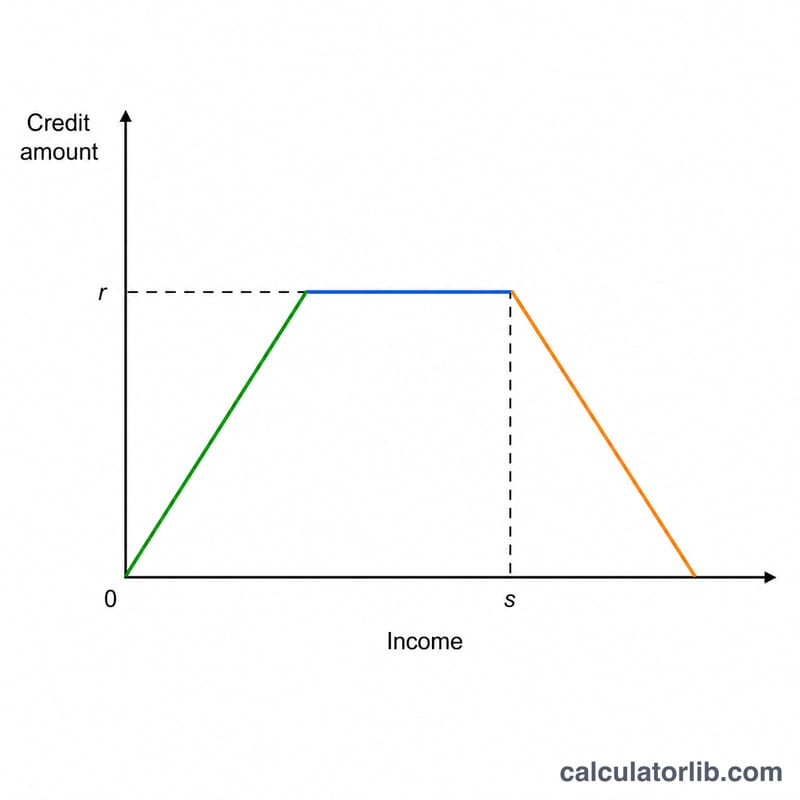
This tool estimates the United States federal Earned Income Tax Credit (EITC) for the 2026 tax year. The EITC is a refundable credit for low- to moderate-income working individuals and families. It is a US-only program administered by the IRS; the figures below use 2026 parameters and are an estimate, not tax advice.
How to use it
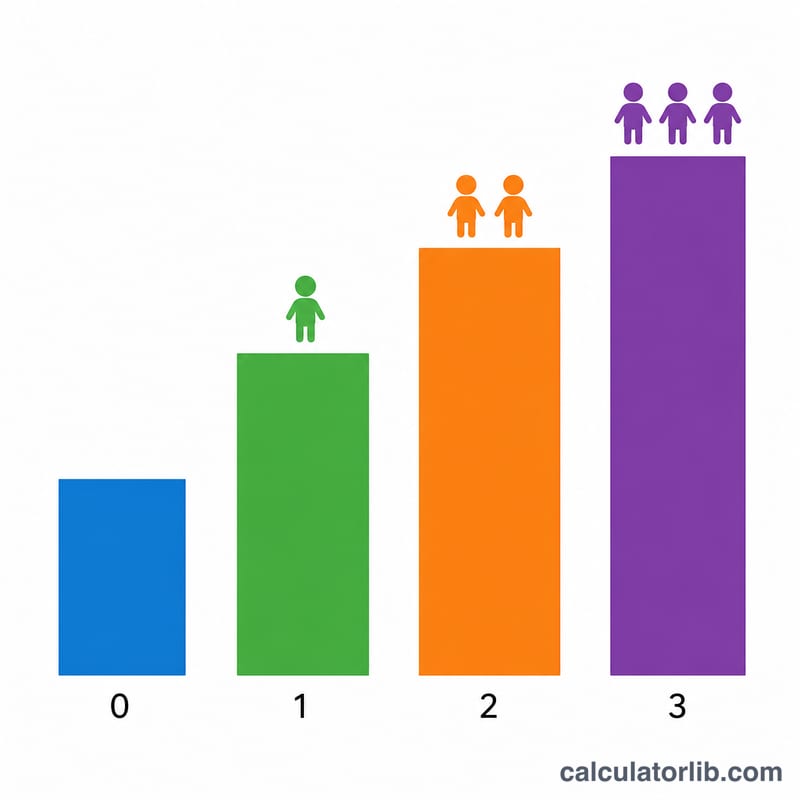
Choose your number of qualifying children (0 to 3+), select your filing status (Single/Head of Household or Married Filing Jointly), then enter your earned income and adjusted gross income (AGI). The calculator applies the correct phase-in rate up to the maximum credit, then reduces it based on the greater of your earned income or AGI.
The formula explained
$$\text{EITC} = \min\!\left(\text{earned} \times \text{credit\_rate},\; \text{max\_credit}\right) - \max\!\left(0,\; (\text{income} - \text{phaseout\_start}) \times \text{phaseout\_rate}\right)$$ The first term phases the credit in as you earn more, capped at the maximum. The second term phases it out once income exceeds the threshold. A negative result simply means the phase-out has fully eliminated the credit (treat it as \(\$0\)).
Worked example
Single filer, 0 children, $20,000 of earned income and AGI. Phase-in: $$\min(20000 \times 0.0765,\; 664) = \$664$$ Phase-out: $$(20000 - 10860) \times 0.0765 = \$699.21$$ Credit = $$664 - 699.21 = -\$35.21,$$ meaning income is above the cutoff so no credit applies.
FAQ
Why is my result negative? A negative number means your income exceeds the phase-out range — your actual EITC is \(\$0\).
Which income is used for phase-out? The IRS uses the greater of your earned income or AGI, which this calculator applies automatically.
Is this exact? It is a close estimate using 2026 parameters; investment-income limits and other eligibility rules can affect the actual credit.