



What the estimator does now
Pick your utility's tariff, or type a price per kWh and any fixed monthly charge, then enter the kWh from your bill: the total and a tier-by-tier table update as you type. Tiered tariffs from official sources are built in for Vietnam (EVN), South Korea (KEPCO), Japan (TEPCO), Taiwan, Beijing, Mumbai, Saudi Arabia, Moscow and France. Switch to One appliance to see what a device costs from its watts and hours of use.
Example: 900 kWh at the U.S. average price comes to $163.44. Price: EIA Electric Power Monthly, Table 5.6.A (U.S. residential average), August 1, 2026. The numbers you type stay in your browser.
What is the Electricity Bill Estimator?
This calculator estimates your monthly electricity bill from three simple inputs: how much energy you use in kilowatt-hours (kWh), the price you pay per kWh, and any flat fixed charge your utility adds each month. It works with any currency and any country — just enter the rate from your bill in your local currency.
How to use it
Find your monthly usage in kWh on a recent statement (or estimate it from appliance use). Enter your rate per kWh — typically a few cents — and the fixed/service charge that appears regardless of usage. The tool returns your estimated monthly bill, the energy portion, and a projected annual cost.
The formula explained
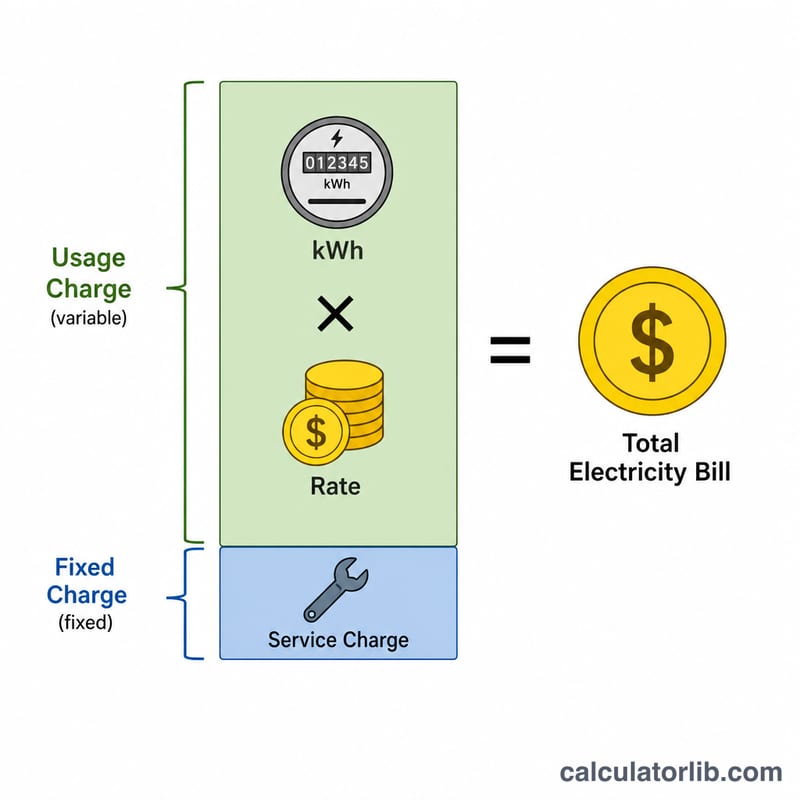
The math is straightforward: $$\text{Bill} = \text{kWh} \times \text{Rate} + \text{Fixed Charge}$$. The energy cost (\(\text{kWh} \times \text{Rate}\)) scales with how much you consume, while the fixed charge stays constant. Multiplying the monthly bill by 12 gives a rough annual estimate assuming steady usage.
Worked example
Suppose you use 900 kWh in a month, your rate is $0.15 per kWh, and the fixed charge is $10. Energy cost = \(900 \times 0.15 = \$135\). Adding the $10 fixed charge gives a monthly bill of $145, or about $1,740 per year.
Typical Appliance Energy Use (kWh per Month)
Every appliance's energy use comes from the same conversion: power (watts) multiplied by how long it runs, divided by 1,000 to turn watt-hours into kilowatt-hours.
$$\text{kWh per month} = \frac{\text{Watts} \times \text{Hours per day} \times \text{Days per month}}{1000}$$
The table below uses a 30-day month. For a 1,500 W space heater run 4 hours a day: \(1500 \times 4 \times 30 \div 1000 = 180\) kWh per month.
| Appliance / load | Typical power | Assumed use | kWh per month (30 days) |
|---|---|---|---|
| Central air conditioner (cooling season) | 3,500 W | 6 h/day | 630 |
| Electric storage water heater | 4,500 W element | 3 h/day of element run time | 405 |
| Electric vehicle, Level 2 home charging | 7,200 W | 1.5 h/day | 324 |
| Window air conditioner | 1,000 W | 8 h/day | 240 |
| Electric space heater | 1,500 W | 4 h/day | 180 |
| Clothes dryer (electric, vented) | 3,000 W | 0.75 h/day | 67.5 |
| Dishwasher (incl. heated dry) | 1,800 W | 1 h/day | 54 |
| Electric oven / range | 2,500 W | 0.5 h/day | 37.5 |
| Refrigerator (modern, compressor cycling) | 150 W while running | 8 h/day of run time | 36 |
| Desktop PC + monitor | 200 W | 5 h/day | 30 |
| Ceiling fan | 70 W | 8 h/day | 16.8 |
| Clothes washer (cold wash) | 500 W | 0.5 h/day | 7.5 |
| Ten incandescent bulbs | 60 W each = 600 W | 5 h/day | 90 |
| Ten LED bulbs (same light output) | 10 W each = 100 W | 5 h/day | 15 |
Turning kWh into money uses the calculator's formula, \(\text{Bill} = \text{kWh} \times \text{Rate} + \text{Fixed charge}\). A household that totals 900 kWh in a month on a rate of $0.16 per kWh with a $12 monthly service charge pays:
$$\text{Bill} = 900 \times \$0.16 + \$12 = \$144.00 + \$12 = \$156.00$$
That is $156.00 for the month, or about $1,872 a year if usage and rates held steady.
These figures are typical ranges, not measurements of your equipment. Actual use varies widely with model, age, efficiency rating, insulation, climate, thermostat setting and household habits — a heat-pump water heater or an inverter air conditioner can use less than half the energy shown here. Electricity prices also differ enormously by country and utility: the $0.16 per kWh used above is a rough United States residential figure, while rates elsewhere may be a fraction of that or several times higher. Check the rate printed on your own bill, and read your appliance's nameplate or energy label for its real wattage.
Key Terms on Your Electricity Bill
Bill formats differ by country and utility, so not every term below appears on every bill — but these are the concepts that determine what you pay.
- Kilowatt (kW) — a unit of power: the rate at which energy is being used at a given instant. One kilowatt equals 1,000 watts, roughly a microwave oven running at full power.
- Kilowatt-hour (kWh) — a unit of energy: one kilowatt drawn for one hour. This is what your meter counts and what you are billed for, so a 2 kW heater running 3 hours uses 6 kWh.
- Rate (price per kWh) — the amount charged for each kilowatt-hour of energy, expressed in currency per kWh (for example $0.16/kWh). Multiply it by your metered usage to get the variable part of the bill.
- Fixed charge (service or customer charge) — a flat monthly amount billed regardless of how much energy you use, covering metering, billing and grid connection. It is stated as a currency amount per month and is the reason a bill is never zero even in an empty home.
- Supply (generation / energy) charge — the portion of the bill that pays for producing or procuring the electricity itself, in currency per kWh. In deregulated markets this part may come from a competitive supplier you choose.
- Delivery (distribution / transmission) charge — the portion that pays the utility for moving electricity over wires to your meter, also usually billed per kWh plus a fixed component. Supply and delivery added together give your effective all-in rate per kWh.
- Tiered (block) rates — a structure where the first block of kWh each month is billed at one price and additional blocks at higher (occasionally lower) prices. For example, the first 500 kWh at one rate and everything above it at a higher rate, so heavy months cost disproportionately more.
- Time-of-use (TOU) rates — prices that change by hour of day, day of week or season, with expensive on-peak periods and cheaper off-peak periods. Shifting laundry, dishwashing or EV charging into off-peak hours lowers the bill without reducing total kWh.
- Demand charge — a charge based on your highest sustained power draw during the billing period, measured in kW (often the peak 15- or 30-minute average) rather than total kWh. It is standard on commercial and industrial accounts and appears on some residential tariffs.
- Net metering — a billing arrangement for customers with on-site generation such as rooftop solar, where energy exported to the grid offsets energy imported from it. The credit rate and rules vary by jurisdiction; some programs credit exports at the full retail rate, others at a lower export rate.
- Estimated vs actual meter reading — an actual reading comes from the meter itself (read on site or transmitted by a smart meter), while an estimated reading is the utility's forecast based on past usage when no reading was taken. Estimates are trued up at the next actual reading, which can produce an unusually large or small catch-up bill.
- Load factor — the ratio of your average power use to your peak power use over a period, expressed as a percentage. A high load factor means steady consumption, which is cheaper to serve and matters most where demand charges apply.
To use this estimator, take the total kWh from your bill (or add up the appliance figures above), enter your all-in rate per kWh, and enter the fixed monthly charge separately so the two parts are not double-counted. If you are on tiered or time-of-use pricing, a blended average rate — total energy charges divided by total kWh from a recent bill — gives the most realistic estimate.
FAQ
Where do I find my rate per kWh? Divide your total energy charges by the kWh used on your bill, or check the "price per kWh" line your utility lists.
Why is the actual bill different? Real bills can include taxes, tiered rates, demand charges, and seasonal adjustments this simple model does not capture.
Can I use this for any country? Yes — the formula is universal. Just enter your rate and fixed charge in your local currency.