What Is the CC to HP Calculator?
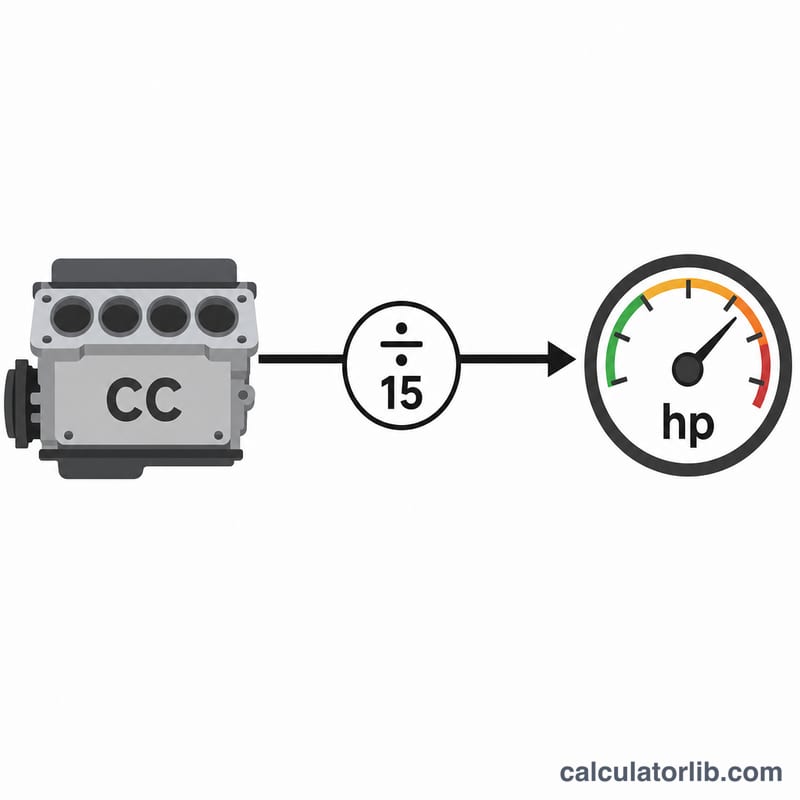
This tool gives a quick, ballpark estimate of an engine's horsepower (hp) from its displacement measured in cubic centimeters (cc). It uses a long-standing mechanic's rule of thumb: a typical naturally aspirated gasoline engine produces roughly one horsepower for every 15 cc of displacement. Because real power output depends on tuning, aspiration, fuel, RPM and design, this is an approximation rather than a spec-sheet figure.
How to Use It
Enter your engine's displacement in cc (for example 1500 for a 1.5-litre engine). The default divisor is 15, which suits everyday gasoline engines. If your engine is high-performance, turbocharged or a diesel, you can lower the divisor (e.g. 8–12) for more output per cc, or raise it for an economy or low-revving engine. The calculator instantly shows the estimated horsepower and the equivalent power in kilowatts.
The Formula Explained
The core relationship is $$\text{HP} = \frac{\text{Displacement (cc)}}{\text{Divisor}}$$. With the standard divisor of 15, a 1500 cc engine gives \(1500 / 15 = 100\) hp. The result is then converted to kilowatts using \(1\ \text{hp} = 0.7457\ \text{kW}\), so \(100\ \text{hp} \approx 74.57\ \text{kW}\).
Worked Example
Suppose you have a 998 cc city-car engine. Using the default divisor: \(998 / 15 \approx 66.5\) hp, which equals about 49.6 kW. A sportier engine of the same size might use a divisor of 10, giving roughly 99.8 hp.
Estimated Horsepower by Engine Size and Type
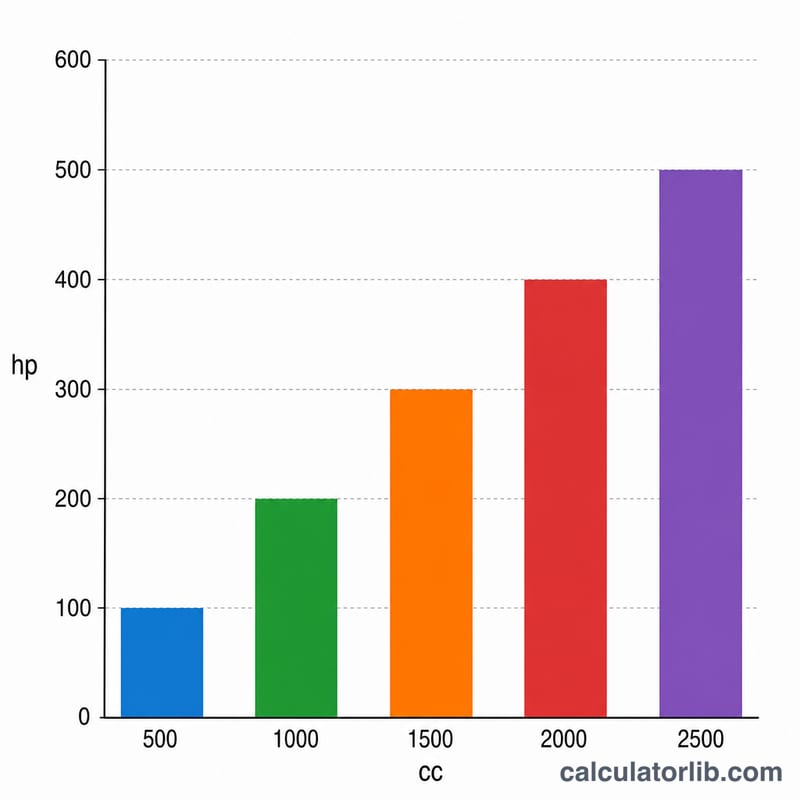
The calculator applies the rule of thumb \(\text{HP} = \dfrac{\text{cc}}{\text{divisor}}\), where a smaller divisor represents a more highly tuned engine. The table below shows the same displacements evaluated with four common divisors, with kilowatts obtained as \(\text{kW} = \text{hp} \times 0.7457\) (1 mechanical horsepower = 0.7457 kW).
| Displacement | ÷ 18 — economy / low-tune | ÷ 15 — standard NA gasoline | ÷ 12 — sporty / high-revving | ÷ 10 — turbocharged / performance |
|---|---|---|---|---|
| 600 cc (0.6 L) | 33 hp / 24.9 kW | 40 hp / 29.8 kW | 50 hp / 37.3 kW | 60 hp / 44.7 kW |
| 998 cc (1.0 L) | 55 hp / 41.3 kW | 67 hp / 49.6 kW | 83 hp / 62.0 kW | 99.8 hp / 74.4 kW |
| 1500 cc (1.5 L) | 83 hp / 62.1 kW | 100 hp / 74.6 kW | 125 hp / 93.2 kW | 150 hp / 111.9 kW |
| 2000 cc (2.0 L) | 111 hp / 82.9 kW | 133.3 hp / 99.4 kW | 167 hp / 124.3 kW | 200 hp / 149.1 kW |
| 3000 cc (3.0 L) | 167 hp / 124.3 kW | 200 hp / 149.1 kW | 250 hp / 186.4 kW | 300 hp / 223.7 kW |
| 5000 cc (5.0 L) | 278 hp / 207.1 kW | 333 hp / 248.6 kW | 417 hp / 310.7 kW | 500 hp / 372.9 kW |
Worked example for the 2.0-litre standard row:
$$\text{HP} = \frac{2000\ \text{cc}}{15} = 133.3\ \text{hp}, \qquad 133.3 \times 0.7457 = 99.4\ \text{kW}$$Every figure above is a rule-of-thumb estimate produced by a single division — none of them is a manufacturer rating. Real output depends on compression ratio, valve timing, boost pressure, intake and exhaust design, fuel and the rev limit, and published ratings are measured on a dynamometer under a defined test standard (for example SAE J1349 in the United States or ECE R85 / EU type approval in Europe, which do not always give identical numbers for the same engine). Use these values for rough comparison only, and check the manufacturer's specification sheet for anything that matters.
Displacement and Power Unit Conversions
Displacement. Engine size is quoted in cubic centimetres (cc) or litres in most of the world, and in cubic inches (cu in) in traditional North American practice. The exact relationships are \(1\ \text{L} = 1000\ \text{cc}\) and \(1\ \text{cu in} = 16.387\ \text{cc}\), so \(1\ \text{L} = 61.024\ \text{cu in}\).
| Cubic centimetres (cc) | Litres (L) | Cubic inches (cu in) |
|---|---|---|
| 1000 cc | 1.0 L | 61.0 cu in |
| 1600 cc | 1.6 L | 97.6 cu in |
| 5000 cc | 5.0 L | 305.1 cu in |
To convert in either direction:
$$\text{cu in} = \frac{\text{cc}}{16.387}, \qquad \text{cc} = \text{cu in} \times 16.387$$Power. Three units are in everyday use. Mechanical (imperial) horsepower is standard in the United States and the United Kingdom; PS — metric horsepower, also written CV or pk — is common in continental Europe and Japan; the kilowatt is the SI unit and the one used in EU type-approval documents and on many registration papers.
| From | Equals | Equals |
|---|---|---|
| 1 mechanical hp | 0.7457 kW | 1.0139 PS |
| 1 kW | 1.341 hp | 1.360 PS |
| 1 PS (metric hp) | 0.7355 kW | 0.9863 hp |
Because hp and PS differ by only about 1.4%, a figure quoted as "150 hp" in one market and "150 PS" in another describes almost — but not exactly — the same engine. The divisor rule used by this calculator produces mechanical horsepower; multiply by 1.0139 if you need the result in PS.
Typical Divisor Values by Engine Type
The divisor is just the inverse of specific output. Because \(\text{hp} = \text{cc} / \text{divisor}\) and one litre is 1000 cc, the two are linked by
$$\text{hp per litre} = \frac{1000}{\text{divisor}}$$So a divisor of 15 corresponds to roughly 67 hp per litre, and a divisor of 10 to 100 hp per litre. Pick the row that best matches your engine's configuration and state of tune.
| Engine type | Suggested divisor | Approximate specific output |
|---|---|---|
| Economy / low-revving naturally aspirated gasoline (utility engines, older small cars, generators) | 17 – 20 | 50 – 60 hp/L |
| Standard naturally aspirated gasoline (the classic rule-of-thumb case) | 15 | about 67 hp/L |
| Modern naturally aspirated gasoline (variable valve timing, direct injection) | 12 – 14 | 70 – 85 hp/L |
| Turbocharged gasoline | 8 – 11 | 90 – 125 hp/L |
| High-revving motorcycle / sport engine | 6 – 9 | 110 – 165 hp/L |
| Naturally aspirated diesel | 20 – 25 | 40 – 50 hp/L |
| Turbodiesel | 13 – 17 | 60 – 75 hp/L |
These are typical observed ranges gathered from common production engines, not a standard, a regulation or an official classification — no engineering body publishes a "cc-to-hp divisor." Highly tuned racing engines, heavily boosted builds and small two-stroke engines fall well outside these bands, and a worn or restricted engine can fall short of the low end of its row. Two engines of identical displacement can differ by a factor of two or more in output, so treat the divisor as a starting assumption you adjust once you know the real figure for a comparable engine.
A practical way to calibrate: take an engine you do know the rating for, divide its displacement in cc by its rated horsepower, and use that number as your divisor for similar engines. For example, a 1798 cc engine rated at 140 hp implies a divisor of \(1798 / 140 \approx 12.8\), which is consistent with the modern naturally aspirated gasoline row above.
FAQ
Is cc/15 accurate? It is only a rough guide. Modern turbo engines easily exceed it, while older or low-tune engines fall short.
What divisor should I use? About 15 for standard gasoline engines, 8–12 for performance or forced-induction engines, and higher for economy or diesel engines.
Does this work for motorcycles? Yes, the same rule applies, though high-revving bike engines often beat the cc/15 estimate.