
What this calculator does
This calculator applies the three core laws of exponents to simplify an expression built from powers that share a common base. Give it a base a and two exponents m and n, choose whether you are multiplying, dividing, or raising a power to a power, and it returns the result as a single power of the base along with its numeric value.
How to use it
Enter the base, the first exponent, and the second exponent. Pick the operation:
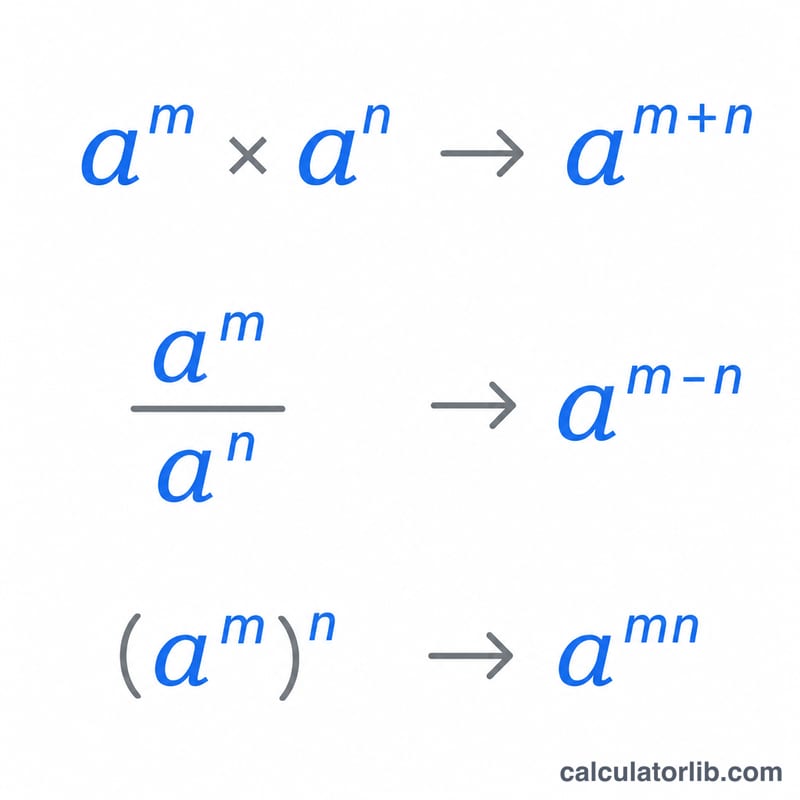
- Multiply — combines \(a^m \times a^n\) by adding exponents.
- Divide — combines \(a^m \div a^n\) by subtracting exponents.
- Power of a power — combines \((a^m)^n\) by multiplying exponents.
The result shows the simplified exponent, the rewritten power, and its decimal value.
The formula explained
The laws of exponents let you collapse repeated multiplication into a single exponent whenever the base is identical. Multiplying adds exponents because you are stacking factors: $$a^m \cdot a^n = a^{m+n}.$$ Dividing cancels common factors, subtracting exponents: $$\frac{a^m}{a^n} = a^{m-n}.$$ Raising a power to another power repeats the multiplication \(n\) times, so the exponents multiply: $$(a^m)^n = a^{mn}.$$ These rules hold for any real exponents, including negatives and fractions.
Worked example
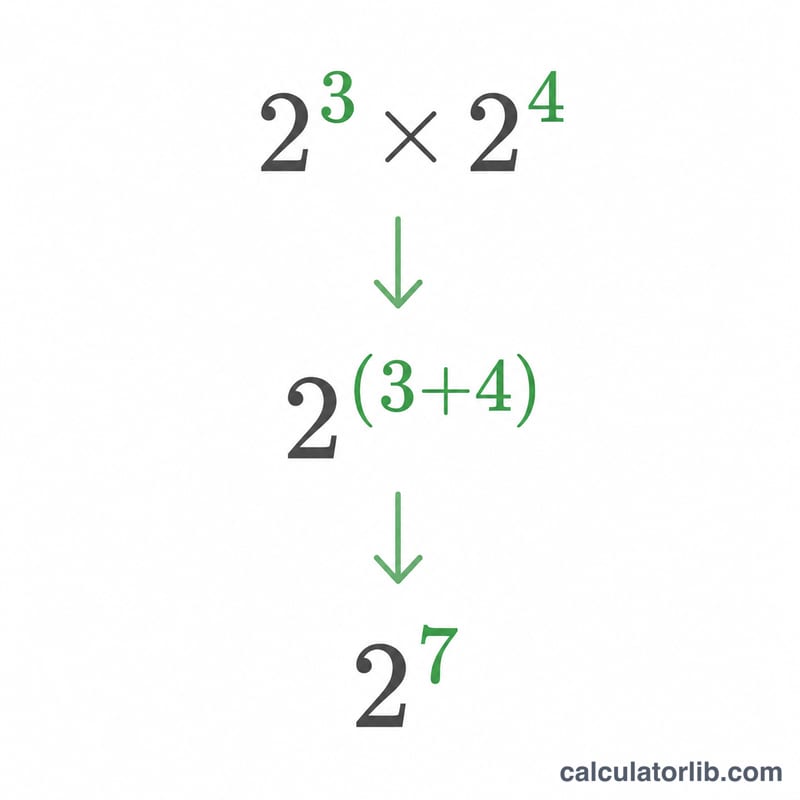
Simplify \(2^3 \times 2^4\). With base \(a = 2\), \(m = 3\), \(n = 4\) and the multiply operation, the exponents add: \(3 + 4 = 7\). So the expression simplifies to $$2^7 = 128.$$
FAQ
Do the bases have to match? Yes. These rules only apply when the powers share the same base. Different bases cannot be combined this way.
Can I use negative or fractional exponents? Yes. The rules work for any real exponents, so \(a^{-2}\) or \(a^{1/2}\) are fine.
What if the resulting exponent is negative? A negative exponent means a reciprocal: \(a^{-k} = 1/a^k\). The numeric value field reflects this automatically.