What This Calculator Does
Buying your first home means budgeting for more than just the loan. This calculator estimates your full monthly housing payment — often abbreviated PITI plus PMI — by combining your mortgage principal and interest with monthly portions of property tax, homeowner's insurance, and private mortgage insurance (PMI). Figures here use US-style dollar amounts, but the math works for any currency.
How to Use It
Enter the home price and your planned down payment. Add the interest rate (APR) and loan term in years. Then enter your annual property tax, annual home insurance premium, and annual PMI (lenders usually charge PMI when your down payment is under 20%). The calculator returns your estimated total monthly payment along with a breakdown of each component.
The Formula Explained
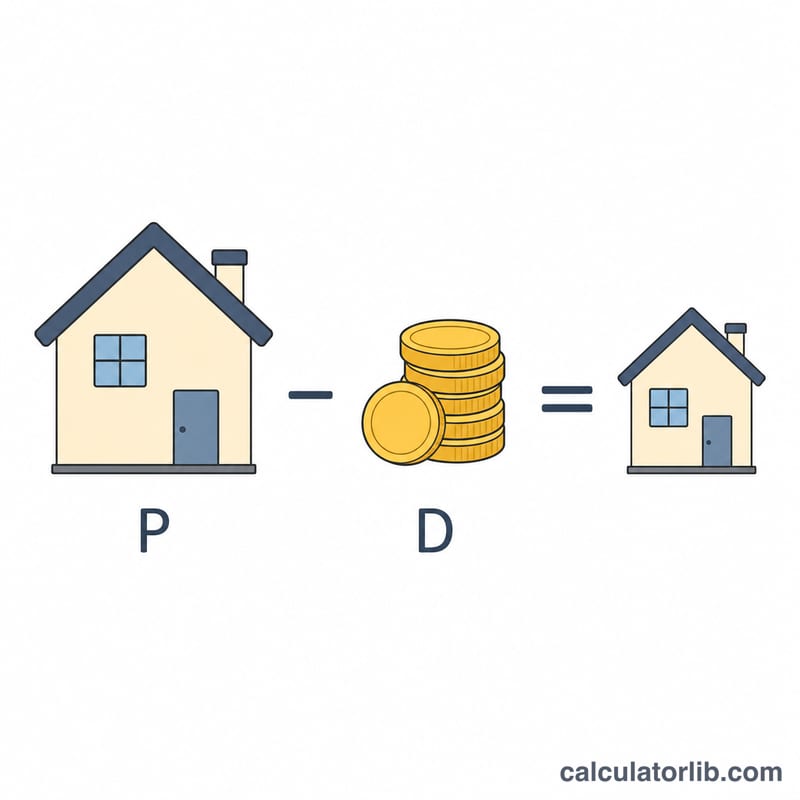
The loan amount is the price minus the down payment. The principal-and-interest portion uses the standard amortization formula:
$$M = \frac{L \cdot r\,(1+r)^{n}}{(1+r)^{n}-1} + \frac{\text{Tax}}{12} + \frac{\text{Insurance}}{12} + \frac{\text{PMI}}{12}$$
$$\text{where}\quad \left\{ \begin{aligned} L &= \text{Home Price} - \text{Down Payment} \\ r &= \dfrac{\text{Rate}}{1200} \\ n &= 12 \times \text{Term (yrs)} \end{aligned} \right.$$
where \(r\) is the monthly rate (APR ÷ 12 ÷ 100) and \(n\) is the total number of monthly payments (years × 12). We then add one-twelfth of your annual tax, insurance, and PMI to reach the full monthly cost.
Worked Example
Home price $300,000 with a $30,000 down payment means a $270,000 loan. At 6.5% over 30 years, the monthly rate is \(0.0054167\) and \(n = 360\). Principal & interest works out to about $1,706.58. Adding $3,600/12 = $300 tax, $1,200/12 = $100 insurance, and $1,500/12 = $125 PMI gives roughly $2,231.58 per month.
How Down Payment and Rate Change Your Monthly Payment
The table below uses a $300,000 home and a 30-year (360-month) fixed-rate loan. Principal and interest (P&I) come from the amortization formula \(M = L\cdot\frac{r(1+r)^{n}}{(1+r)^{n}-1}\), where \(r\) is the annual rate divided by 1,200 and \(n = 360\). For example, at 6.5% \(r = 0.065/12 \approx 0.0054167\), which gives a payment factor of about 0.0063207 per dollar borrowed. Every scenario assumes the same escrow costs: property tax of $3,600 per year ($300 per month) and homeowners insurance of $1,200 per year ($100 per month), so $400 per month together. These are illustrative assumptions, not averages for any area.
| Scenario | Down payment | Rate | Loan amount | Principal & interest | P&I + tax + insurance (before PMI) |
|---|---|---|---|---|---|
| A | 5% ($15,000) | 7.0% | $285,000 | $1,896.11 | $2,296.11 |
| B | 10% ($30,000) | 6.5% | $270,000 | $1,706.58 | $2,106.58 |
| C | 20% ($60,000) | 6.5% | $240,000 | $1,516.96 | Total: $1,916.96 |
| D | 20% ($60,000) | 6.0% | $240,000 | $1,438.92 | $1,838.92 |
PMI note: Scenarios A and B put down less than 20%, so a conventional loan in the US would typically add private mortgage insurance (PMI) on top of the totals shown. PMI cost varies with credit score, loan size and down payment, and is often quoted as roughly 0.3% to 1.5% of the loan per year. Scenarios C and D put down 20%, so PMI is normally not required and the totals are complete for this calculator's inputs.
Takeaways: Moving from scenario A to C cuts P&I by $379.15 per month, from both a smaller loan and a lower rate. Comparing C and D shows that a 0.5-point rate difference on a $240,000 loan changes P&I by about $78 per month. Rates and PMI pricing differ by lender and borrower, so use quoted figures when you have them.
Mortgage Payment Terms Explained
- PITI
- Principal, Interest, Taxes and Insurance: the four parts of a typical monthly housing payment. This calculator's result is PITI plus any PMI you enter.
- Principal
- The portion of your payment that reduces the amount you still owe on the loan.
- Interest
- The cost of borrowing, charged on the remaining loan balance. Early in the loan, most of each payment is interest.
- APR (annual percentage rate)
- The yearly cost of a loan expressed as a percentage, including the interest rate plus certain lender fees and costs. It is usually higher than the note rate. This calculator uses the interest rate, not the APR.
- Escrow
- An account the lender or servicer uses to collect part of your property tax and insurance each month and pay those bills when due.
- PMI (private mortgage insurance)
- Insurance that protects the lender, not you, if you default. On US conventional loans it is typically required when the down payment is under 20%. Other loan types, such as FHA loans, have their own mortgage insurance rules.
- Down payment
- The upfront amount you pay toward the purchase price. The loan amount is the price minus the down payment.
- Loan-to-value (LTV)
- The loan amount divided by the home's value. A $240,000 loan on a $300,000 home is 80% LTV, which corresponds to a 20% down payment.
- Amortization
- Paying off a loan through scheduled equal payments over a set term, with the share going to principal growing and the share going to interest shrinking over time.
- HOA dues
- Fees paid to a homeowners association for shared amenities or maintenance. HOA dues are not included in this calculator's result, so add them separately if they apply.
Interpreting Your Monthly Payment
How the payment splits. Your total is made of two groups. Principal and interest is the fixed loan payment that stays the same on a fixed-rate loan. Taxes, insurance and PMI are escrowed costs, shown here as annual amounts divided by 12, which can change over time as tax assessments, premiums or PMI status change. In scenario C above (a $240,000 loan at 6.5% for 30 years), the $1,916.96 total is $1,516.96 of P&I (about 79%) and $400 of escrowed tax and insurance (about 21%).
Within the P&I portion, the first month's interest is \(240{,}000 \times 0.065/12 = 1{,}300.00\), so only $216.96 goes to principal. Over the years the interest share falls and the principal share rises.
Common lender benchmarks. These are general guidelines widely cited in US lending, not rules that apply everywhere:
- Front-end ratio: housing costs around 28% of gross monthly income. For a $1,916.96 payment, that implies gross income of about \(1{,}916.96 / 0.28 \approx 6{,}846\) per month, or roughly $82,150 per year.
- Back-end debt-to-income (DTI): total monthly debt payments, including housing, car loans, student loans and card minimums, of about 36% to 43% of gross monthly income. Limits vary by lender and loan program.
- 20% down payment: the standard threshold for avoiding PMI on a conventional loan (80% LTV). Under the US Homeowners Protection Act, PMI on many conventional loans can be requested to be removed at 80% LTV and generally ends automatically at 78% of the original value, if payments are current.
What is left out. The result does not include maintenance and repairs, utilities, HOA dues, closing costs, or changes in tax and insurance over time. Budget separately for these.
This is general information, not personal financial advice. Lender requirements differ, so confirm figures with a licensed lender or housing counselor.
Central bank policy rates today
The latest official policy rates of major central banks, updated automatically — the benchmark that bank deposit and loan rates follow.
- Federal Reserve · United States
- 3.75–4.00%
- As of
- 2026-11-13
- Change in 1 year
- 0 pp
Latest change Up +25 bp Federal Reserve changed its rate on 2026-09-17: from 3.50–3.75% to 3.75–4.00%.
| Central bank | Policy rate | As of | Change in 1 year |
|---|---|---|---|
| Banco Central do Brasil (Selic) · Brazil | 13.75% | 2026-11-16 | −1.25 pp |
| Banco de México · Mexico | 6.25% | 2026-11-10 | −1.00 pp |
| Federal Reserve · United States | 3.75–4.00% | 2026-11-13 | 0 pp |
| ECB | 2.50% | 2026-11-16 | +0.50 pp |
| Sveriges Riksbank · Sweden | 2.00% | 2026-11-16 | +0.25 pp |
| Saudi Central Bank (SAMA) · Saudi Arabia | 4.50% | 2026-10-29 | 0 pp |
| Reserve Bank of Australia · Australia | 4.60% | 2026-10-31 | +1.00 pp |
| Central Bank of the Republic of Türkiye · Türkiye | 36.00% | 2026-11-06 | −3.50 pp |
| Bank of Russia · Russia | 14.00% | 2026-11-10 | −2.50 pp |
| People’s Bank of China · China | 3.00% | 2026-11-10 | 0 pp |
| Bank of Canada · Canada | 2.50% | 2026-11-13 | +0.25 pp |
| Reserve Bank of India · India | 5.50% | 2026-10-19 | 0 pp |
| Bank of England · United Kingdom | 4.00% | 2026-11-16 | 0 pp |
| Bank of Japan · Japan | 1.25% | 2026-11-10 | +0.75 pp |
| Bank of Korea · South Korea | 3.00% | 2026-11-02 | +0.50 pp |
Federal Reserve: key rates and overnight market rates
The rates that frame monetary policy and the overnight market rate they steer, each with the date of its latest published value.
| Rate | Level | As of | Change in 1 year |
|---|---|---|---|
| Federal funds target range | 3.75–4.00% | 2026-11-13 | 0 pp |
| Effective federal funds rate (EFFR) | 3.88% | 2026-11-13 | 0 pp |
| Secured Overnight Financing Rate (SOFR) | 3.90% | 2026-11-13 | −0.10 pp |
Each rate keeps the date of its own latest published value; overnight market rates are published on the next business day.
Latest figure: 2026-11-13 Data last updated 2026-11-16 · current
Source: Banco Central do Brasil ODbL; Bank for International Settlements (BIS) Terms of permitted use of BIS statistics; Federal Reserve Bank of New York New York Fed Terms of Use; Board of Governors of the Federal Reserve System Public domain (U.S. government work); European Central Bank ECB reuse policy; Sveriges Riksbank Riksbank open data terms; The World Bank Group CC BY 4.0; Reserve Bank of Australia 2026 RBA copyright terms (Cash Rate); Bank of Canada Bank of Canada terms of use; Bank of England Open Government Licence v3.0
The one-year change is computed by CalculatorLib from these data. The EFFR and SOFR are subject to the Terms of Use posted at newyorkfed.org. The New York Fed is not responsible for publication of the EFFR and SOFR by CalculatorLib, does not sanction or endorse any particular republication, and has no liability for your use.
Source details and methodology
- Banco Central do Brasil
- Bank for International Settlements (BIS) — Central bank policy rates
- Federal Reserve Bank of New York — Reference rates (EFFR, SOFR)
- Board of Governors of the Federal Reserve System
- European Central Bank
- Sveriges Riksbank
- The World Bank Group — World Development Indicators (FR.INR.LEND, FR.INR.RINR)
- Reserve Bank of Australia 2026
- Bank of Canada
- Bank of England
FAQ
What is PMI and can I avoid it? PMI protects the lender if your down payment is less than 20% of the price. Once you reach about 20% equity you can usually request its removal.
Why include tax and insurance? Most lenders collect these monthly in an escrow account, so they are part of your real monthly outflow even though they are not part of the loan.
Is this exact? It is an estimate. Your actual rate, tax assessment, insurance premium, HOA dues, and PMI may differ. Always confirm with a loan officer before committing.