What Is the Grams to Ounces Calculator?
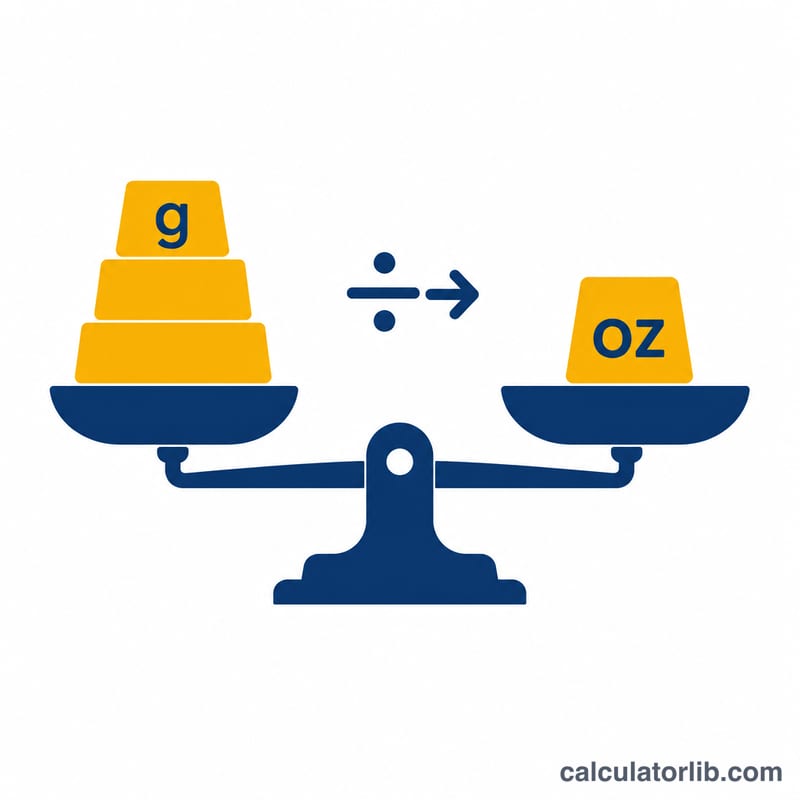
This tool converts a mass measured in grams (g) into avoirdupois ounces (oz), the unit used for everyday weight in the United States and parts of the UK. It uses the internationally defined relationship where one ounce equals exactly 28.349523125 grams, so the result is precise rather than an approximation.
How to Use It
Type the number of grams you want to convert into the input box and the calculator instantly returns the equivalent weight in ounces. It works for any value — a few grams of spice, hundreds of grams of flour, or kilogram-scale quantities entered in grams.
The Formula Explained
The conversion divides grams by the number of grams in one ounce:
$$\text{ounces} = \frac{\text{grams}}{28.349523125}$$
Because there are more grams than ounces in a given weight (a gram is smaller), dividing always gives a smaller number than the gram value you started with.
Worked Example
Suppose you have 100 grams of coffee beans. Divide by 28.349523125: $$100 \div 28.349523125 \approx 3.5274 \text{ ounces}.$$ So 100 g is roughly 3.53 oz. A quicker mental estimate is "grams \(\times 0.035\)".
Common Grams to Ounces Conversions
The table uses the avoirdupois ounce (the ounce used for food and everyday goods), where 1 oz = 28.349523125 g exactly. The formula is \(\text{oz} = \frac{\text{g}}{28.349523125}\), or about \(\text{g} \times 0.035274\). The pound column uses 1 lb = 453.59237 g. Troy ounces, used for precious metals, are different (1 troy oz ≈ 31.1035 g) and are not covered here.
| Grams (g) | Ounces (oz) | Pounds (lb) |
|---|---|---|
| 1 | 0.0353 | 0.0022 |
| 5 | 0.1764 | 0.0110 |
| 10 | 0.3527 | 0.0220 |
| 25 | 0.8818 | 0.0551 |
| 28.35 | 1.0000 | 0.0625 |
| 50 | 1.7637 | 0.1102 |
| 100 | 3.5274 | 0.2205 |
| 150 | 5.2911 | 0.3307 |
| 200 | 7.0548 | 0.4409 |
| 250 | 8.8185 | 0.5512 |
| 454 | 16.0144 | 1.0009 |
| 500 | 17.6370 | 1.1023 |
| 750 | 26.4555 | 1.6535 |
| 1000 | 35.2740 | 2.2046 |
Worked check for 100 g: \(\frac{100}{28.349523125} \approx 3.5274\) oz. Note that 454 g is a common rounding of 1 lb (16 oz); the exact value is 453.59237 g.
Everyday Scenarios: Grams vs Ounces
These typical item weights show how metric package sizes translate to ounces. Ounce values are rounded to two decimals. The item weights are typical examples, and actual products vary by brand and country.
| Item | Weight (g) | Ounces (oz) |
|---|---|---|
| Teaspoon-sized portion of salt-like seasoning (about) | 5 | 0.18 |
| Tablespoon of butter (about) | 15 | 0.53 |
| Serving of nuts | 30 | 1.06 |
| Chocolate bar | 100 | 3.53 |
| US butter stick (about) | 113 | 3.99 |
| Sugar or flour, small bag | 200 | 7.05 |
| Metric butter block | 250 | 8.82 |
| Canned beans or tomatoes (typical) | 400 | 14.11 |
| Pasta packet | 500 | 17.64 |
| Bag of sugar | 1000 | 35.27 |
Example: a 250 g butter block is \(\frac{250}{28.349523125} \approx 8.82\) oz, which is just over half a pound (8 oz). Keep in mind that ounces here measure weight, not volume, so they are not the same as fluid ounces.
FAQ
How many grams are in an ounce? Exactly 28.349523125 grams in one avoirdupois ounce.
Is this a troy ounce? No. This calculator uses the standard avoirdupois ounce for food and general weight, not the troy ounce used for precious metals (which is about 31.103 g).
How do I convert ounces back to grams? Multiply ounces by 28.349523125 to return to grams.