
What This Calculator Does
The Gross Profit Margin Calculator measures how much of your sales revenue remains after you subtract the direct costs of producing or buying the goods you sell. It is a quick way to gauge core profitability before operating expenses, taxes and interest are factored in. The tool works with any currency, so it is useful for businesses anywhere in the world — just enter the same currency for both figures.
The Inputs You Provide
- Revenue — the total income from sales over a period (a month, quarter or year).
- Cost of Goods Sold (COGS) — the direct costs tied to producing or purchasing those goods, such as raw materials, manufacturing labour and inventory purchases. It excludes overhead like rent, marketing and salaries of non-production staff.
The Formula Explained
The calculator runs three connected steps:
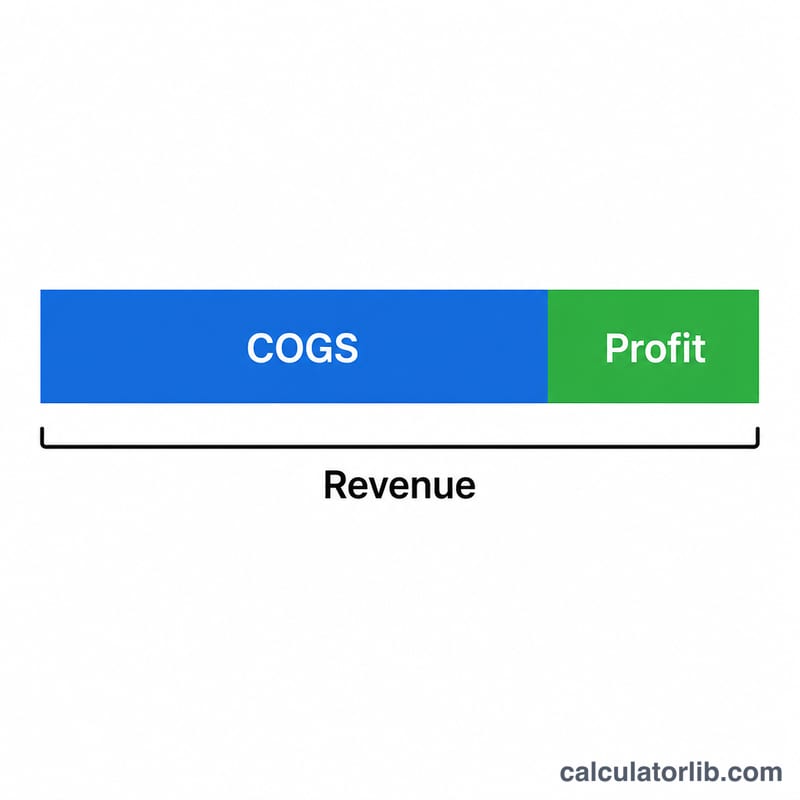
- Gross Profit = \(\text{Revenue} - \text{Cost of Goods Sold}\)
- Gross Profit Margin (%) = \((\text{Gross Profit} \div \text{Revenue}) \times 100\)
- Gross Margin Ratio = \(\text{Gross Profit} \div \text{Revenue}\) (the same figure expressed as a decimal)
The full formula is:
$$\text{Gross Margin} = \frac{\text{Revenue} - \text{COGS}}{\text{Revenue}} \times 100\%$$The percentage tells you what share of every sales dollar (or euro, pound, etc.) you keep after covering direct production costs.
Worked Example
Suppose your business records Revenue of 50,000 and Cost of Goods Sold of 30,000.
- Gross Profit = \(50{,}000 - 30{,}000 = 20{,}000\)
- Gross Profit Margin = \((20{,}000 \div 50{,}000) \times 100 = 40\%\)
- Gross Margin Ratio = \(20{,}000 \div 50{,}000 = 0.40\)
This means 40% of your revenue is left to cover overheads and generate net profit, while 60% went toward making or buying the products.
Frequently Asked Questions
What is a good gross profit margin? It varies widely by industry. Software and services often exceed 70%, retail may sit around 25–40%, and grocery can be in single digits. Compare your margin against competitors in the same sector rather than a universal benchmark.
What's the difference between gross margin and net margin? Gross margin only subtracts direct production costs (COGS). Net margin goes further, also deducting operating expenses, interest and taxes, giving the bottom-line profitability.
Can the margin be negative? Yes. If your COGS is higher than your revenue, gross profit becomes negative, signalling that you are selling products for less than they cost to produce — a sign you need to raise prices or reduce direct costs.