

What This Calculator Does
The Hourly Wage to Monthly Take-Home Calculator turns an hourly pay rate into an estimated monthly net income. It accounts for how many hours you work each week and the combined percentage lost to taxes and other deductions, giving you a realistic picture of the money that actually lands in your bank account each month.
How to Use It
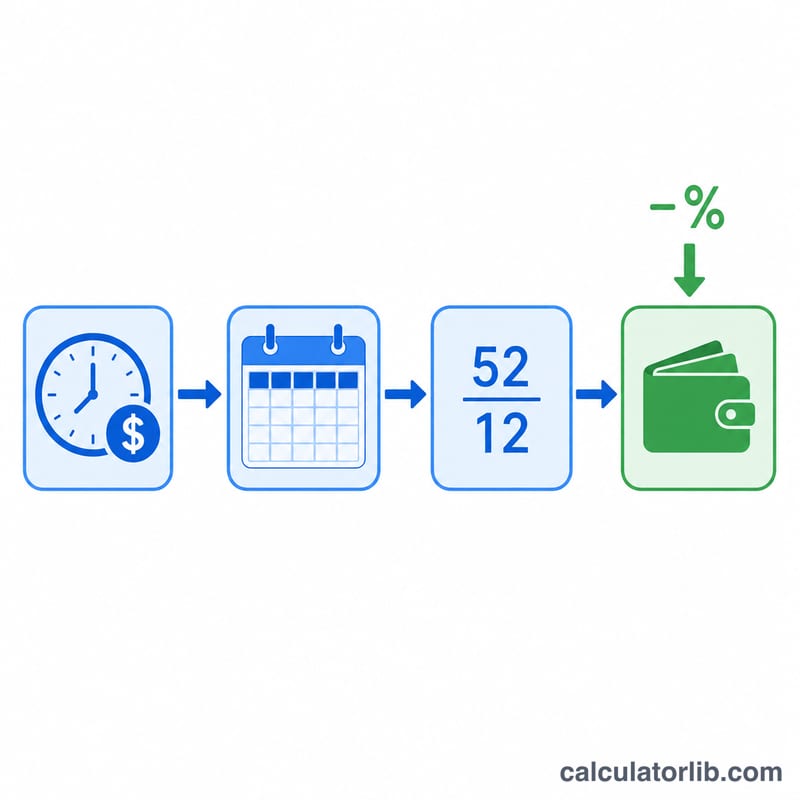
Enter three values: your hourly wage, the number of hours you work per week, and your estimated tax and deductions percentage (income tax, social contributions, retirement, insurance, etc.). The calculator multiplies your weekly earnings across 52 weeks, divides by 12 months, and subtracts your deduction rate to show monthly take-home pay alongside gross weekly, monthly, and annual figures.
The Formula Explained
The core formula is:
$$\text{Monthly Net} = \frac{\text{Hourly} \times \text{Hours/Week} \times 52}{12} \times \left(1 - \text{Tax Rate}\right)$$
Multiplying by 52 annualizes your weekly pay, and dividing by 12 spreads it evenly across the months. The factor \((1 - \text{Tax Rate})\) removes the proportion withheld for taxes and deductions. Using \(52/12 \approx 4.333\) weeks per month gives a smoother, more accurate average than assuming exactly 4 weeks.
Worked Example
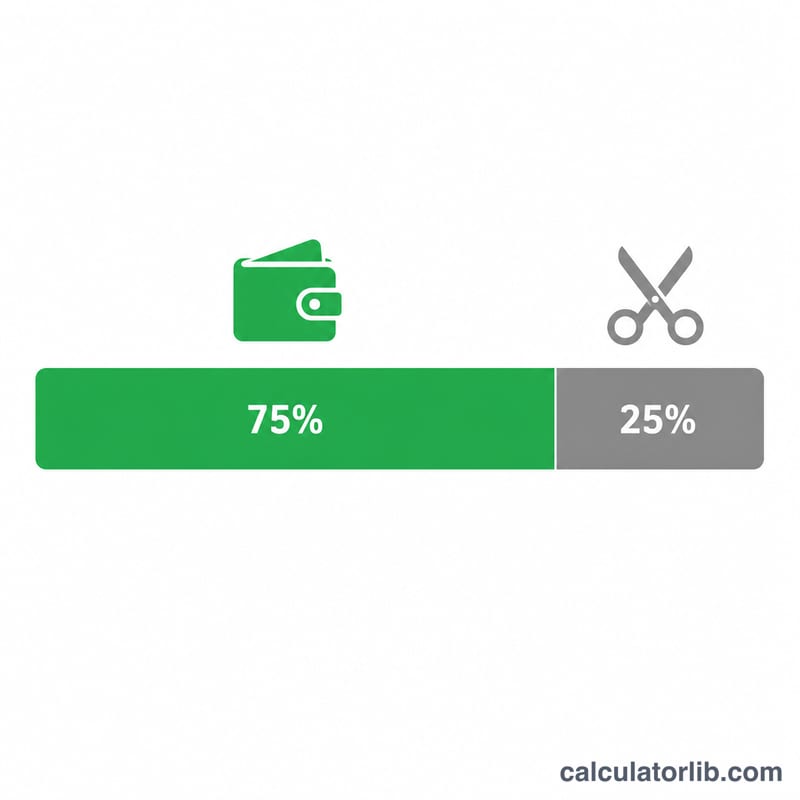
Suppose you earn $25/hour, work 40 hours per week, and lose 20% to taxes and deductions. Gross annual pay is \(25 \times 40 \times 52 = \$52{,}000\). Divided by 12, gross monthly pay is about $4,333.33. After removing 20%, your monthly take-home is \(4{,}333.33 \times 0.80 \approx\) $3,466.67.
FAQ
Is this exact for my paycheck? No — it's an estimate. Real payroll uses tiered tax brackets and varied deductions, so use this as a planning guide.
What should I enter for the tax rate? Use your effective combined rate (total deductions ÷ gross pay). Many workers fall between 15% and 35%.
Why use 52/12 instead of 4 weeks? A year has 52 weeks, not 48, so \(52/12\) captures the extra pay periods and avoids underestimating your income.