What is Indian-Style Multiplication?
Indian-style (sometimes called Vedic) multiplication is ordinary multiplication presented as a mental-arithmetic exercise. The core idea taught in many Indian classrooms is that the easy partial steps of long multiplication — multiplying by a single digit, adding rounded numbers, or splitting a factor into a sum — are done in your head rather than on paper. The math is unchanged: you still compute A times B. What changes is the habit of breaking the problem into friendly chunks and combining them mentally, which sharpens number sense and speed.
How to Use This Calculator
Type the first factor in the "Problem" box and the second factor in the box after the multiplication sign, then submit. The calculator returns the exact product in the "Answer" box. Use it to check your own mental calculation: try to compute the product in your head first, then verify it here. Because it is pure arithmetic, it works the same everywhere in the world.
The Formula Explained
The result is the simple product:
$$\text{product} = \text{multiplicand} \times \text{multiplier}$$
The "Indian method" is a teaching technique for getting to that product mentally — for example by splitting one factor: \(139 \times 142 = 139 \times 100 + 139 \times 42\). Each smaller piece is easy to handle in your head, and you add the pieces at the end.
Worked Example
Suppose the problem is 139 and the second factor is 142. Split 142 into \(100 + 42\). Then $$139 \times 100 = 13{,}900$$ and $$139 \times 42 = 5{,}838.$$ Add them: $$13{,}900 + 5{,}838 = 19{,}738.$$ So the answer is 19,738, which matches \(139 \times 142\).
Step-by-Step: Vertically and Crosswise Method
The Urdhva-Tiryagbhyam ("vertically and crosswise") method comes from the Vedic mathematics tradition. It builds the product one digit position at a time. At each position you add up the digit products that belong there, write the unit digit, and carry the tens forward.
Carry rule
At every step, compute: (sum of digit products) + (carry from the previous step). Write down the last digit of the total. Everything before that last digit becomes the carry for the next step. At the final step, write the whole number.
Two-digit case: 23 × 14
Write the numbers one above the other: first factor digits \(a\,b = 2\,3\), second factor digits \(c\,d = 1\,4\).
- Right digits (vertical): \(3 \times 4 = 12\). Write 2, carry 1.
- Crosswise: \(2 \times 4 + 3 \times 1 = 8 + 3 = 11\).
- Add the carry: \(11 + 1 = 12\). Write 2, carry 1.
- Left digits (vertical): \(2 \times 1 = 2\), plus carry \(1\) gives 3.
- Combine from left to right: 3, 2, 2, so \(23 \times 14 = \)322.
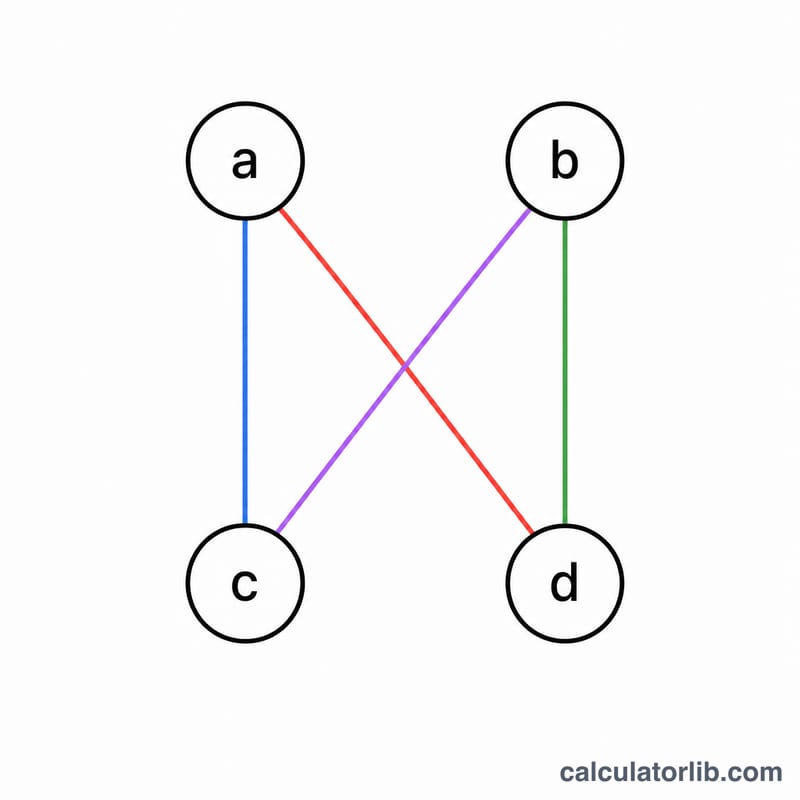
Layout of the pattern for \(\overline{ab} \times \overline{cd}\): the product is built from three parts, \(ac\) | \(ad + bc\) | \(bd\), with carries moving from right to left.
Three-digit case
For \(\overline{abc} \times \overline{def}\) there are five positions, taken from right to left:
- \(c \times f\)
- \(b \times f + c \times e\)
- \(a \times f + b \times e + c \times d\)
- \(a \times e + b \times d\)
- \(a \times d\)
Apply the carry rule at each position. Example: 123 × 132.
- \(3 \times 2 = 6\): write 6, carry 0.
- \(2 \times 2 + 3 \times 3 = 4 + 9 = 13\): write 3, carry 1.
- \(1 \times 2 + 2 \times 3 + 3 \times 1 = 2 + 6 + 3 = 11\), plus carry 1 is 12: write 2, carry 1.
- \(1 \times 3 + 2 \times 1 = 5\), plus carry 1 is 6: write 6, carry 0.
- \(1 \times 1 = 1\): write 1.
Reading the digits from the last step to the first gives 1, 6, 2, 3, 6, so \(123 \times 132 = 16236\). Check: \(12300 + 3936 = 16236\).
More Worked Examples: Shortcut Techniques
1. Near-base method (base 100): 97 × 94
- Both numbers are just below 100. Deficits: \(97 - 100 = -3\) and \(94 - 100 = -6\).
- Cross-subtract: \(97 - 6 = 91\) (or \(94 - 3 = 91\), the same result). This is the left part.
- Multiply the deficits: \((-3) \times (-6) = 18\). This is the right part, written with two digits because the base is 100.
- Join the parts: 91 | 18, so \(97 \times 94 = \)9118.
Check: \(97 \times 94 = 9700 - 97 \times 6 = 9700 - 582 = 9118\). ✓
2. Vertically and crosswise: 46 × 32
- Right digits: \(6 \times 2 = 12\). Write 2, carry 1.
- Crosswise: \(4 \times 2 + 6 \times 3 = 8 + 18 = 26\), plus carry 1 is 27. Write 7, carry 2.
- Left digits: \(4 \times 3 = 12\), plus carry 2 is 14. Write 14.
- Combine: 14 | 7 | 2, so \(46 \times 32 = \)1472.
Check: \(46 \times 30 + 46 \times 2 = 1380 + 92 = 1472\). ✓
3. Nikhilam (base 100, numbers above the base): 105 × 102
- Surpluses over 100: \(+5\) and \(+2\).
- Cross-add: \(105 + 2 = 107\) (or \(102 + 5 = 107\)). This is the left part.
- Multiply the surpluses: \(5 \times 2 = 10\). This is the right part, with two digits.
- Join the parts: 107 | 10, so \(105 \times 102 = \)10710.
Check: \(105 \times 100 + 105 \times 2 = 10500 + 210 = 10710\). ✓
Tip: if the right part has more digits than the base has zeros (two for base 100), carry the extra digits into the left part.
FAQ
Does it work with decimals or negative numbers? Yes. The normal sign and decimal rules apply, although the mental-math exercise is usually practiced with positive whole numbers.
What happens if a factor is 0? The product is 0, since anything multiplied by zero is zero.
Is this only for India? No. The framing comes from Indian classroom practice, but multiplication is universal and the answer is identical anywhere.