What Is Lead Time?
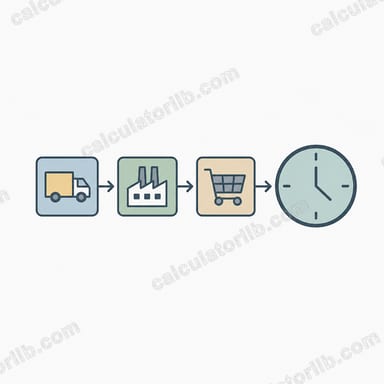
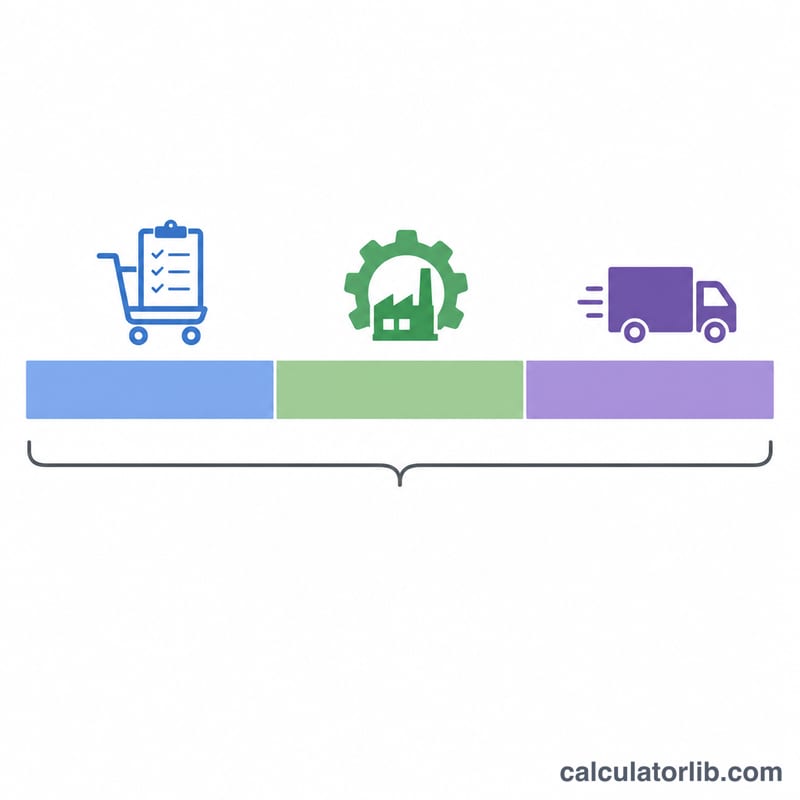
Lead time is the total elapsed time from the moment an order is placed until it is delivered and ready to use. In supply chain and inventory management, it is one of the most important metrics for planning purchases, setting reorder points, and keeping customers happy. This Lead Time Calculator breaks the cycle into its three core stages—procurement, manufacturing, and shipping—and adds them together to give you the total lead time in days and weeks.
How to Use the Calculator
Enter the number of days for each stage of your order cycle:
- Procurement / Sourcing Time — how long it takes to source raw materials or place the order with a supplier.
- Manufacturing / Production Time — how long the goods take to be produced or assembled.
- Shipping / Transit Time — how long delivery and customs clearance take.
The calculator instantly sums these values into a total lead time and converts it to weeks for easier planning.
The Formula Explained
The cumulative lead time formula is simply:
$$\text{Lead Time} = \text{Procurement} + \text{Manufacturing} + \text{Shipping}$$
If you already know your order placement date and expected delivery date, the lead time equals the number of calendar days between them. Both approaches measure the same thing—the total wait before goods are available.

Worked Example
Suppose a retailer places an order with these stage durations: procurement of 3 days, manufacturing of 7 days, and shipping of 5 days. The total lead time is $$3 + 7 + 5 = 15 \text{ days},$$ or about 2.14 weeks. The buyer should therefore reorder at least 15 days before stock runs out.
Lead Time Scenarios Compared
The table applies the calculator's three-stage model: \(\text{Lead Time} = \text{Procurement} + \text{Manufacturing} + \text{Shipping}\). The day counts are illustrative examples only, not industry benchmarks. Real lead times vary widely by supplier, product, route, season and customs conditions. Weeks are total days ÷ 7, rounded to one decimal.
| Scenario | Procurement (days) | Manufacturing (days) | Shipping (days) | Total (days) | Total (weeks) | Dominant stage |
|---|---|---|---|---|---|---|
| Domestic stocked item | 2 | 0 | 3 | 5 | 0.7 | Shipping |
| Made-to-order, domestic | 5 | 15 | 4 | 24 | 3.4 | Manufacturing |
| Overseas, sea freight | 10 | 20 | 35 | 65 | 9.3 | Shipping |
| Overseas, air freight | 10 | 20 | 7 | 37 | 5.3 | Manufacturing |
Worked check for the made-to-order case: \(5 + 15 + 4 = 24\) days, and \(24 \div 7 \approx 3.4\) weeks. Note how switching the overseas order from sea to air shortens the total by 28 days (65 − 37) while the manufacturing stage stays the same, so the bottleneck shifts from shipping to manufacturing.
Lead Time Terms and Glossary
- Procurement lead time
- The time from deciding to buy until the supplier has accepted and is ready to act on the order. It covers sourcing, quoting, approvals, purchase order processing and any waiting for raw materials. This is the first input in the calculator.
- Manufacturing lead time
- The time needed to make, assemble, test and pack the goods, including queue and wait time. It is zero or near zero for items already in stock. This is the second input.
- Shipping (transit) time
- The time goods spend in transit from the supplier to your location, including handling, customs clearance and final delivery where relevant. This is the third input.
- Cumulative lead time
- The total time to deliver a finished product when every sequential stage is counted, including the lead times of components or subassemblies that must be obtained first. The calculator's sum is a simple version of this.
- Order-to-delivery lead time
- The time from the customer or buyer placing an order until the goods arrive. Depending on how you define your stages, it equals the sum of the three stages plus any internal order-processing time you choose to include.
- Cycle time
- The time actually spent working on one unit or batch in a process step. It is typically shorter than lead time, because lead time also includes waiting and transit.
- Safety buffer
- Extra time added to a lead time estimate, or extra stock held, to absorb delays and variability.
- Reorder point
- The stock level at which a new order should be placed so that stock lasts until the delivery arrives. It is commonly calculated as average daily demand × lead time (in days) + safety stock.
Practical Tips for Reducing and Planning Around Lead Time
- Add a buffer to the longest or most variable stage. Many planners add roughly 10–20% to the stage that is longest or least predictable. For a 24-day total, a 15% buffer gives \(24 \times 1.15 = 27.6\), so plan for about 28 days. The right percentage depends on how reliable your supplier and carrier have actually been.
- Order before you run out. Place orders at least one full lead time before stock would reach zero. If your total is 24 days, you need to reorder while there are still at least 24 days of stock on hand, plus a margin.
- Use the reorder point formula. $$\text{Reorder Point} = \text{Daily Demand} \times \text{Lead Time} + \text{Safety Stock}$$ For example, with 20 units per day, a 24-day lead time and 100 units of safety stock: \(20 \times 24 + 100 = 580\) units.
- Confirm quotes in writing. Ask suppliers whether quoted days are business days or calendar days, whether they start at order or at payment, and whether they include packing. Make sure your inputs use consistent units.
- Check customs and transit timing. For international orders, ask your freight forwarder or broker about typical clearance times, port or holiday closures, and seasonal congestion, and account for them in the shipping figure.
- Target the longest stage first. Run the calculator with your real numbers and see which stage dominates. Shortening the biggest stage (for example, a faster freight mode, a nearer supplier, or pre-approved purchase orders) usually has more effect than trimming a small one.
- Track actual versus quoted times. Record real delivery dates for each order and update your inputs, since actual performance is a better planning basis than quotes.
Lead times differ greatly between businesses, so treat these steps as general planning guidance rather than fixed norms. For inventory or financial decisions, this is general information, not professional advice.
FAQ
What is a good lead time? Shorter is generally better, but the ideal depends on your industry. Many e-commerce sellers aim to keep total lead time under 30 days to reduce inventory risk.
Should I include buffer time? Yes—adding a safety buffer to shipping or manufacturing protects against delays and stockouts. Simply add the buffer days into the relevant stage.
What's the difference between lead time and cycle time? Lead time covers the entire customer-facing wait, while cycle time measures only the active production duration of a single unit.