What the Lightning Distance Calculator Does
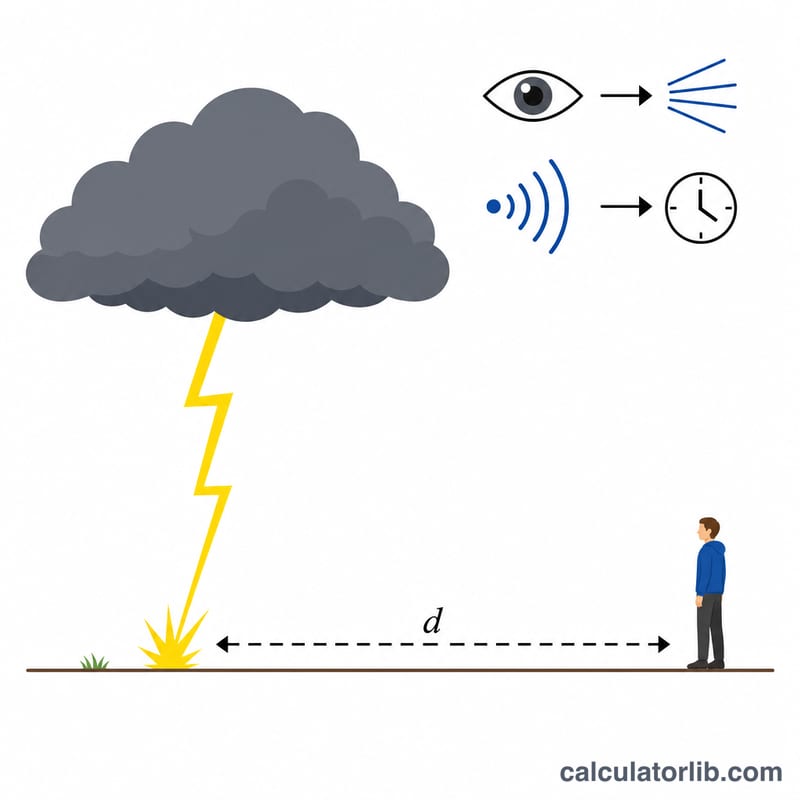
This calculator estimates how far away a lightning strike is by using the time gap between seeing the flash and hearing the thunder. Light reaches your eyes almost instantly, but sound travels much slower — roughly 343 metres per second. By counting the seconds between the flash and the rumble, you can work out the distance to the storm. The tool reports the distance in kilometers (it also works out miles internally) and gives you a danger level so you know how seriously to take the threat.
How to Use It
There is a single input field:
- Seconds between lightning and thunder — start counting the moment you see the flash and stop when you hear the thunder. Enter that number of seconds.
Press calculate and the tool returns the estimated strike distance in kilometers, plus a danger rating: Extreme, High, Moderate or Still Dangerous.
The Formula Explained
The calculator uses the well-known "5-second rule." Divide the seconds by 5 to get the distance in miles, then convert to kilometers:
$$\text{Distance (km)} = \frac{\text{Time in seconds}}{5} \times 1.60934$$Dividing by 5 works because sound covers about one mile every five seconds. The factor \(1.60934\) converts miles to kilometers.
The danger level is based on the distance in miles:
- Extreme Danger — 1 mile or less
- High Danger — over 1 up to 3 miles
- Moderate Danger — over 3 up to 6 miles
- Still Dangerous — more than 6 miles. If you can hear thunder, lightning is close enough to strike you: go indoors.
Worked Example
Suppose you count 15 seconds between the flash and the thunder. First, \(15 \div 5 = 3\) miles. Convert to kilometers: $$3 \times 1.60934 \approx 4.83 \text{ km}$$ Because the distance is 3 miles, the calculator flags this as High Danger — the storm is close enough that you should already be seeking shelter.
Flash-to-Thunder Time vs. Distance at a Glance
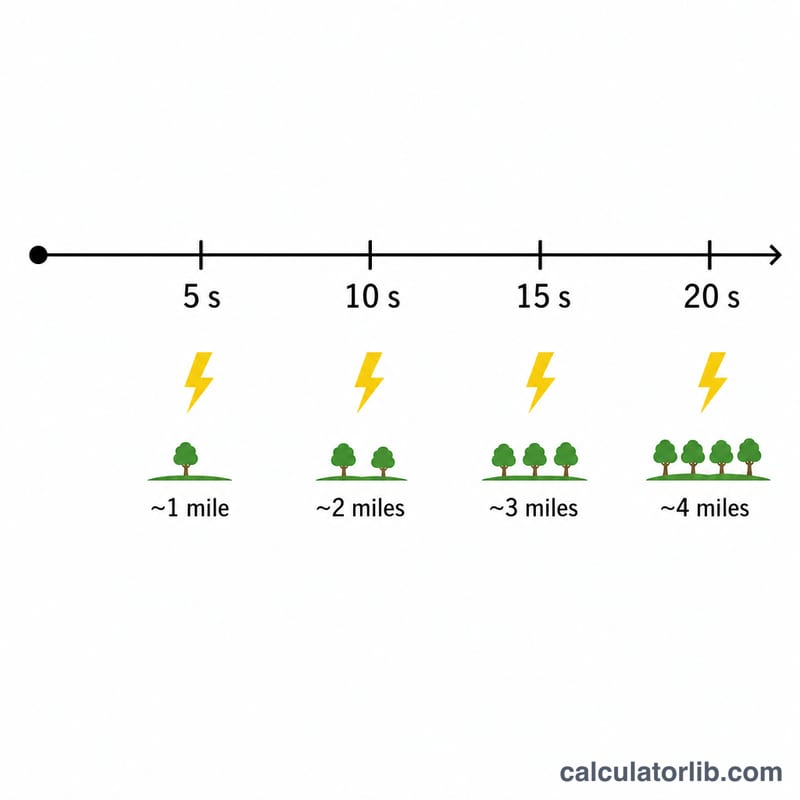
Count the seconds from the moment you see the flash until you hear the thunder (the "flash-to-bang" count). Divide by 5 for miles, or by roughly 3 for kilometres:
$$\text{Distance (mi)} = \frac{\text{Seconds}}{5}, \qquad \text{Distance (km)} = \text{Distance (mi)} \times 1.60934$$| Seconds between flash and thunder | Distance (miles) | Distance (kilometres) | Danger level |
|---|---|---|---|
| 1 | 0.2 | 0.3 | Extreme |
| 3 | 0.6 | 1.0 | Extreme |
| 5 | 1.0 | 1.6 | Extreme |
| 10 | 2.0 | 3.2 | High |
| 15 | 3.0 | 4.8 | High |
| 20 | 4.0 | 6.4 | Moderate |
| 25 | 5.0 | 8.0 | Moderate |
| 30 | 6.0 | 9.7 | Moderate |
| 45 | 9.0 | 14.5 | Still dangerous |
| 60 | 12.0 | 19.3 | Still dangerous |
Danger bands used by this calculator: Extreme at 1 mile (1.6 km) or less, High above 1 up to 3 miles (1.6–4.8 km), Moderate above 3 up to 6 miles (4.8–9.7 km), and Still Dangerous beyond 6 miles (9.7 km): if you can still hear thunder, lightning is close enough to strike you.
Worked example: you see a flash and count 20 seconds before the thunder arrives.
$$\text{Distance} = \frac{20\ \text{s}}{5} = 4.0\ \text{mi} = 4.0 \times 1.60934 = 6.4\ \text{km}$$That is a 4.0 mile (6.4 km) strike distance, placing it in the Moderate band.
Constants Used in the Calculation
| Constant | Value | Role in the estimate |
|---|---|---|
| Speed of sound in dry air at 20 °C | 343 m/s (1,235 km/h; 1,125 ft/s) | Sets how long thunder takes to reach you |
| Seconds per kilometre | ≈ 2.92 s (rounded to 3 s) | Basis of the "divide by 3" metric rule |
| Seconds per mile | ≈ 4.69 s (rounded to 5 s) | Basis of the "divide by 5" rule this tool uses |
| Speed of light in vacuum | 299,792,458 m/s (exact, by SI definition) | Flash arrival time treated as zero |
| Miles → kilometres | × 1.60934 (1 mile = 1,609.34 m exactly) | Converts the mile result to kilometres |
| Temperature sensitivity of sound speed | ≈ 0.6 m/s per °C | Explains small seasonal error in the rule |
The per-kilometre and per-mile rules come straight from the speed of sound:
$$\frac{1{,}000\ \text{m}}{343\ \text{m/s}} = 2.92\ \text{s per km}, \qquad \frac{1{,}609.34\ \text{m}}{343\ \text{m/s}} = 4.69\ \text{s per mi}$$Both are rounded up to 3 s and 5 s so the mental arithmetic is easy. Because 5 s is about 6.6 % longer than the true 4.69 s, the divide-by-5 rule slightly underestimates distance — a 30-second count is really about 6.4 miles (10.3 km) rather than 6.0 miles. For a safety decision, erring on the near side is the useful direction to err.
The flash itself contributes nothing measurable. Over 10 km, light takes
$$\frac{10{,}000\ \text{m}}{299{,}792{,}458\ \text{m/s}} = 3.3 \times 10^{-5}\ \text{s} < 0.00005\ \text{s}$$which is far shorter than human reaction time, so the flash marks the moment of the strike for practical purposes.
Air temperature shifts the answer a little. Sound speed changes by roughly 0.6 m/s for each degree Celsius, so at 0 °C it is about 331 m/s and at 30 °C about 349 m/s. In cold air the same distance produces a slightly longer delay — at 0 °C a kilometre takes about 3.02 s instead of 2.92 s — an error of only a few percent, well inside the precision of counting seconds by ear. Humidity, wind and altitude have smaller effects still.
Interpreting Your Distance and Danger Level
The single most important point: if you can hear thunder at all, you are within range of a lightning strike. Thunder is normally audible only out to roughly 10–15 km (about 6–10 miles), and less in noisy, hilly or windy conditions, because the sound refracts upward and away from the ground. Any audible thunder therefore places the storm close enough to matter.
- Extreme — 1 mile / 1.6 km or less (count of 5 s or under). The storm cell is essentially overhead. Successive strikes commonly land several kilometres apart, so the next one could be at your position. A substantial building with wiring and plumbing, or a fully enclosed metal-topped vehicle, is the appropriate shelter.
- High — 1 to 3 miles / 1.6 to 4.8 km (count of 5–15 s). Well inside the strike footprint of the same storm. Outdoor activity should already have stopped; this is not a "finish up first" range.
- Moderate — 3 to 6 miles / 4.8 to 9.7 km (count of 15–30 s). This band brackets the classic threshold: a flash-to-bang count under 30 seconds indicates strikes within about 10 km. Use the time to reach shelter, not to keep watching.
- Still dangerous — beyond 6 miles / 9.7 km (count over 30 s). You are still hearing it, which means it is within audible — and therefore strike — range. Go indoors now; no place outside is safe.
The older 30-30 rule combined both halves of the problem: if the flash-to-bang count is under 30 seconds, seek shelter; and wait 30 minutes after the last audible thunder before returning outdoors. Current US National Weather Service (NOAA) guidance drops the counting step — if you hear thunder at all, go indoors; no place outside is safe — and keeps the 30-minute wait. That wait matters as much as going in — a large share of lightning injuries happen at the end of a storm, when the rain has stopped and people go back outside too soon.
Distance also does not guarantee safety. So-called "bolt from the blue" discharges leave the side or anvil of a thunderstorm and travel horizontally before striking ground 10–15 km from the parent cell, sometimes under a clear sky with no rain falling. A comfortable-looking 40-second count is exactly the situation in which such a strike is possible.
Watch the trend rather than any single count. Take a reading every few flashes: a shrinking count means the storm is moving toward you and you should already be sheltering, while a growing count means it is receding — though the 30-minute wait still applies from the last thunder you hear. Erratic counts often mean multiple cells, in which case treat the shortest count as the real one.
Finally, be clear about what this tool does. It converts a time interval into an estimated distance using an average speed of sound. It is an estimate of distance, not a certification of safety, and it cannot see the next strike. Counting is imprecise, thunder from distant flashes can be missed entirely, and terrain distorts both sound and visibility. This is general information, not professional advice — follow the lightning-safety guidance issued by your own national weather service and any local venue, workplace or event safety policy, which take precedence over a number on a screen.
Frequently Asked Questions
Is lightning ever dangerous even if it's far away? Yes. Lightning can strike up to 10 miles from the centre of a storm. If you can hear thunder at all, you are within striking range, which is why "When thunder roars, go indoors" is the safety rule.
How accurate is this estimate? It is an approximation. The speed of sound varies slightly with temperature and humidity, and your counting reaction time adds error, so treat the result as a useful guide rather than an exact measurement.
What if I hear thunder and see the flash at the same time? That means roughly zero seconds and near-zero distance — the strike is directly overhead. This is the most dangerous situation; take shelter immediately.