
What Is Percent Error?
Percent error measures how far a measured (experimental) value deviates from a known or accepted (theoretical) value, expressed as a percentage. It is one of the most common ways to express the accuracy of a measurement in physics, chemistry, and engineering lab work. A small percent error means your result is close to the true value; a large percent error signals measurement problems or systematic bias.
How to Use This Calculator
Enter your experimental value — the figure you measured or computed — and the theoretical value — the accepted, published, or true value. The calculator returns the percent error along with the absolute error so you can see both the magnitude and the relative size of the discrepancy.
The Formula Explained
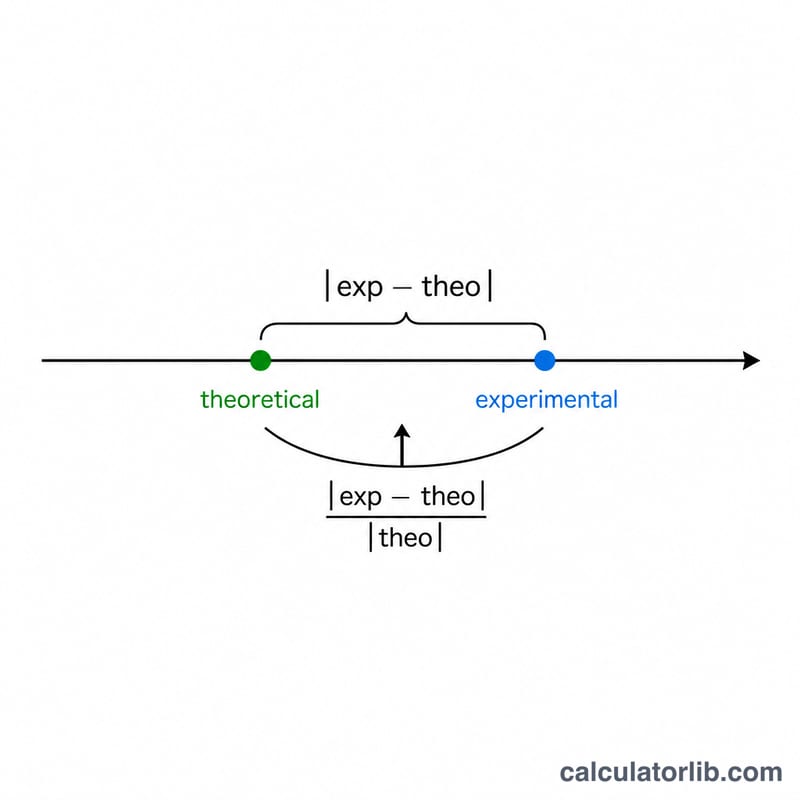
The percent error is the absolute error divided by the absolute theoretical value, times 100:
$$\text{Percent Error} = \frac{\left|\,\text{Experimental} - \text{Theoretical}\,\right|}{\left|\,\text{Theoretical}\,\right|} \times 100\%$$
Taking absolute values ensures the result is always non-negative — percent error describes the size of the deviation, not its direction. The theoretical value is used in the denominator because it is the reference standard against which accuracy is judged.
Worked Example
Suppose you measure the acceleration due to gravity as 9.8 m/s² in the lab, while the accepted value is 9.81 m/s². The absolute error is \(|9.8 - 9.81| = 0.01\). Dividing by the theoretical value gives $$\frac{0.01}{9.81} = 0.0010193\ldots,$$ and multiplying by 100 yields a percent error of about 0.102% — an excellent result.
FAQ
Can percent error be negative? No. Because we use absolute values, percent error is always zero or positive. If you need to know whether your measurement was too high or too low, look at the sign of (experimental − theoretical) separately.
What if the theoretical value is zero? Percent error is undefined when the accepted value is zero, since you cannot divide by zero. In that case, report the absolute error instead.
What counts as a good percent error? It depends on the field, but in many introductory science labs an error under 5% is considered acceptable, and under 1% is excellent.