
What this calculator does
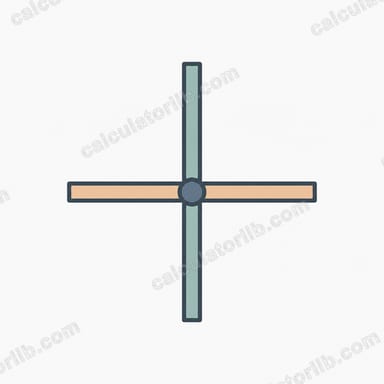
This tool finds the equation of the straight line that is perpendicular to a given line and passes through a specific point. You enter the slope m of the original line and the coordinates of a point (x₁, y₁), and it returns the perpendicular line in slope-intercept form, \(y = mx + b\).
How to use it
Enter the slope of the line you want to be perpendicular to, then enter the x and y coordinates of the point your new line must pass through. The calculator computes the perpendicular slope and the y-intercept and displays the full equation. If the original line is horizontal (\(m = 0\)), the perpendicular line is vertical and is shown as \(x = x_1\).
The formula explained
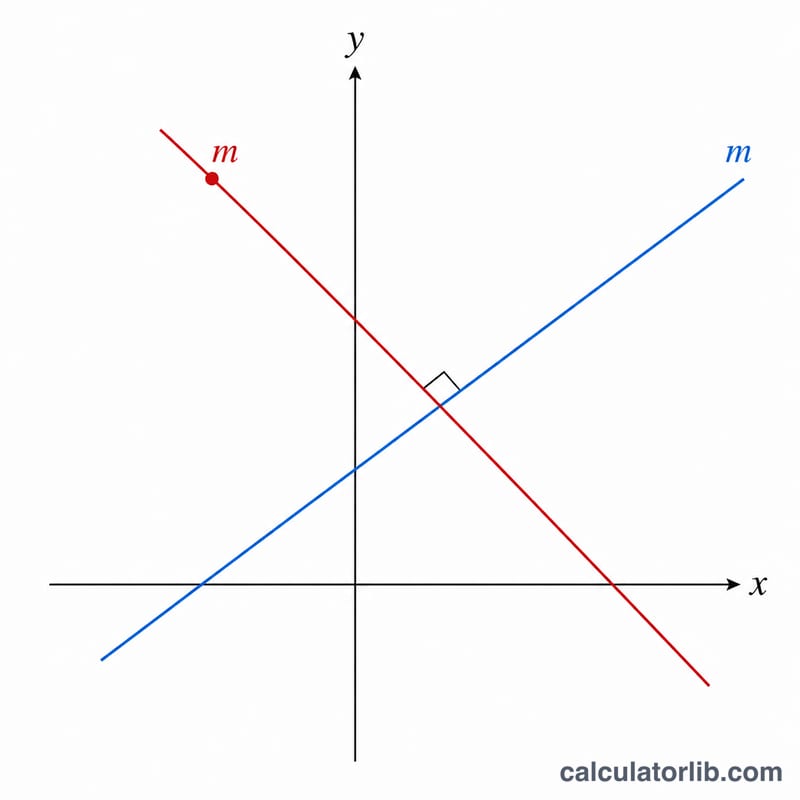
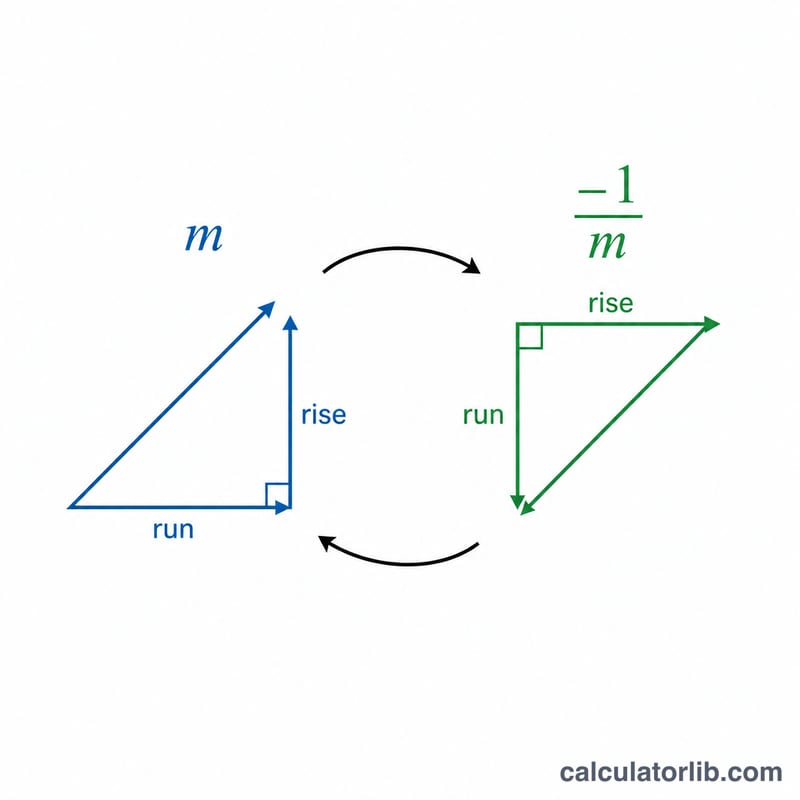
Two non-vertical lines are perpendicular when the product of their slopes is −1. So the perpendicular slope is the negative reciprocal of the original slope: \(m_\perp = -\frac{1}{m}\). Using point-slope form,
$$y - y_1 = m_\perp\left(x - x_1\right)$$and rearranging gives \(y = m_\perp x + b\) where the intercept \(b = y_1 - m_\perp \cdot x_1\).
Worked example
Suppose the original line has slope \(m = 2\) and the point is (3, 4). The perpendicular slope is \(-\frac{1}{2}\). Then
$$b = 4 - \left(-\frac{1}{2}\right)(3) = 4 + 1.5 = 5.5$$The perpendicular line is \(y = -0.5x + 5.5\).
FAQ
What if the given slope is 0? A horizontal line (slope 0) is perpendicular to a vertical line, which has no defined slope. The result is shown as \(x = x_1\).
Why negative reciprocal? Perpendicular lines meet at 90°. The condition \(m_1 \cdot m_2 = -1\) captures this, so \(m_2 = -\frac{1}{m_1}\).
Does the point change the slope? No — the point only fixes the y-intercept (position). The slope depends solely on the original line.