What Is the Password Combination Calculator?
This tool calculates the total number of unique passwords that can be formed given a character set size and a password length. It also reports the entropy in bits, a standard measure of password strength. The more possible combinations, the harder a password is to crack by brute force.
How to Use It
Enter the character set size — the number of distinct characters allowed (for example 10 for digits, 26 for lowercase letters, 62 for letters and digits, or about 94 if symbols are included). Then enter the password length, the number of characters in the password. The calculator returns the total combinations and the entropy.
The Formula Explained
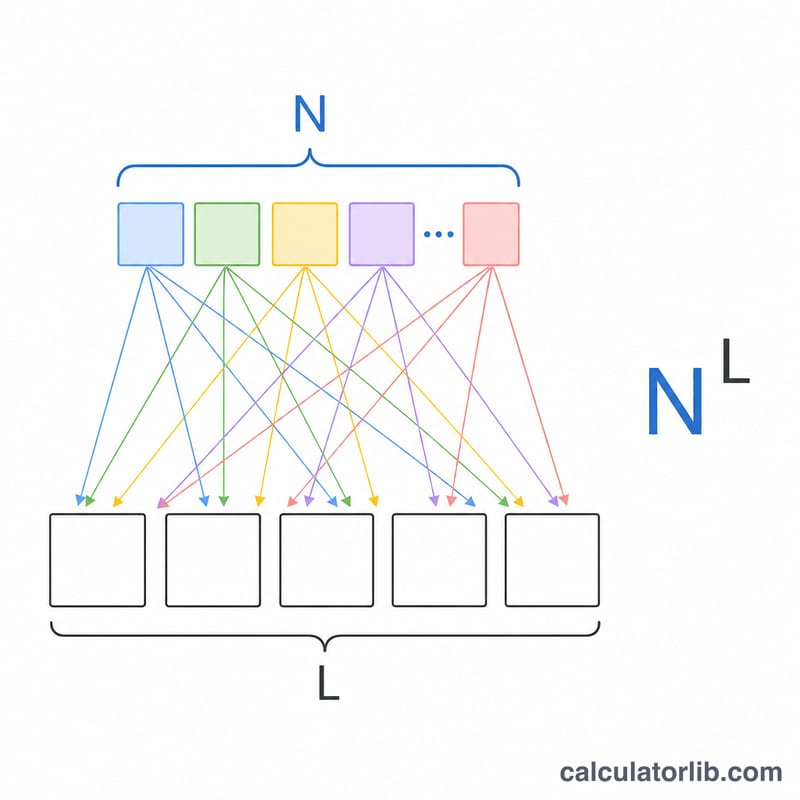
The number of combinations is simply the character set size raised to the power of the length: \(C = N^{L}\). Each of the L positions can independently be any of the N characters, so the totals multiply. Entropy follows from $$E = L \times \log_{2}(N)$$ expressing the search space size as bits. Each extra bit doubles the work required to brute-force the password.
Worked Example
Suppose you use lowercase letters and digits (N = 62) and an 8-character password (L = 8). The combinations are $$62^{8} = 218{,}340{,}105{,}584{,}896$$ — over 218 trillion possibilities. The entropy is \(8 \times \log_{2}(62) \approx 47.63\) bits, which is moderate; security experts often recommend 60+ bits for sensitive accounts.
Interpreting Your Entropy Result
Entropy measures how large the search space is, in bits. For a password of length \(L\) drawn at random from a character set of size \(N\), the number of combinations is \(N^L\) and the entropy is:
$$E = \log_2\left(N^{L}\right) = L \cdot \log_2 N$$For example, a 12-character password from the 94 printable ASCII characters gives \(E = 12 \times \log_2 94 \approx 12 \times 6.5546 =\) 78.66 bits, assuming every character is chosen uniformly at random.
Entropy bands
| Entropy | Rating | Meaning |
|---|---|---|
| Under 40 bits | Weak | Can be exhausted in minutes or less by a fast offline attacker. Suitable only where guesses are strictly rate-limited. |
| 40–60 bits | Moderate | Resists casual attacks but may fall to a determined offline attack with strong hardware. |
| 60–80 bits | Strong | Beyond practical reach for most attackers, though a very well-resourced attacker against a fast hash could still be a concern near the low end. |
| 80+ bits | Very strong | Brute force is infeasible with current technology when the password is truly random. |
Each bit doubles the work
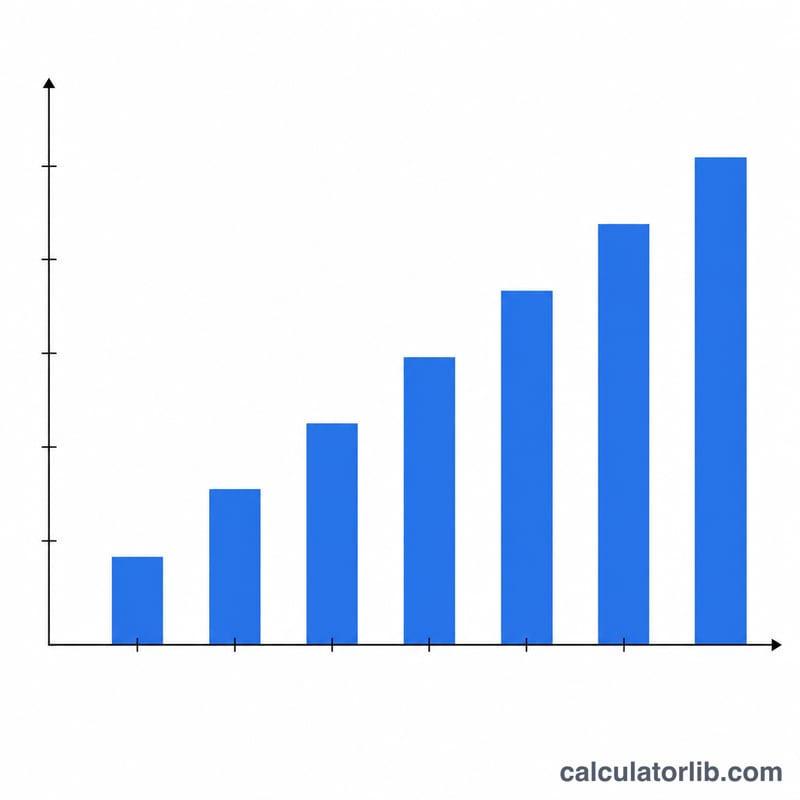
Adding one bit of entropy doubles the search space. Adding 10 bits multiplies it by 1,024. On average, an attacker finds a randomly chosen password after searching about half the space, which is about \(2^{E-1}\) guesses.
Illustrative time to exhaust the space
The figures below assume an attacker making \(10^{10}\) (10 billion) guesses per second and use 1 year ≈ \(3.156 \times 10^{7}\) seconds. They are illustrations, not predictions. Real rates vary enormously with the hashing method and hardware.
| Entropy | Search space \(2^E\) | Time to try all | Average time (half) |
|---|---|---|---|
| 30 bits | ≈ \(1.07 \times 10^{9}\) | ≈ 0.11 seconds | ≈ 0.05 seconds |
| 40 bits | ≈ \(1.10 \times 10^{12}\) | ≈ 110 seconds | ≈ 55 seconds |
| 60 bits | ≈ \(1.15 \times 10^{18}\) | ≈ 3.7 years | ≈ 1.8 years |
| 80 bits | ≈ \(1.21 \times 10^{24}\) | ≈ \(3.8 \times 10^{6}\) years | ≈ \(1.9 \times 10^{6}\) years |
| 128 bits | ≈ \(3.40 \times 10^{38}\) | ≈ \(1.1 \times 10^{21}\) years | ≈ \(5.4 \times 10^{20}\) years |
Important caveats
- Uniform randomness is assumed. The formula only holds if every character is picked independently and uniformly from the full set, for example by a random generator.
- Human-chosen passwords have far less real entropy. Predictable words, names, dates, keyboard patterns and common substitutions (such as "a" to "@") shrink the effective search space dramatically, so the calculated value is an upper bound for such passwords.
- Attack conditions matter. Online guessing, which is usually rate-limited or locked out, is much slower than offline cracking of a stolen hash. The hashing algorithm used by the service changes the guess rate by many orders of magnitude.
- Context standards. NIST SP 800-63B (a US guideline on digital identity) emphasizes password length, screening against known-compromised passwords, and rate limiting over arbitrary composition rules. It does not prescribe a single entropy target.
This is general educational information about how entropy is calculated, not personalized security advice.
FAQ
What character set size should I use? Use the count of all characters your password could contain: 10 (digits), 26 (one case of letters), 52 (mixed case), 62 (mixed case + digits), or ~94 (adding common symbols).
How many bits of entropy is "strong"? A common guideline is 50–60 bits for everyday accounts and 80+ bits for high-value secrets. Longer passwords add entropy faster than larger character sets.
Does this guarantee my password is secure? No. This measures theoretical brute-force resistance only. Predictable words, reuse, and leaks can compromise even high-entropy passwords.