
What is the Perceived Stress Scale (PSS-10)?
The Perceived Stress Scale (PSS-10) is one of the most widely used psychological instruments for measuring how unpredictable, uncontrollable, and overloaded people find their lives. Developed by Sheldon Cohen and colleagues, it asks about your feelings and thoughts over the last month. It is a self-assessment tool used in research and education — it is not a clinical diagnosis. This calculator works for anyone, anywhere; the scoring is universal and not tied to any country.
How to use this calculator
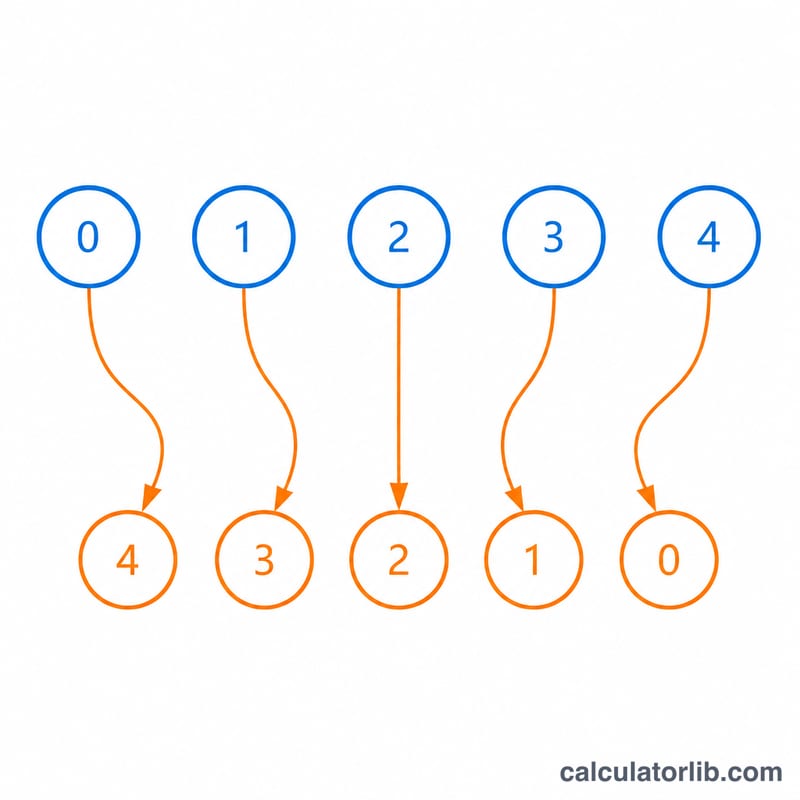
Answer all 10 questions based on how often you felt each way during the past month, using the 0-4 scale (0 = Never, 1 = Almost Never, 2 = Sometimes, 3 = Fairly Often, 4 = Very Often). The calculator adds your answers and automatically reverse-scores the four positively worded items (questions 4, 5, 7, and 8). Your total ranges from 0 to 40, and you receive an instant stress category.
The formula explained
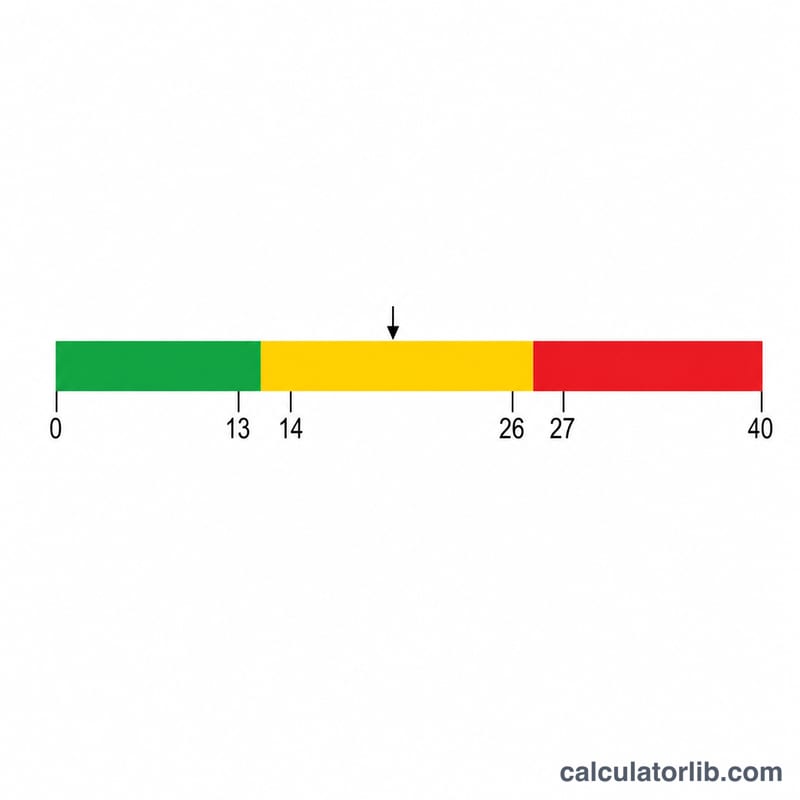
Six items (1, 2, 3, 6, 9, 10) are scored directly. The four positive items (4, 5, 7, 8) are reverse-scored — a response of x becomes \(4 - x\) — because agreeing with them indicates less stress. The sum is interpreted as: 0-13 = low, 14-26 = moderate, and 27-40 = high perceived stress.
$$\begin{gathered} \text{PSS} = \text{Q1} + \text{Q2} + \text{Q3} + \text{Q6} + \text{Q9} + \text{Q10} \\[0.6em] + \left(4 - \text{Q4}\right) + \left(4 - \text{Q5}\right) + \left(4 - \text{Q7}\right) + \left(4 - \text{Q8}\right) \end{gathered}$$
Worked example
Suppose every answer is "2" (Sometimes). The six direct items contribute 2 each (\(6 \times 2 = 12\)). The four reverse items each become \(4 - 2 = 2\), contributing another 8. Total \(= 12 + 8 = 20\), which falls in the moderate range.
FAQ
Is a high score bad? A higher score means you perceive more stress, but PSS is a snapshot of the past month, not a diagnosis. Persistent high scores may be worth discussing with a professional.
Why are some questions reversed? Items like "felt confident about your ability to handle problems" measure coping. Higher agreement means lower stress, so they are flipped to keep the scale pointing in one direction.
What's the difference between PSS-10 and PSS-14? The PSS-14 is the original 14-item version; the PSS-10 is a refined, shorter form with better psychometric properties and is now the most commonly recommended version.