What is a percentage increase / decrease?
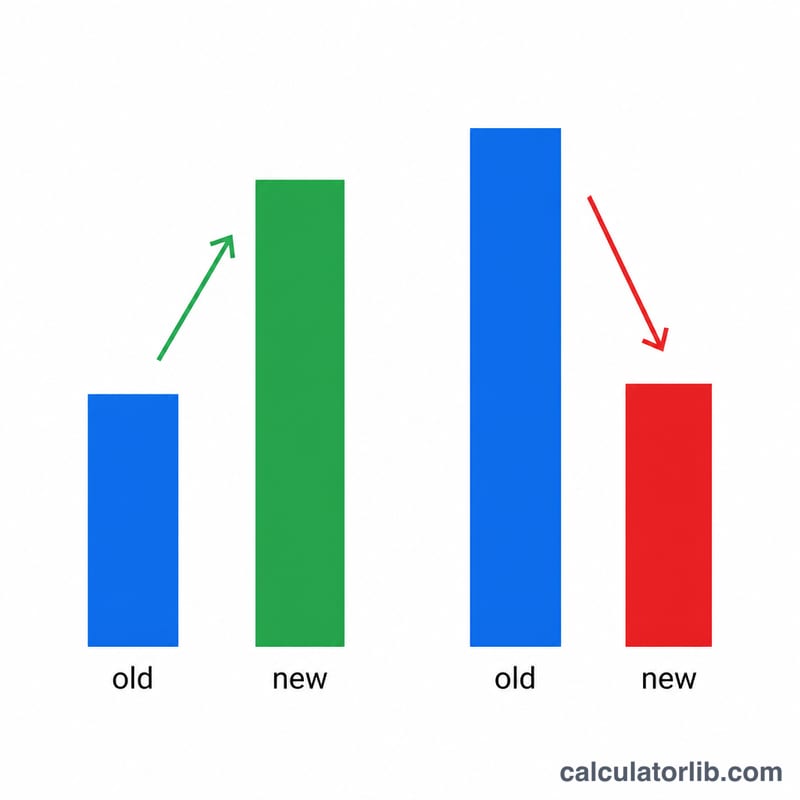
A percentage change measures how much a value has grown or shrunk relative to its starting point. If a price rises from 80 to 100, that is a 25% increase; if it falls from 100 to 80, that is a 20% decrease. This calculator works for any two numbers — prices, salaries, statistics, weights, scores — and tells you both the direction and the size of the change.
How to use it
Enter the Original Value (the starting or "old" number) and the New Value (the ending number). The calculator returns the percentage change, whether it is an increase or decrease, and the raw absolute difference between the two numbers.
The formula explained
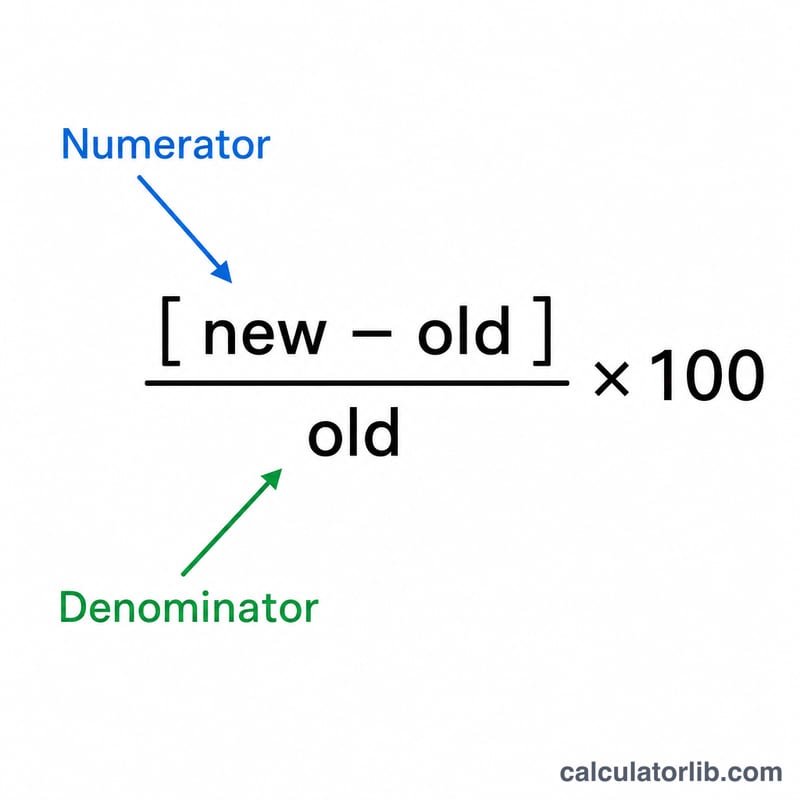
The percent change is the difference between the new and old values, divided by the old value, multiplied by 100:
$$\text{\%change} = \frac{\text{new} - \text{old}}{\text{old}} \times 100$$
The result is positive for an increase and negative for a decrease. The displayed headline figure shows the absolute size of the change, while the direction (up or down) is stated alongside it.
Worked example
Suppose a value goes from 200 to 350. The difference is \(350 - 200 = 150\). Dividing by the original gives \(150 \div 200 = 0.75\), and multiplying by 100 gives a 75% increase. If instead it dropped from 350 back to 200, the change would be $$(200 - 350) \div 350 \times 100 \approx -42.86\%,$$ a decrease.
Percentage Change Across Common Scenarios
The table shows how the same arithmetic behaves for different starting points. The absolute difference is new minus original, and the percent change is that difference divided by the original value.
| Original | New | Absolute difference | Percent change | Direction |
|---|---|---|---|---|
| 80 | 100 | +20 | +25% | Increase |
| 100 | 80 | −20 | −20% | Decrease |
| 50 | 100 | +50 | +100% | Increase |
| 100 | 50 | −50 | −50% | Decrease |
| 200 | 210 | +10 | +5% | Increase |
| 0 | 50 | +50 | Undefined | Increase from zero (cannot divide by 0) |
| −50 | −25 | +25 | −50% by the plain formula (+50% if the base is taken as an absolute value) | The value rose, but the sign is ambiguous |
Why the changes are not symmetric: the percentage is always measured against the starting value. Going from 100 to 50 is a 50% drop, but going from 50 back to 100 is a 100% increase. A 50% decrease therefore needs a 100% increase to recover.
Zero and negative bases: percent change from zero is undefined because the denominator is zero. When the original value is negative, the plain formula divides by a negative number, so a move toward zero (−50 to −25) comes out as −50% even though the value went up. For negative bases, many analysts divide by the absolute value of the original instead, or avoid percent change and report the absolute difference. Treat such results with caution.
Key Terms: Percent Change, Percentage Points and Absolute Difference
- Original (base) value
- The starting number you are comparing against. It is the reference for the percentage, so swapping the original and new values gives a different percent change.
- New value
- The ending number, the value after the change has happened.
- Absolute difference
- The raw amount of change in the same units as the values, calculated as new minus original. It is positive for a rise and negative for a fall.
- Percent change
- The absolute difference expressed as a percentage of the original value. It tells you how large the change is relative to where you started.
- Percent increase vs. decrease
- A positive percent change is an increase and a negative one is a decrease. Some writers state the decrease as a positive number, as in "a 20% drop", and let the wording carry the direction.
- Percentage points vs. percent
- Percentage points measure the simple subtraction between two percentages, while percent measures the relative change. A rate moving from 10% to 12% is up 2 percentage points, but it is a relative increase of \(\frac{2}{10} = 20\%\). Mixing the two up is a common source of misleading statements.
How to Calculate Percentage Change by Hand
Example: a value goes from 40 to 46.
- Subtract the original from the new value: \(46 - 40 = 6\).
- Divide by the original value: \(6 \div 40 = 0.15\).
- Multiply by 100: \(0.15 \times 100 = \) 15%.
- Read the sign: a positive result means an increase and a negative result means a decrease. Here +15% is an increase.
Applying a percentage change to find a new value
Use \(\text{new} = \text{old} \times \left(1 + \frac{p}{100}\right)\), where \(p\) is negative for a decrease.
- Increase 120 by 15%: \(120 \times (1 + 0.15) = 120 \times 1.15 = 138\).
- Decrease 250 by 12%: \(250 \times (1 - 0.12) = 250 \times 0.88 = 220\).
Finding the original from a new value
Reverse the step with \(\text{old} = \text{new} \div \left(1 + \frac{p}{100}\right)\).
- A price is now 138 after a 15% increase: \(138 \div 1.15 = 120\).
- A price is now 220 after a 12% decrease: \(220 \div 0.88 = 250\).
Note that the original is not found by subtracting 15% (or 12%) from the new value. The percentage was taken from the original, not from the new value.
FAQ
Why is the percentage different when I reverse the values? Because the denominator changes — percent change is always relative to the original value, so 80→100 (+25%) is not the symmetric of 100→80 (−20%).
What if the original value is zero? Percent change is undefined when the original value is 0 (division by zero), so the calculator returns 0% in that case.
Can I use negative numbers? Yes, but interpret the sign carefully — percent change with negative bases can be counter-intuitive.